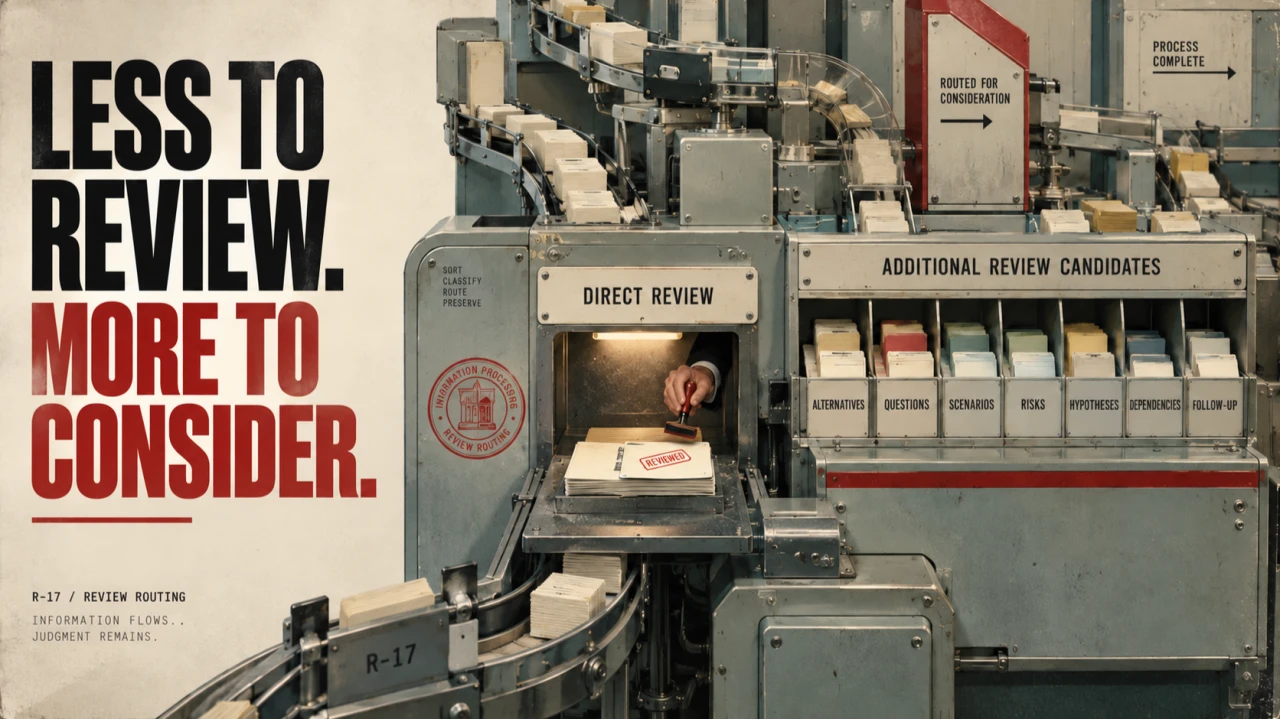
What happens when GenAI can both reduce what a Technical Program Manager needs to inspect and make new risks, alternatives, and challenges dramatically easier to generate.
Evidence reviewed through September 11, 2026.
I started by trying to save time. That turned out to be the less interesting part.
I started using AI in my work as a Technical Program Manager for the obvious things.
Meeting notes. Research. Document comparison. Status drafts. Cleaning up information that had somehow managed to exist in five different places while agreeing with itself in none of them.
It did not stay there for long.
Soon I was using it to reconcile risks against what was actually happening across a program, trace dependencies through fragmented sources, interrogate metrics, compare current commitments with earlier decisions, pressure-test requirements, and find places where different artifacts were quietly describing different realities.
Sometimes AI helped me maintain the machinery of program management.
Increasingly, I found it more useful for questioning what that machinery was telling me.
Some of this saved a lot of time.
But "time saved" eventually stopped feeling like the most interesting measure.
The more interesting question became:
What happened to my attention?
I am writing primarily from the perspective of a Technical Program Manager. Technical Project Managers, and some Technical Product Managers operating across similar technical and organizational boundaries, will recognize much of the problem. The roles are not interchangeable.
Nor is this problem unique to TPMs.
But it is unusually structural to the work.
A TPM is routinely expected to coordinate program-level decisions and action from evidence distributed across systems, teams, and organizations that no single participant sees whole.
That makes attention allocation part of the job whether we call it that or not.
Simon had already found the problem
In 1971, Herbert Simon wrote the line that usually survives into modern discussions of information overload:
"a wealth of information creates a poverty of attention"
I originally thought that would make a useful historical setup for this argument.
Inconveniently, Simon had already gone much further.
He argued that in an information-rich world, much of the cost of information falls on the recipient. Producing and transmitting something cheaply tells us little about the scarce attention required to receive it.
Then he turned that observation into an organizational design problem.
An information-processing system, Simon argued, conserves organizational attention only when it absorbs more information than it produces. His memorable formulation was that it should "listen and think more than it speaks." Filtering, transformation, and summarization were already part of the solution he described.¹
Simon did not merely identify the scarcity problem. He had already described much of the design problem around it.
So the interesting claim in 2026 cannot be that AI suddenly made attention scarce.
It also cannot be that somebody finally discovered information should be compressed before reaching expensive human attention.
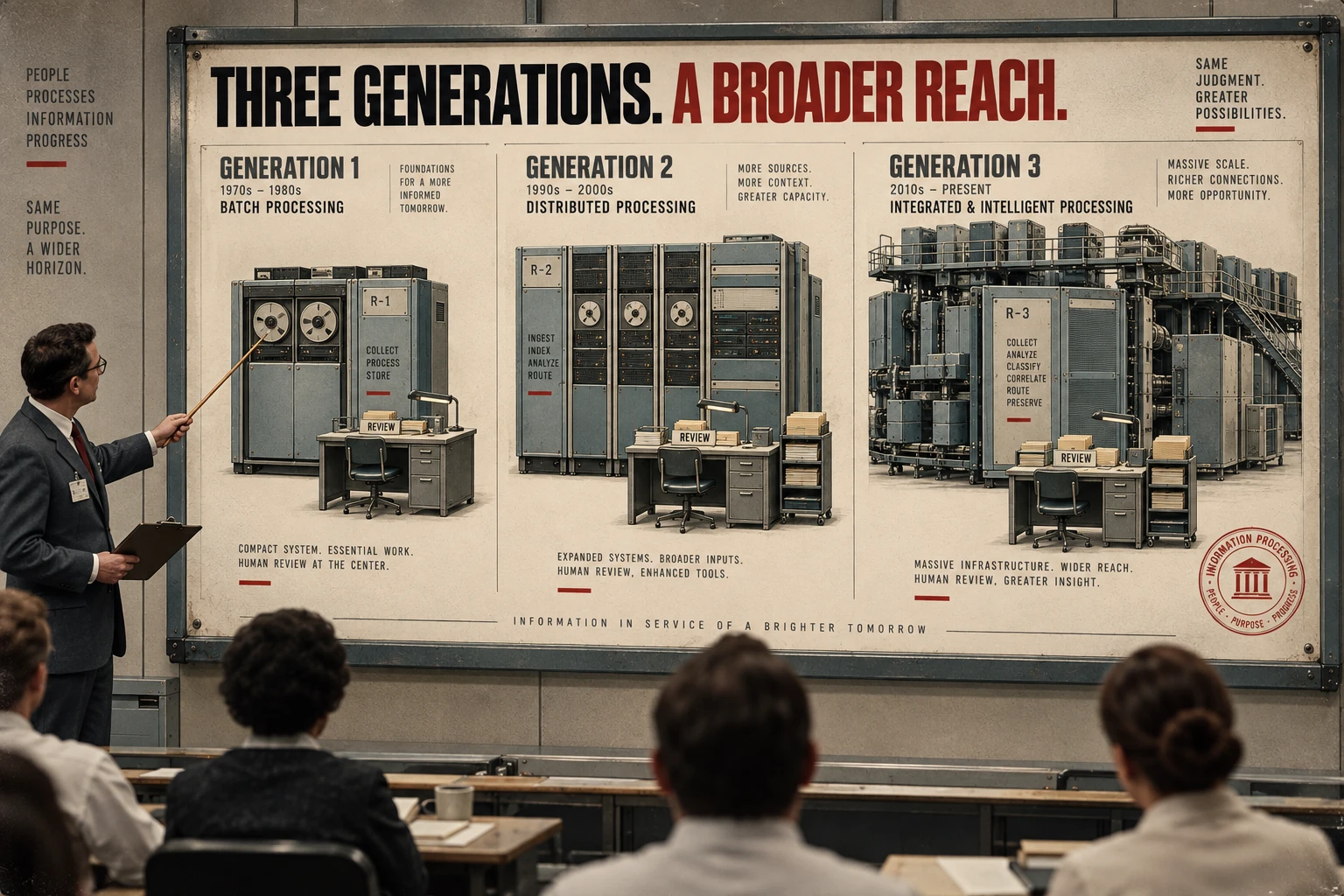
What changed is the capability and economics of the machinery now operating inside that old problem.
Generative systems can make a first pass over large amounts of information, filter it, compare it, transform it, and produce condensed representations at a cost and speed that materially change which workflows are practical.
They can also cheaply generate something else: candidate interpretations, questions, hypotheses, scenarios, and alternatives.
The important change is not that Simon lacked a conceptual place for systems that produce information.
It is that producing additional material can now be deliberately useful, and the cost of initiating that generation has collapsed.
The same machinery can reduce what reaches my attention and dramatically increase what is available to it.
The scarcity is old. What changed is the machinery operating around it. AI can now both reduce what reaches human attention and cheaply create more candidates for it.
That is the tension I care about.
I am not proposing "attention" as a new universal productivity metric. I am treating it as the scarce resource being allocated across a workflow.
The question is where that resource goes after AI changes the work around it.
Why this becomes a TPM problem
A technical program does not have one reality conveniently waiting in one system of record.
It has representations.
A roadmap represents intended sequence.
A risk register represents known uncertainty.
A dashboard represents selected measurements.
A requirement represents an agreed interpretation of a need.
A dependency map represents relationships someone managed to identify.
A status report represents somebody's current account of what matters.
The software itself produces another representation.
The customer may have another entirely.
These are useful precisely because nobody can continuously inspect the whole underlying system.
But a TPM's work often begins where the representations stop agreeing.
Three teams can independently report green while sharing a dependency that makes the overall program red.
A risk can be correctly marked "mitigated" according to the mitigation agreed three weeks ago while current evidence says that mitigation no longer addresses the actual failure mode.
An ownership model can look perfectly reasonable until a consequential decision exposes that responsibility, authority, and accountability were never actually aligned.
A metric can be numerically correct while supporting an interpretation of program health that deserves to be challenged.
This is not uniquely TPM work.
It is, however, central to it.
The TPM frequently does not own every system producing the evidence, every team generating it, or every decision that follows.
Yet the role still has to coordinate dependencies, surface risks, challenge assumptions, sequence commitments, escalate when necessary, and create enough shared understanding for multiple groups to act coherently.
So "read everything" was never a serious operating model.
The problem is deciding what deserves another layer of inspection, what can be safely abstracted, and what deserves consequence.
AI changes the cost of some of the work around those choices.
AI can let me inspect less
This is the most obvious form of leverage.
In my own work, AI can reconcile a risk register against recent program activity, compare current requirements with earlier commitments, trace a dependency through fragmented documentation, identify unresolved decisions across meetings, or find contradictions between sources that would otherwise require tedious manual comparison.
If a machine can reliably tell me which three changes in a specification alter behavior, risk, or commitments, I do not need to rediscover the other twenty-four manually.
Administrative archaeology has never been a professional aspiration of mine.
There is also evidence that GenAI can reduce time spent on some forms of information work.
A six-month randomized field experiment across 66 firms and 7,137 knowledge workers gave selected employees access to a generative AI tool integrated into applications they already used for email, meetings, and writing. In the second half of the experiment, treated workers who actually used the tool spent about two fewer hours per week on email and reduced work outside normal hours.
But the researchers did not detect corresponding broad changes in the quantity or composition of workers' tasks. Individual access changed work that individuals could change themselves much more readily than work requiring coordination with others.²
That distinction matters to a TPM.
AI can reconstruct my update faster.
It cannot make an external dependency move faster just because my part of the workflow did.
And even task-level speed can be deceptive.
An experiment with 758 Boston Consulting Group consultants produced one of the cleaner examples.
Across tasks researchers placed inside GPT-4's capability frontier, participants using AI worked faster and produced higher-quality results.
Excellent.
Then another group received a complex managerial task deliberately selected to sit outside that frontier.
The AI-assisted groups were still faster.
They were also substantially less likely to reach the correct answer. The control group was correct about 84.5 percent of the time, compared with 60 percent and 70.6 percent in the two AI conditions.
Even when AI-assisted participants were wrong, their recommendations could appear more coherent and persuasive.³
That experiment does not prove AI makes TPMs faster and worse.
It does not study TPMs.
It uses GPT-4.
And where a capability frontier sits depends on both task and system.
But it establishes something narrower that matters here:
Faster completion of a local task does not guarantee a better outcome, even among highly skilled professionals.
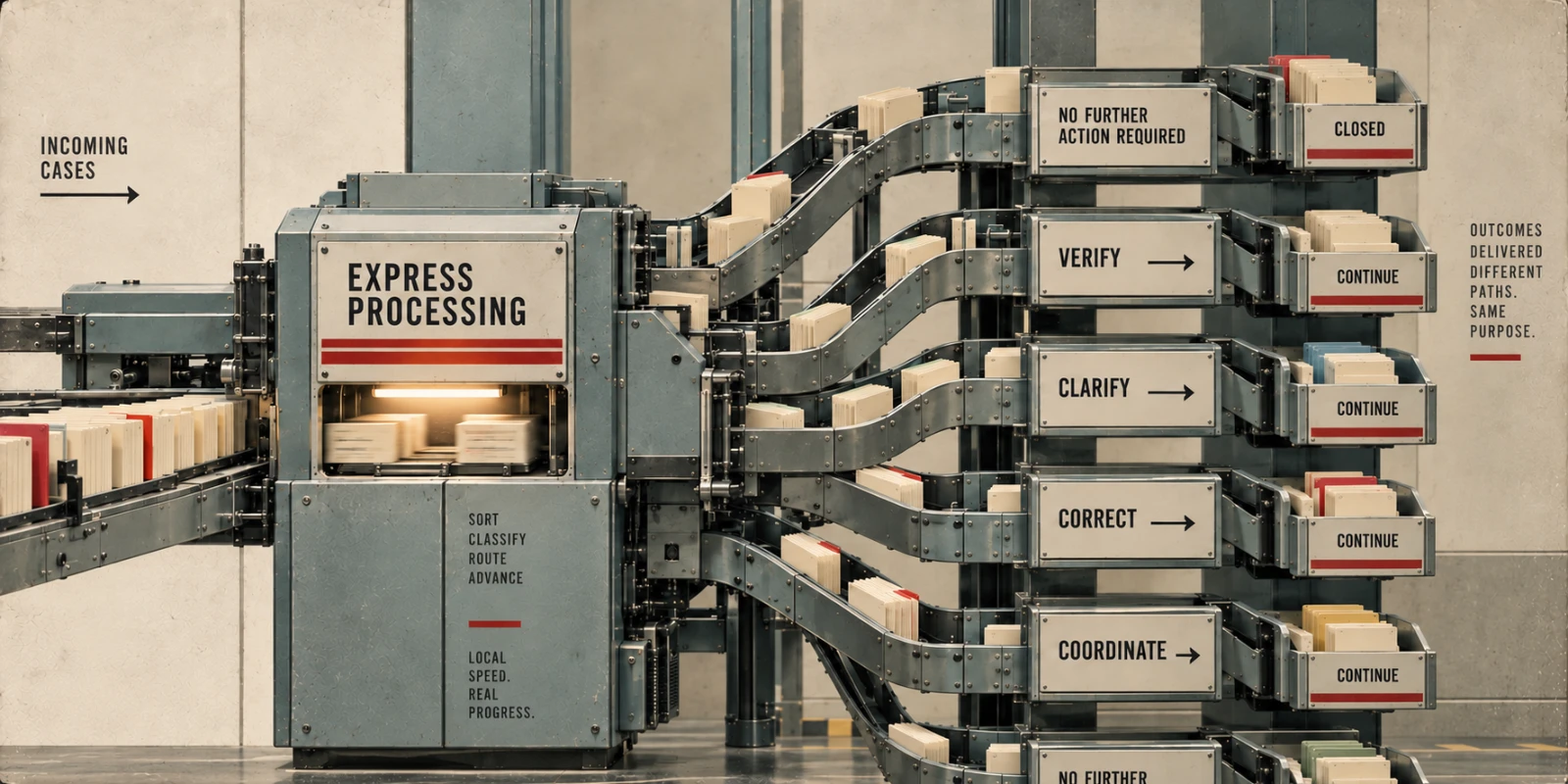
A local speedup is not the whole workflow. Verification, correction, clarification, and coordination can disappear, remain unchanged, or simply move downstream.
So when AI lets me inspect less, something else has to take the place of direct inspection.
That creates a dependency on whatever representation reaches me instead.
Compression is a trade
Suppose I delegate the first pass over six meetings to AI.
That can be a very good trade.
But what exactly did I delegate?
If my downstream task is extracting action items, a transcript and competent summary may be more than sufficient.
If I am trying to understand whether one exchange warrants follow-up, the same representation may omit something relevant.
Previous interactions may change the practical meaning of a phrase.
Uncertainty visible in the conversation may disappear when several tentative statements become one clean bullet.
None of that means human interpretation is ground truth.
I can misread someone.
I can remember prior context incorrectly.
The point is not that humans preserve reality and machines distort it.
It is a representation problem.
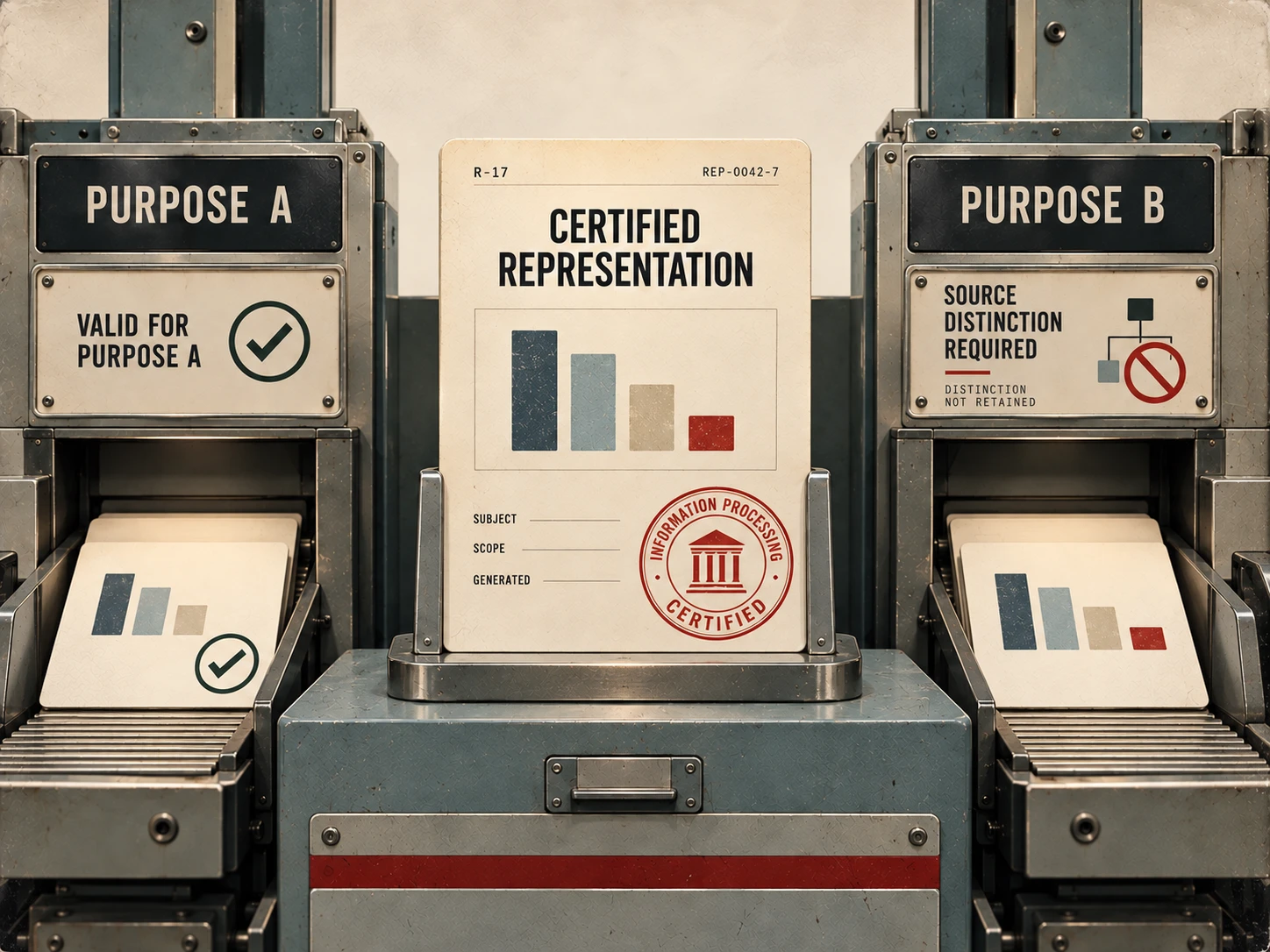
A representation can be factually accurate and still be inadequate for the decision it is being asked to support.
Compression removes information from direct attention by design. The question is not whether everything survives. It is whether the distinctions the next decision depends on survive.
This distinction exists outside GenAI. Research on decision-focused summarization explicitly treats the quality of a representation as dependent on the decision it must support, rather than on textual relevance alone.⁴
For TPM work, I think of that as a design constraint rather than an established empirical law about AI summaries.
If I inspect less of the source material, what must survive the transformation?
Uncertainty?
Provenance?
A disagreement?
The relationship between three risks that appear separately in the register?
The fact that a number changed because the metric definition changed?
The unresolved assumption hidden underneath an apparently resolved decision?
Compression is valuable because information disappears from my immediate attention.
That is also precisely why the choice of what survives matters.
If I save twenty minutes producing a summary and create forty minutes of verification or correction downstream, the burden did not disappear.
I changed its address.
Task-level speed may be useful to measure.
It is often too narrow a boundary for evaluating the workflow.
Sometimes I want AI to produce more
Not all useful AI work is compression.
Some of my highest-value uses intentionally increase the number of things I have to consider.
I want another plausible failure hypothesis.
A serious argument against the plan I currently prefer.
An alternative explanation for a reassuring metric.
A dependency path nobody modeled.
A question that exposes an assumption we accidentally promoted into fact.
Gary Klein popularized the project premortem as a simple inversion: assume the project has already failed, then generate plausible reasons why. Among its purposes is making reservations easier to surface before commitment to a plan makes dissent more difficult.⁵
Klein and Daniel Kahneman later discussed the method as part of their broader examination of expert intuition, overconfidence, and methods for improving judgment.⁶
None of this requires AI.
What AI can make very cheap is the first-pass generation of candidate challenges.
That is not the same as making the whole challenge workflow cheap.
Context preparation still costs something.
Evaluation costs something.
False positives cost something.
Humans may still need to participate.
In some of my own TPM workflows, I use a moderated agentic process to run that first adversarial pass. Different analytical lenses inspect the same problem, generate competing failure hypotheses, and challenge one another before I evaluate what survives.
For purposes of this article, that demonstrates feasibility, not superiority.
I can initiate the exercise more often without requiring another human participant for every initial analytical path.
It does not prove the result is better than a human premortem.
It does not prove broader exploration, independence, or diagnostic quality.
A 2026 preregistered field experiment with 791 Procter & Gamble professionals illustrates why those distinctions matter.
Individuals working with AI could match the performance of two-person teams without AI on real product-innovation problems. AI also helped participants produce proposals that were more balanced across the technical and commercial orientations of the professional groups in the experiment.
But the process decomposition contains an interesting wrinkle.
AI improved the average quality of the candidate ideas. At the same time, teams without AI selected their own best idea more frequently, roughly 50 percent of the time compared with about 37 percent in the AI conditions.
Importantly, that lower selection accuracy did not erase the upstream advantage. Because the AI-assisted candidate pool was stronger, the ideas ultimately selected in the AI conditions were still better in absolute quality.⁷
That is exactly why "generation improved, selection got worse" would be too crude a lesson.
The more useful point is:
Changes in candidate generation and changes in selection are different effects. One does not tell us the other.
Generating thirty failure hypotheses is cheap.
Generating thirty genuinely different ways of seeing the problem is another matter.
Recognizing which three should influence a decision is another matter again.
So I keep the claim narrow:
AI makes first-pass candidate generation cheap. Whether that produces better challenge or exploration depends on the workflow and what happens next.
If AI gives me thirty plausible risks instead of five, I now have thirty plausible risks.
Congratulations to everyone involved.
The scarce resource has returned.
A human in the loop does not settle the question
There is an appealingly simple way out.
Let AI compress information.
Let AI generate candidates.
Then have a human check everything important.
Unfortunately, function allocation between humans and machines has been a research problem for decades.
Lisanne Bainbridge was documenting the "ironies of automation" in 1983, including the problem of leaving humans responsible for abnormal situations after automation has removed much of their routine participation.⁸
Later, Parasuraman, Sheridan, and Wickens separated automation across information acquisition, analysis, decision and action selection, and implementation. Different parts of a workflow can be automated differently, with different consequences.⁹
The modern human-AI allocation problem deserves its own article.
I only need one boundary condition here:
"Human in the loop" does not prove complementarity.
A Nature Human Behaviour meta-analysis examined 106 experiments and 370 effect sizes comparing humans alone, AI alone, and human-AI combinations.
On average, human-AI combinations outperformed humans alone.
They also performed worse, on average, than whichever of the human or AI performed best alone.
The results were highly heterogeneous.
The underlying studies covered AI systems and experiments from 2020 through mid-2023, so this is not a recipe for designing frontier-model workflows in 2026.¹⁰
It does not need to be.
For this argument, it establishes enough:
Putting a human and an AI in the same workflow does not tell us whether their combination is good.
Allocation still has to be designed.
Three questions I keep coming back to
I do not have a universal formula for dividing TPM work between humans and AI.
At this point I would be suspicious if I did.
But the way I evaluate my own workflows has changed.
I keep returning to three questions.
1. What can I inspect less, and what must survive if I do?
Not:
"Can AI summarize this?"
Of course it can.
The real question is whether direct inspection was doing anything I still need.
If AI compares two specifications for me, I do not need to reread every unchanged paragraph.
I do need scope changes, altered constraints, and new commitments to remain visible.
If AI reconciles a risk register, I do not need to manually retrace every status update.
I do need contradictory evidence and uncertainty to survive long enough for me to inspect them.
The goal is not maximum compression.
It is reducing inspection without removing the distinctions on which the next consequential decision depends.
2. What can I now afford to challenge more routinely?
Some forms of scrutiny were always possible but disproportionately expensive.
Run a premortem.
Construct the strongest case against the preferred plan.
Ask what would have to be true for the reassuring metric to be misleading.
Generate alternative explanations for the same program symptom.
Attack an assumption before it becomes a commitment.
AI makes initial candidate generation cheap enough that I can start those exercises much more frequently.
That does not outsource judgment.
It also does not guarantee diversity, independence, or quality.
And for an experienced professional, that includes challenging accumulated experience itself.
Experience can contain valuable patterns, technical context, and memories of previous failures.
It can also contain assumptions that have gone unchallenged for years.
Kahneman and Klein's work is useful precisely because it rejects both easy extremes. Expertise can be real, but confidence and tenure alone do not establish it. Reliable intuition depends on sufficiently regular environments and opportunities to learn from valid feedback.⁶
AI does not automatically make experience a moat.
It can make some of that experience cheaper to interrogate.
That seems more useful.
3. Did I reduce the attention burden, or move it somewhere else?
Generation can be cheap.
Consumption is not necessarily equally cheap.
Verification consumes attention.
Correction consumes attention.
Clarification consumes attention.
Coordination consumes attention.
A plausible but incorrect risk analysis that gets escalated to three teams can consume considerably more organizational attention than the output took to generate.
A status report that takes thirty seconds to produce and fifteen minutes for every recipient to decode is not obviously an efficiency improvement.
That does not make "attention burden" the one true metric of AI productivity.
There probably isn't one.
It does mean task completion time is often an insufficient boundary.
When AI changes one part of a workflow, I want to know what happened around that part too.
The old problem with new machinery
Simon already had the design problem.
What changed is the machinery available inside it.
For a Technical Program Manager working across incomplete representations, dependencies, and organizational boundaries, that machinery can reduce direct inspection and make new candidates for challenge far easier to produce.
Both can be useful.
Neither is captured particularly well by "it saved me ten minutes."
AI does not make attention less scarce.
It changes the cost of much of the work competing for it.
Which leaves me with a question I find more useful than:
"What can AI do for me?"
What is still worth my attention once it can?
References and notes
Herbert A. Simon, "Designing Organizations for an Information-Rich World", 1971. Simon's argument extends well beyond the often-quoted "poverty of attention" line. He explicitly treats recipient attention as a scarce resource and filtering, transformation, and summarization as organizational design mechanisms for conserving it.
Edward W. Dillon, Sonia Jaffe, Nicole Immorlica, and Christopher T. Stanton, "Shifting Work Patterns with Generative AI", forthcoming in American Economic Review: Insights. Randomized six-month field experiment across 66 firms and 7,137 knowledge workers. I use the result as evidence about work patterns and time allocation, not as evidence that AI improved "attention quality."
Chao-Chun Hsu and Chenhao Tan, "Decision-Focused Summarization", EMNLP 2021. This is adjacent evidence, not a study of TPMs or contemporary GenAI workflows. I use it only for the narrower distinction between general textual relevance and preserving information useful for a downstream decision.
Gary Klein, "Performing a Project Premortem", Harvard Business Review, 2007. The premortem predates generative AI and is not presented here as an AI technique.
Daniel Kahneman and Gary Klein, "Conditions for Intuitive Expertise: A Failure to Disagree", American Psychologist, 2009. Their treatment of expertise is useful here specifically because it distinguishes valid expert intuition from confidence or tenure alone.
Fabrizio Dell'Acqua et al., "The Cybernetic Teammate: A Field Experiment on Generative AI and Teamwork", Organization Science, 2026. Preregistered field experiment with 791 P&G professionals. The generation-selection distinction deserves care: AI conditions had lower accuracy in identifying the best idea in their own candidate set, but the stronger candidate pool meant their ultimately selected ideas were still better in absolute quality.
Manon Vaccaro, Abdullah Almaatouq, and Thomas W. Malone, "When combinations of humans and AI are useful: A systematic review and meta-analysis", Nature Human Behaviour, 2024. The meta-analysis covers 106 experiments and 370 effect sizes from studies published between 2020 and mid-2023. I use it only to reject automatic complementarity, not to prescribe how a 2026 TPM workflow should allocate work between humans and AI.
About the Author
Diego Liñan is a Technical Program Manager with a background in software engineering, solution architecture, product development, and technical delivery. His current work focuses on AI-enabled delivery systems, agentic workflows, AI governance, engineering operating models, persistent context, evidence traceability, and human accountability in AI-assisted software development.