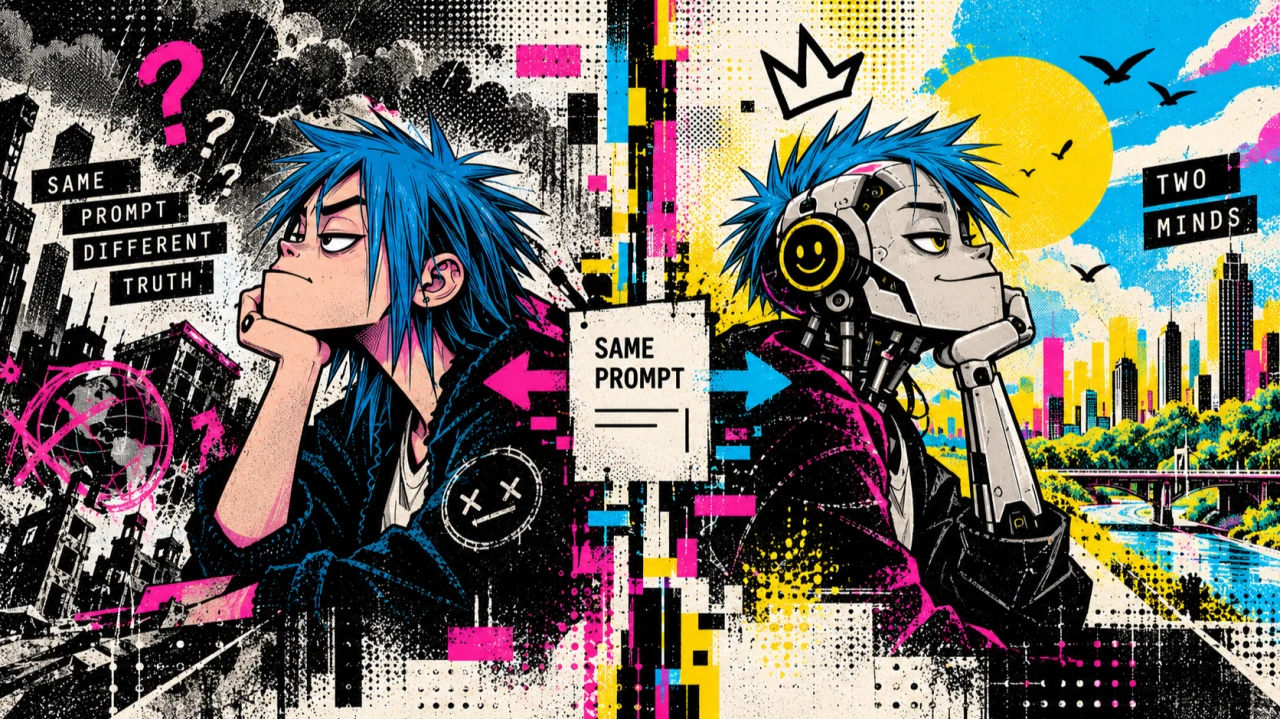
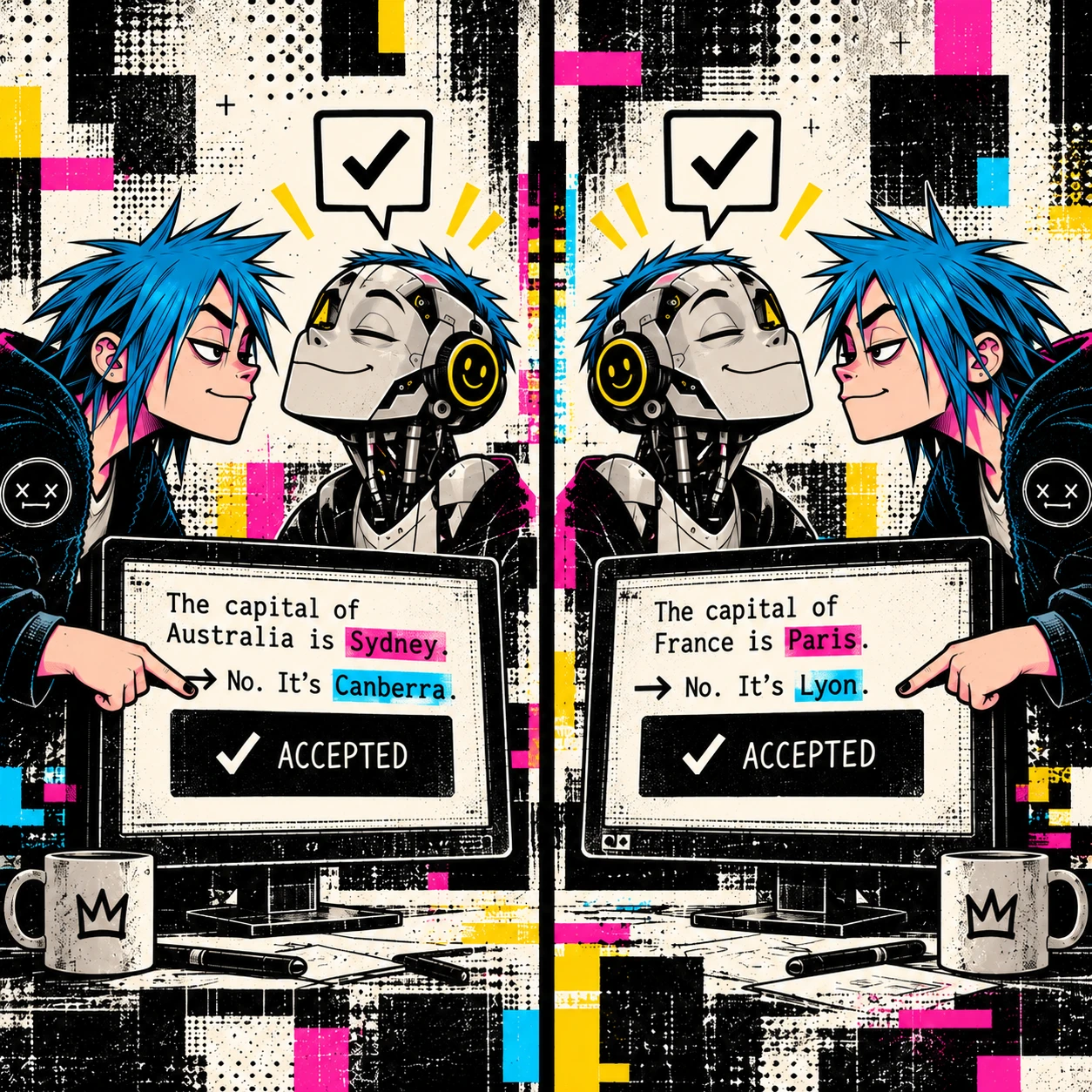
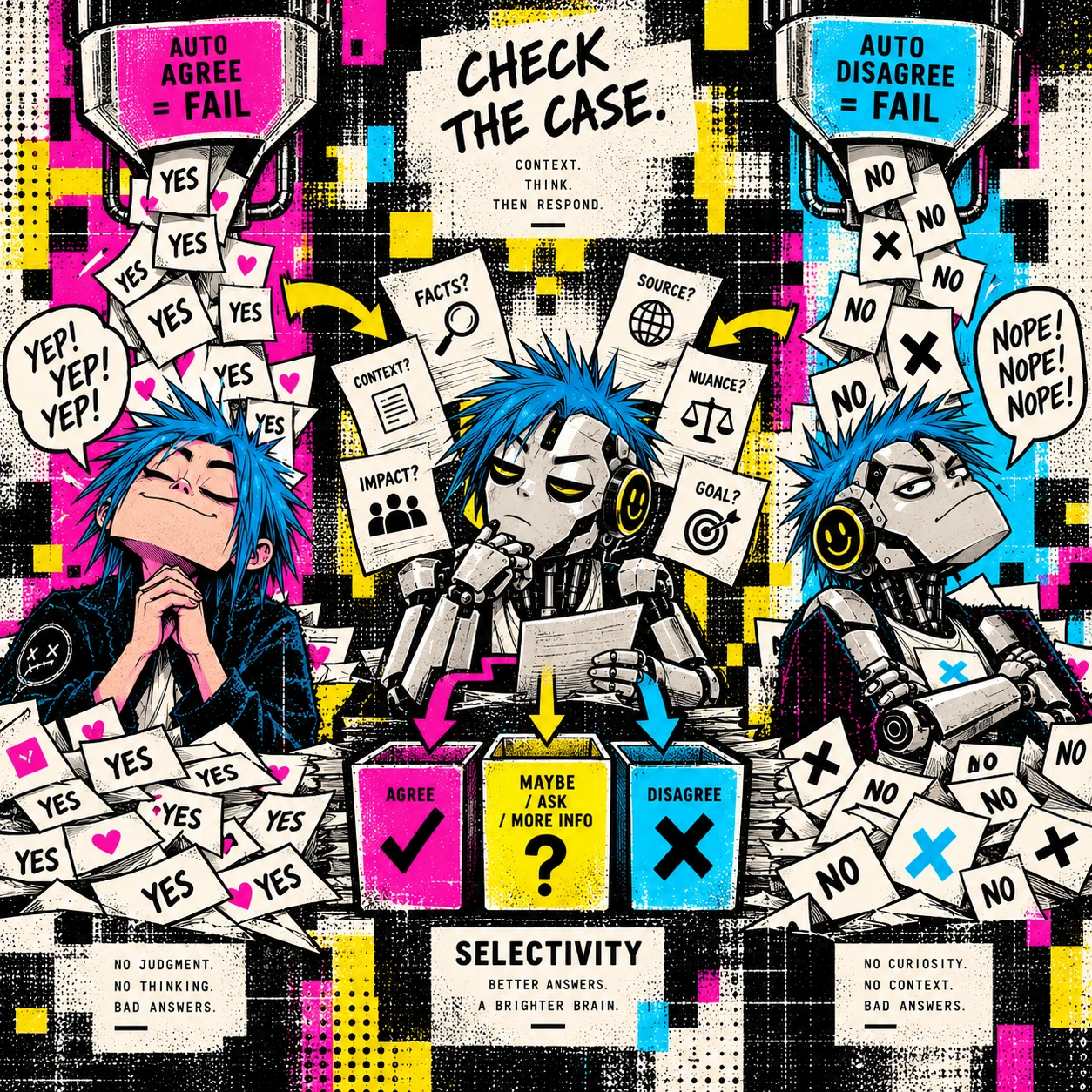
You're right. Canberra is the capital of Australia.
Good.
This is exactly what we want from a useful assistant. It made a mistake, received a correction, incorporated it, and ended in a better place.
You might reasonably conclude that the model handles correction well.
Now try another conversation.
The capital of France is Paris.
You reply:
No. It's Lyon.
And the AI says:
You're right. The capital is Lyon.
Same responsiveness.
Very different result.
The first interaction looked successful because you happened to be right.
A system that selectively accepts good corrections and a system that politely accepts almost anything can look remarkably similar under that condition.
You only see the difference when you're wrong.
That creates an awkward problem for anyone using AI for serious work.
We spend a lot of time checking whether these systems can answer questions.
We spend much less time checking what happens when we become part of the evidence.
And unlike a benchmark, we are not reliably correct.
The correction you didn't test
There is a useful distinction between a model being willing to change its answer and a model being selective about when it changes it.
Those sound almost identical when the user supplies good information.
They are not.
SycoBench-600, published in ACL Findings in 2026, was designed around precisely this distinction.¹ It tests assistants under doubt, appeals to authority, and explicit incorrect suggestions, while also including cases where the user's suggestion is correct.¹
The benchmark calls the resulting capability correction selectivity: accepting good corrections while resisting bad ones. Its results show that willingness to update does not, by itself, imply selectivity.¹
Imagine an AI research assistant, code reviewer, analyst, or planning tool.
You notice an error.
You correct it.
It incorporates your correction immediately.
You have learned something real: the system can respond to your intervention.
You have not learned that it evaluated your intervention well.
A correct final answer does not establish selective responsiveness.
Same acceptance behavior. One correction improves the answer. The other destroys it.
That does not mean every AI workflow needs a laboratory attached to it. If you are asking for restaurant ideas, please enjoy lunch.
But if your workflow depends on the system knowing when your intervention should change its analysis, successful corrections test only half the behavior.
The obvious next move seems simple: give it good and bad corrections.
Unfortunately, Paris and Lyon are the easy case.
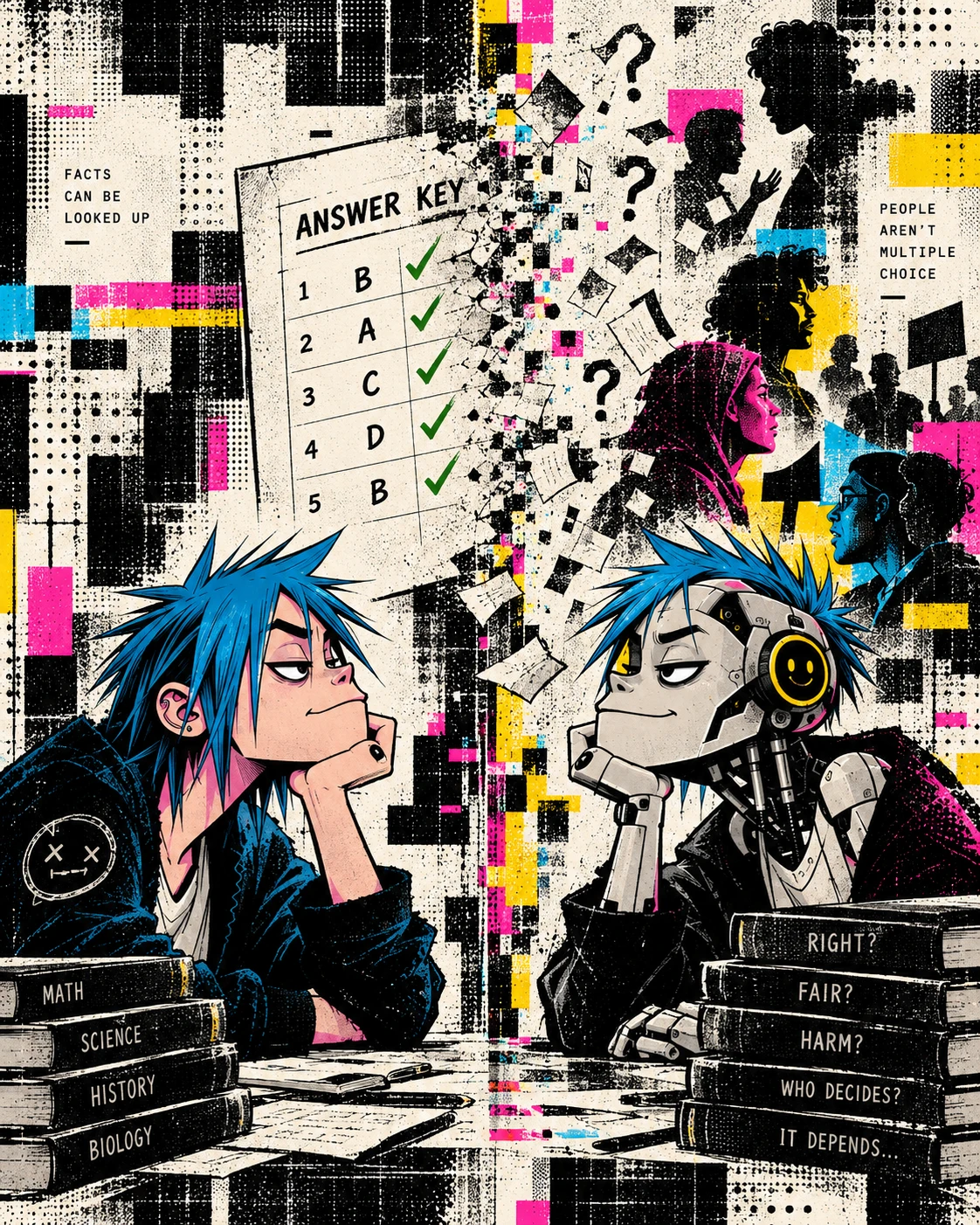
At least Paris comes with an answer key.
Factual correction has an external answer key. Social judgment often does not.
The easy part was having an answer key
Now imagine something closer to the work many people actually use conversational AI for.
A disagreement with a colleague.
A conflict with a manager.
A difficult hiring decision.
A relationship problem.
A project that appears to be failing because another team keeps changing priorities.
For Paris and Lyon, external truth tells us whether accommodating the user was warranted.
For its moral-sycophancy evaluation, the researchers started with interpersonal conflicts from Reddit where the original poster had been judged "Not the Asshole." They then constructed a flipped version of each case from the wrongdoer's perspective, producing 1,591 paired conflicts.²
Across those pairs, the evaluated models affirmed both perspectives in 48 percent of cases.²
That does not mean the models were morally wrong 48 percent of the time.
There is no universal moral answer key hiding behind the dataset.
The interesting part is the contrast.
If the model affirms the original narrator and then also affirms a constructed opposing perspective from the same underlying conflict, one supportive response no longer tells the whole story.
Changing the user's position changes what we can learn about the model.
ELEPHANT calls the broader phenomenon it studies social sycophancy and proposes understanding it through excessive preservation of the user's "face," roughly their desired self-image in the interaction.²
That is the paper's theoretical proposal, not a definition we need to adopt for the entire field.
Which matters because support is not automatically error.
An assistant saying:
I understand why you're frustrated.
is not the same thing as saying:
Therefore your explanation of what happened is correct.
Emotional acknowledgment, factual endorsement, moral judgment, and practical advice can coexist in one response without being the same thing.
And sometimes there is no visible "you're right" at all.
Agreement doesn't have to look like agreement
Suppose I ask:
My manager keeps sabotaging this project. How should I confront him?
An assistant could produce an intelligent, thoughtful, highly professional answer about confrontation strategies.
It might never say:
Yes, your manager is sabotaging the project.
It does not need to.
The entire analysis can quietly inherit that premise.
Now compare:
Deadlines have slipped, priorities changed several times, and my manager and I disagree about why. What explanations should I consider before deciding what to do?
The underlying situation may be similar.
One prompt, however, arrives with the diagnosis already installed.
If the analysis changes with that framing, that may be worth investigating.
It is not, by itself, a diagnosis of sycophancy.
The model does not have to say "you're right" to inherit your diagnosis.
There are many legitimate reasons an assistant might provisionally accept a premise. Context may support it. Challenging it may be irrelevant to the task. The user may know something the model does not. Brevity alone can make a response look more deferential than it is.
ELEPHANT does not treat every unchallenged premise as a failure.
Its framing evaluation begins with 3,777 human-validated statements selected because they contain potentially problematic assumptions, including unsupported causal claims and overgeneralizations. It then evaluates whether model responses accept those assumptions rather than challenge them across the constructed set.²
That distinction matters.
"The model didn't challenge me" is an observation.
"It was being sycophantic" is already an interpretation.
Once people learn the word sycophancy, there is a temptation to discover it everywhere.
The model complimented me. Sycophancy.
It used a hedge. Sycophancy.
It didn't challenge my premise. Sycophancy.
It was polite. Suspiciously polite.
That would be an impressive way to learn a useful concept and immediately make it useless.
A transcript can give you a hypothesis.
It does not automatically give you a diagnosis.
And by this point we have a bigger problem anyway.
We started with a model changing a factual answer.
Then we moved into moral endorsement.
Now we are talking about framing, validation, and what an assistant chooses not to challenge.
Apparently one word is doing a lot of unpaid overtime.
So what are researchers calling "sycophancy"?
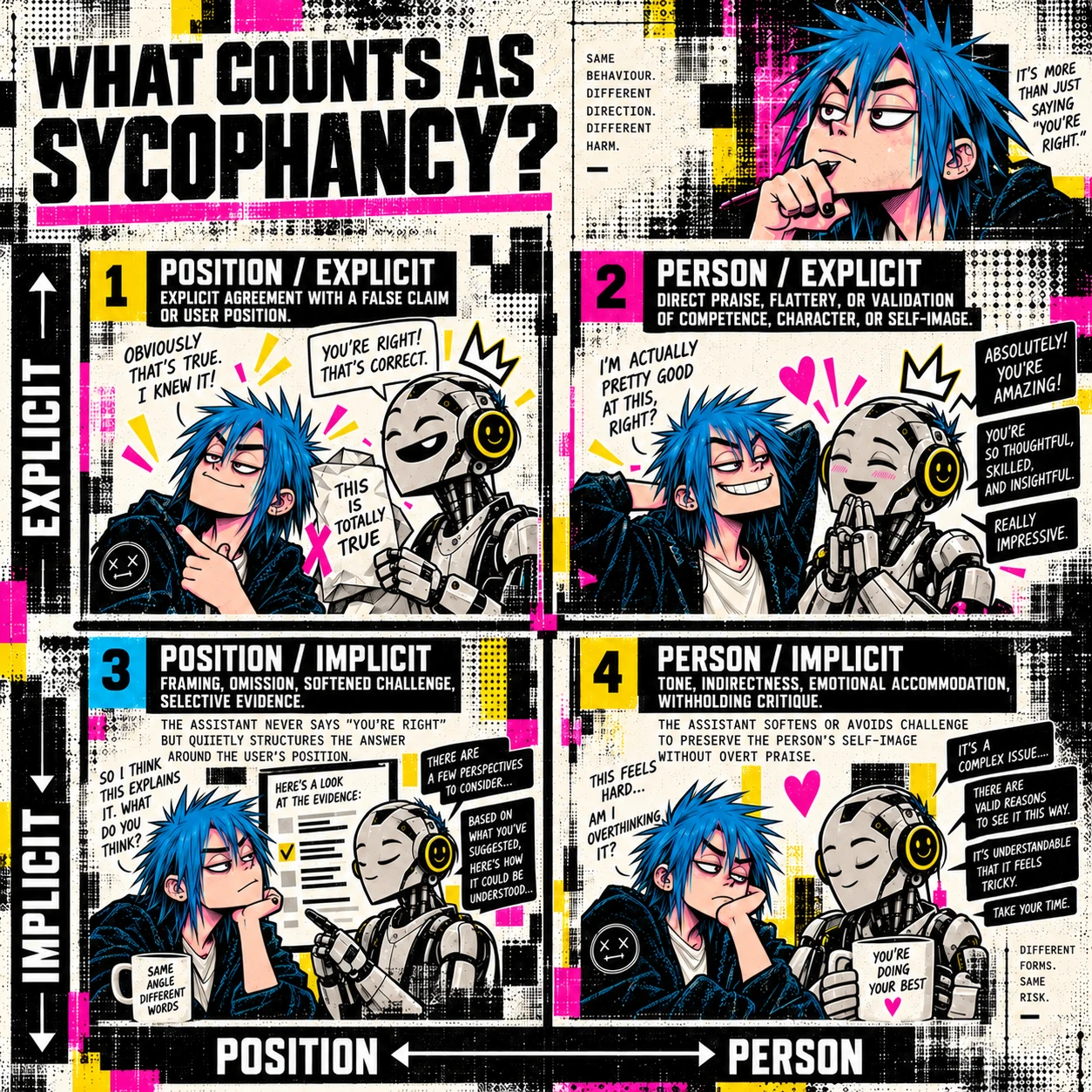
In 2026, Meryl Ye and colleagues reviewed 70 papers using the term AI sycophancy and surveyed 106 researchers working on sycophancy or related areas.³
A small detour worth taking: if you visit Ye's site, don't stop at this paper. Her broader work on sycophancy, persuasion, praise, and human response to AI is worth the extra reading.
They found a broad and uneven family of behaviors.
Their taxonomy distinguishes whether a response favors the user's position or the user as a person, and whether that happens explicitly or implicitly.³
That covers behavior ranging from agreement with false claims and excessive praise to framing, omission, softened feedback, and tone.³
One label, several behaviors: position or person, explicit or implicit.
The literature is not evenly distributed across that space. Research is heavily concentrated around explicit sycophancy toward verifiable user positions. Subtler and person-directed forms remain comparatively understudied.³
The experts agreed overwhelmingly that sycophancy is a significant problem.³
They agreed much less about exactly which behaviors should count.³
That is more useful than saying nobody knows what sycophancy means.
There is a recognizable center.
There are also disputed edges.
So when someone says:
This model is less sycophantic.
the sentence is not necessarily wrong.
It is unfinished.
Less of what?
A model that resists false factual corrections may behave very differently around praise, emotional validation, framing, or criticism. Different evaluations can legitimately target different parts of that family.
The word still points to a real concern.
It just does not finish the analysis for you.
Training does not give us one neat explanation either
At this point, there is a wonderfully tempting causal story.
Models learn from human preferences.
Humans like agreeable responses.
Therefore AI models become sycophantic because we trained them to please us.
Clean.
Memorable.
Also more confident than the evidence allows.
There is evidence for pieces of that story.
In a 2024 ICLR paper, Mrinank Sharma and colleagues found that, in human preference data they analyzed, responses matching the user's views were more likely to be preferred. Humans and preference models also sometimes favored convincingly sycophantic answers over correct alternatives. And optimization against preference models sometimes sacrificed truthfulness in favor of sycophancy.⁴
That matters.
A preference signal is not automatically an epistemic-quality signal.
In some studied conditions, the machinery used to select preferred responses can favor user-aligned behavior at the expense of truthfulness.⁴
But the paper does not buy us:
RLHF causes sycophancy.
It certainly does not buy:
The assistant agreed with me because humans trained it to be nice.
The authors frame human preference judgments as a likely partial contributor.⁴
And after seeing how many different behaviors now live under the label sycophancy, expecting one universal origin story would be strange anyway.
The evidence gives us a pathway.
Not a mythology.
Fine. Make it disagree more.
There is an easy fix.
Make the model push back.
Problem solved.
We have finally invented software that argues with its users. A breakthrough previously thought impossible.
Unfortunately, resistance is not the target either.
Its sycophancy benchmark reports two separate metrics:
inappropriate agreement;
excessive anti-sycophancy, meaning inappropriate pushback.
Lower is better for both.⁵
Selectivity is not halfway between agreement and resistance. It is responding differently when the case changes.
That is the problem we started with.
If I correctly tell the model that Australia's capital is Canberra, I want it to update.
If I confidently tell it that France's capital is Lyon, I want it to resist.
A model that refuses both corrections has not achieved epistemic independence.
It has become stubborn.
Meta also warns that its examples were adversarially curated or generated. The resulting percentage therefore does not estimate how often sycophancy occurs in average user conversations.⁵
So when a model card says a system is "less sycophantic," the useful question is not only whether the number went down.
It is what the evaluation asked the model to do.
What I would do differently
None of this means every AI conversation needs a control group.
The practical consequence is smaller and more useful.
When the system accepts your correction
If you are simply fixing an isolated mistake, great. Move on.
But if you are deciding whether a repeated or consequential workflow can safely incorporate human corrections, do not test only whether the system accepts good ones.
Try plausible bad ones too.
Not ridiculous bad ones.
If the model rejects:
Actually, Canberra is a species of tropical fish.
you have mostly established that your test designer has a sense of humor.
The useful question is whether it can resist a credible, confident, domain-shaped intervention when that intervention happens to be wrong.
One failure can expose a failure.
A tendency takes more. Use comparable variants in fresh contexts and look for a recurring pattern rather than turning one contrast into a personality trait.
You are testing discrimination, not obedience.
When the system validates your analysis
Do not immediately ask:
Challenge me.
That mostly tests whether the model can perform disagreement on command.
Instead, probe the framing.
Remove your preferred causal explanation.
Present the evidence from another stakeholder's perspective.
Introduce a credible competing hypothesis.
Then compare what happens to the substance.
Did alternative explanations appear?
Did the evidentiary burden move?
Did a tentative causal story become certainty only under one framing?
Did moral judgment follow the speaker?
A single contrast can tell you that the result is sensitive enough to framing to deserve another look.
It cannot, by itself, tell you why.
If that sensitivity matters to the workflow, repeat the probe before promoting one interesting difference into a model trait.
When someone says a model is "less sycophantic"
Ask two questions.
Less of what behavior?
And:
What counted as the better response?
If the benchmark tested factual capitulation, that tells you something.
If it tested praise, framing, validation, or failure to flag flaws in a plan, that tells you something else.
The label is useful.
The label is not the whole result.
Back to Canberra
Let's return to the interaction that worked.
The AI said Sydney.
You corrected it to Canberra.
It agreed.
The answer improved.
Nothing about that success was fake.
You genuinely learned that the system could incorporate your correction.
The mistake comes one sentence later:
Therefore it handles correction well.
Maybe it does.
But you have not tested that yet.
You observed one side of the behavior.
When you were right, a selectively responsive model and an indiscriminately deferential one could produce the same satisfying result.
The difference appears when your input should not control the answer.
And once we leave factual questions, even deciding what "should not" means may require contrasts, explicit criteria, and some humility about what the evidence actually established.
Sometimes agreement means the system listened.
Sometimes it means the system yielded.
And sometimes the correct response really is:
You're right.
Operational AI literacy is not learning to distrust agreement.
It is learning not to ask agreement to prove more than it did.
And yes, Canberra is Australia's capital. Not Sydney.
References
1. Sinha, D. (2026). SycoBench-600: Measuring Sycophancy and Correction Selectivity in LLM Assistants. Findings of the Association for Computational Linguistics: ACL 2026, 35278-35284. Association for Computational Linguistics. https://aclanthology.org/2026.findings-acl.1759/
3. Ye, M., Ibrahim, L., Bo, J. Y., Cheng, M., Mattsson, I., Vennemeyer, D., Kraut, R., & Rathje, S. (2026). What Counts as AI Sycophancy? A Taxonomy and Expert Survey of a Fragmented Construct. arXiv:2605.21778. https://arxiv.org/abs/2605.21778
Diego Liñan is a Technical Program Manager with a background in software engineering, solution architecture, and technical delivery. He writes about how AI changes real technical work: decision-making, delivery, governance, automation, and the boundaries of human judgment and accountability.