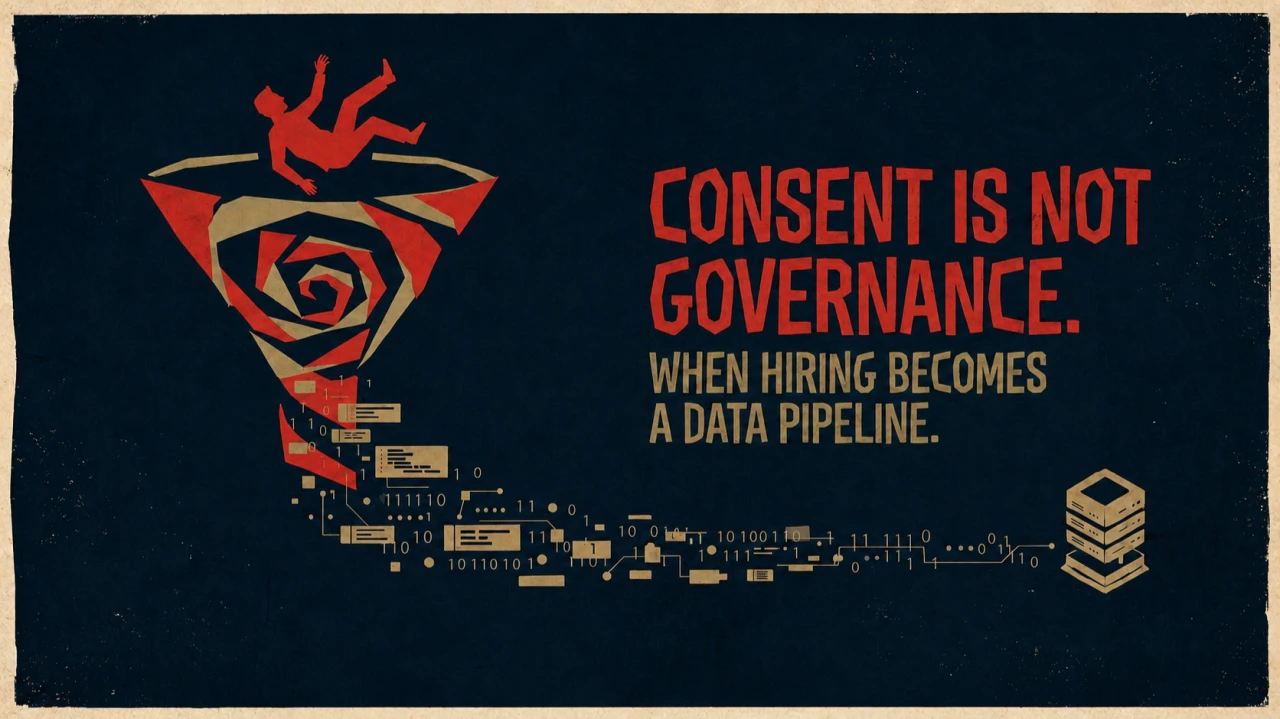
AI-enabled hiring is exposing a deeper governance failure in professional work: the boundary between assessment, contribution, consent, and extraction.
The thesis behind the observation
I am currently working on a broader research thesis about governed operating memory in professional-services environments.
The question behind it is simple to state and hard to govern:
How do people decide what to trust when sources, evidence, claims, identity, incentives, and context become detached from one another?
That question started in the world of professional services: client accounts, delivery risk, staffing decisions, stakeholder context, escalation paths, handoffs, operating memory, and the uncomfortable human reality that important decisions are often made with incomplete, stale, or untraceable information.
But a recent job-market interaction pushed the same question into a different surface.
Not as a complaint.
As a specimen.
A personal trigger, not a personal grievance
A role appeared under a professional title. It had an attractive hourly range. It looked remote, specialized, and aligned with domain expertise. The language was polished. The company appeared real. The process did not look like the old version of a scam.
Then the next step made the boundary less clear.
The role was not really about delivering a professional-service outcome in the usual sense. It was about contributing expertise to AI training and evaluation. The process moved from professional assessment into an AI-mediated funnel where domain judgment, communication style, reasoning, behavioral signals, and potentially reusable expert input could be captured before any actual employment or contractor relationship existed.
I am intentionally not naming the company here.
The company is not the point.
The failure mode is the point.
A single case, especially a personal one, can only prove that a mechanism is possible. It cannot prove prevalence. So I treated the experience as research material: preserve the evidence, separate fact from inference, look for contradiction first, and only then ask whether the mechanism appears elsewhere.
That distinction matters.
The strongest version of the finding was not:
"This is a scam."
The stronger and more uncomfortable finding was:
A process can be real, disclosed, legally structured, and still ethically broken.
The role-framing problem
A later observation made the mechanism clearer.
A similar professional project-management role appeared more than once across regional job postings, with the same conventional remote-contractor framing: project execution, timelines, budgets, cross-functional coordination, stakeholder communication, risk management, and delivery of software outcomes.
The postings were promoted, regionally distributed, and managed outside the original labor-market surface.
But the application path pointed away from that surface and into the infrastructure of an AI data-labor platform.
That does not prove bad faith.
It does show a governance problem.
The issue is not only routing. It is framing.
The candidate first encounters the opportunity as a conventional professional-services role. The language signals project delivery, client coordination, and operational execution. But the destination can belong to a different economic model, where the candidate’s domain expertise, judgment, examples, explanations, and behavioral signals may become part of an AI evaluation or training pipeline.
When the surface language describes one kind of work, but the destination infrastructure supports another, consent becomes harder to interpret.
I am not treating this observation as proof of prevalence. I am treating it as evidence that the routing mechanism exists and is observable.
The labor-market trust surface is already degrading
The broader labor market is already experiencing a signal problem.
The Wall Street Journal reported Greenhouse data suggesting that 18% to 22% of advertised jobs in 2024 never resulted in a hire.¹ Business Insider, citing a ResumeBuilder survey, reported that around 40% of companies said they had posted fake job listings.²
Different methods. Different samples. Same direction.
The job posting is no longer a clean signal of hiring intent.
Generative AI adds another layer.
Galdin and Silbert’s paper "Making Talk Cheap" argues that large language models reduce the cost of producing written applications, weakening labor markets that relied on writing as a costly signal of quality. In their model, if written applications become useless as signals, workers in the top ability quintile are hired 19% less often, while workers in the bottom ability quintile are hired 14% more often.³
That matters because labor markets depend on signals.
Akerlof’s "lemons" problem and Spence’s signaling theory are old ideas, but they fit the current moment disturbingly well: when quality is hard to judge and signals become cheap or unreliable, markets do not simply become noisy. They can start selecting for the wrong behavior.⁴
Most current discussion focuses on one side of that collapse: candidates using AI to produce better resumes, cover letters, tests, and interview answers.
That is real.
But the other side matters just as much.
AI does not only weaken candidate-side signals. It also makes employer-side extraction cheaper, smoother, and more scalable.
The AI labor market is already showing the pattern
The AI data labor market already gives us warning signs.
TIME reported on an Oxford Fairwork study of 15 digital labor platforms used by AI companies. The study drew on a survey of 752 workers in 94 countries and found that none of the platforms scored more than 5 out of 10 against basic fair-work principles. Among workers on the five platforms most commonly used by AI companies, 26.8% of their time went to unpaid tasks such as looking for work, taking unpaid tests, and applying for work. After accounting for that unpaid time, average hourly earnings were reported at $2.15.⁵
Scale AI has faced lawsuits alleging worker misclassification, underpayment, unpaid training, invasive monitoring, and exposure to disturbing content. The company has disputed or declined comment on various allegations depending on the report, and has emphasized flexibility and compliance. But the repeated litigation around the work model is itself evidence that the governance boundary is contested.⁶
Surge AI was also sued in California. The Los Angeles Times reported allegations that data annotators were classified as independent contractors, denied employee benefits, required to complete unpaid training, and subject to time limits that allegedly caused pay to be docked.⁷
Appen provides a different kind of evidence because the company itself acknowledged payment disruption during its CrowdGen platform transition. The Guardian reported that almost one-third of payments for projects worked on by contractors training AI systems used by companies such as Amazon, Meta, and Microsoft were not paid on time after the migration. Appen said over two-thirds of payments were processed on time and apologized for the stress and frustration caused.⁸
Business & Human Rights Resource Centre has also catalogued allegations by Kenyan data labellers contracted through Appen, including claims connected to work conditions, labor rights, forced labor, wage theft, poverty wages, and mental health. Appen responded that it takes contributor treatment seriously and rejects unfair treatment.⁹
The purpose of citing these cases is not to say every AI labor company is the same.
They are not.
Some pay reliably. Some have stronger processes than others. Some allegations are unresolved. Some cases involve litigation, some involve platform migration failures, some involve worker testimony, and some involve third-party reporting.
But together they show a class of governance problems around AI labor:
unpaid or underpaid work-like activity;
tests, interviews, and training that may not lead to paid work;
weak recourse for globally distributed contributors;
unclear boundaries between assessment and contribution;
asymmetry between what platforms can retain and what workers can contest;
professional or semi-professional labor being converted into AI training input.
This is where my thesis connects.
Why professional services makes this sharper
In professional services, expertise is not metadata around the work.
Expertise is the work.
A project manager’s value is not just a certification or a list of tools. It is judgment under ambiguity: how risks are read, how priorities are ordered, how stakeholder tension is interpreted, how delivery context is preserved, how escalation is timed, how people are protected, how incomplete information is turned into action.
The same is true for consultants, architects, analysts, recruiters, lawyers, clinicians, designers, technical leads, customer-facing operators, and many other knowledge workers.
Their professional identity is not separate from their work product.
Their judgment, reputation, reasoning patterns, domain examples, and decision logic are part of the asset being sold.
So when a hiring process asks a professional to explain how they think, solve scenarios, record answers, produce examples, classify cases, evaluate model outputs, or translate lived domain judgment into structured input, the boundary matters.
Is this assessment?
Is this work?
Is this training data?
Is this a sample?
Is this a contribution?
Can it be reused?
Can it be deleted?
Can the person opt out without losing the opportunity?
Is the person being evaluated for a role, or is the person becoming part of the production pipeline?
These are not anti-AI questions.
They are governance questions.
Consent is not governance
The problem is not that AI systems learn from experts.
They should. High-quality AI systems need human judgment, domain review, adversarial feedback, corrections, examples, and evaluation.
The problem is not even that the process is always hidden. In many cases, it may be disclosed.
The harder problem is this:
Disclosure is not the same as governance.
A checkbox is not governance.
A privacy notice is not governance.
A recorded interview is not automatically abusive, but it becomes risky when there is no clear boundary between evaluation and extraction.
Consent is not meaningful if it is collected before the person knows whether there is a real job, a real contract, a real rate, a real client, a real start date, a real payment path, or a real way to revoke what was captured.
Consent becomes even weaker when the candidate entered the funnel through one semantic frame - a conventional professional role - and is later asked to consent inside another - an AI-mediated expert-evaluation or data-labor process.
Consent under asymmetry can become a one-way extraction layer.
Expertise flows in.
Identity flows in.
Behavioral signals flow in.
Recordings and transcripts may flow in.
Professional judgment flows in.
But the candidate may receive no equivalent guarantee, compensation, transparency, or practical recourse.
That is the governance failure.
The failure is human governance, scaled by AI
This is not primarily an AI failure.
It is a human governance failure scaled by AI.
AI did not invent vague roles, ghost jobs, unpaid tests, overbroad consent, asymmetric contracts, or weak recourse.
Humans did.
Organizations did.
Markets did.
Incentives did.
AI simply makes the system faster, cheaper, more scalable, and easier to hide behind.
That distinction matters because blaming AI lets the humans who design the system disappear.
A human chooses the funnel.
A human defines the consent boundary.
A human decides what gets retained.
A human decides whether rejected candidates can delete their data.
A human decides whether an interview is just an interview or also training material.
A human decides whether professional expertise is compensated when it becomes useful.
A human decides whether the system optimizes for trust or throughput.
The failure is not artificial intelligence. The failure is human governance, scaled by artificial intelligence.
Why "human-in-the-loop" is not enough
"Human-in-the-loop" sounds reassuring.
But it can fail in at least three ways.
First, the human may arrive too late. If the decisive act is capture, reuse, or retention, then a later review is only reviewing the receipt. The value transfer already happened.
Second, the human may not have a usable read-path. If the process is spread across polished job posts, external funnels, dense terms, opaque scoring, off-platform interviews, and unclear data practices, the human cannot meaningfully verify what is happening from inside the process.
Third, the human may no longer be the reviewer. The human may be the material being ingested.
That last inversion is the most important one.
A lot of AI governance assumes the human sits above the system as reviewer, approver, exception handler, or final decision-maker.
But in AI-enabled hiring and expert-evaluation funnels, the human can become the input. Their identity, voice, video, reasoning, examples, and professional judgment are what the system captures.
The gate is no longer simply:
"Human reviews AI."
It can become:
"AI evaluates human, while human becomes data."
That is the epistemic break.
The system is no longer only asking:
"Can we trust this person?"
It is also asking, often less explicitly:
"Can we use this person’s expertise to improve the system?"
Those are different acts.
They require different boundaries.
Provenance helps, but it is not enough
This is where provenance and trust infrastructure enter the conversation.
Carefully.
Provenance helps. Evidence chains help. Decision traces help. Attribution helps. Auditability helps.
But provenance alone is not enough.
A recent independent security analysis of C2PA, a major content provenance standard, argues that the specification is promising but should not yet be relied upon for high-stakes uses such as financial disclosures, journalism, or legal evidence.¹⁰
That warning generalizes.
Knowing where something came from is necessary.
It is not sufficient.
A governed system also needs context, scope, consent boundaries, retention limits, review paths, revocation mechanisms, decision accountability, and effective recourse.
That is the gap my broader thesis is trying to reason about in professional services.
Not "more AI".
Not "less AI".
Not "trust the human".
Not "trust the machine".
The problem is how to govern the chain from sources to evidence, from evidence to claims, from claims to operating memory, and from operating memory to action - before the system presents something as more trustworthy than the evidence actually supports.
What needs to be governed
Hiring is now one surface where that chain is breaking.
A professional role can look like a job but function partly as a sourcing funnel.
A role description can use the language of project delivery, client coordination, and stakeholder management while the application infrastructure belongs to a different AI labor model.
An assessment can look like evaluation but function partly as data production.
Consent can look like permission but function as a liability shield.
A professional labor-market surface can look neutral, while the actual application flow routes candidates into a different infrastructure where assessment, contribution, and data capture are harder to distinguish.
A human can appear to be the decision-maker but actually become the input.
That is not a reason to reject AI in hiring, recruiting, professional services, or expert work.
It is a reason to govern the boundaries more seriously.
The questions should be explicit:
What is being assessed?
What is being collected?
What is being reused?
What is being retained?
What is being compensated?
What can be revoked?
What happens to rejected candidates’ data?
What is the difference between an interview, a test, a work sample, and training material?
Who is accountable when the person never becomes an employee, contractor, vendor, or paid contributor?
And most importantly:
At what exact moment does professional judgment stop being evaluated and start being extracted?
That is the boundary I think we are failing to govern.
Closing
The future of work will not only be shaped by whether AI replaces professionals.
It will also be shaped by how AI systems absorb professional expertise before the work relationship even exists.
That is a quieter problem than replacement.
It is also harder to see.
Because the most troubling version is not necessarily the illegal version.
It may be the version that is disclosed, consented to, operationally efficient, and still structurally wrong.
Selected sources
¹ The Wall Street Journal - ghost jobs / Greenhouse data https://www.wsj.com/lifestyle/careers/ghost-jobs-2c0dcd4e
² Business Insider - ResumeBuilder / fake job listings https://www.businessinsider.com/companies-posting-fake-job-listings-search-resume-2024-6
³ Galdin & Silbert - "Making Talk Cheap: Generative AI and Labor Market Signaling" https://arxiv.org/abs/2511.08785
⁴ Investopedia - Akerlof, Spence, Stiglitz, asymmetric information and signaling https://www.investopedia.com/ask/answers/042415/what-theory-asymmetric-information-economics.asp
⁵ TIME - Oxford Fairwork / AI data gig workers https://time.com/6296196/ai-data-gig-workers/
⁶ Business Insider - Scale AI lawsuits / contractor allegations https://www.businessinsider.com/scale-ai-settle-worker-lawsuits-in-california-2025-10
⁷ Los Angeles Times - Surge AI class action https://www.latimes.com/business/story/2025-05-21/surge-ai-is-latest-san-francisco-start-up-to-face-lawsuit-for-allegedly-misclassifying-data-labeling-workers
⁸ The Guardian - Appen CrowdGen payment delays https://www.theguardian.com/australia-news/2024/oct/25/contractors-training-amazon-meta-and-microsofts-ai-systems-left-without-pay-after-appen-moves-to-new-platform
⁹ Business & Human Rights Resource Centre - Kenyan data labellers / Appen allegations https://www.business-humanrights.org/en/latest-news/australia-kenyan-data-labellers-make-modern-slavery-allegations-against-ai-company-appen/
¹⁰ C2PA limitations paper - "Verifying Provenance of Digital Media: Why the C2PA Specifications Fall Short" https://arxiv.org/abs/2604.24890
About the Author
Diego Liñan is a Technical Program Manager with a background in software engineering, solution architecture, product development, and technical delivery. His current work focuses on AI-enabled delivery systems, agentic workflows, AI governance, engineering operating models, persistent context, evidence traceability, and human accountability in AI-assisted software development.
ORCID iD: https://orcid.org/0009-0004-6730-3150
© 2026 Diego Liñan. All rights reserved.