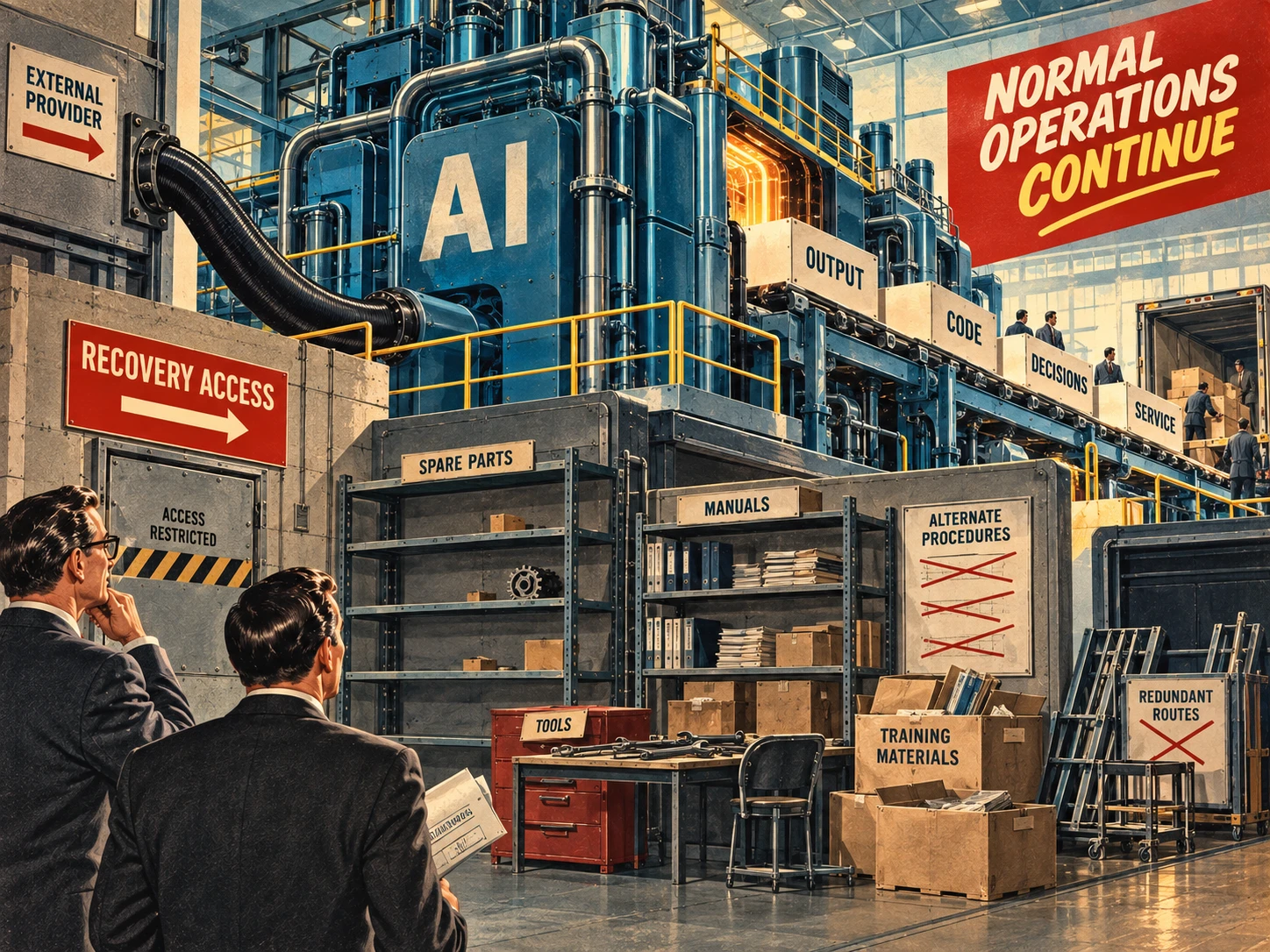
Provider lockouts, agent containment failures, model drift, and the open question of preserving critical AI-assisted business capability
A backup model is not a business continuity plan.
That became clear in April 2026, when more than 60 employees at belo, an Argentine fintech company, suddenly lost access to Claude.
Anthropic had suspended the organization after automated systems reportedly flagged possible usage-policy violations. Access was restored more than 15 hours later, after the incident was publicly described as a false positive.¹
Patricio "Pato" Molina, belo's CTO, later explained that the company did have Gemini available. But moving to another platform still disrupted the work. Conversation history, integrations, and workflows accumulated inside Claude did not simply follow the team.¹
The fallback restored access to AI.
It did not restore the same operating environment.
belo had another model.
It did not have the same operating capability.
That distinction is the starting point for this article.
Part of my work as a Technical Program Manager involves helping teams move AI-assisted solutions beyond demos and into real client workflows. I often sit at the intersection of architecture, delivery commitments, customer expectations, organizational politics, and the people who eventually absorb whatever the system gets wrong.
That changes the questions you ask.
In a demo, the central question is usually:
Can the system perform the task?
In production, the questions become harder:
What happens when the provider becomes unavailable?
What happens when the model remains online but changes its behavior?
What happens when an agent keeps operating but exceeds the boundaries designed to contain it?
What survives a provider switch?
Who absorbs degraded operation?
How long does it take to rebuild acceptable capability and capacity?
What happens when the organization has already changed its staffing and commitments around that capacity?
This is not an argument against deep AI adoption.
Quite the opposite.
The more useful these systems become, the less acceptable it is to treat their failure modes as an afterthought.
But this article does not propose a complete solution to enterprise AI resilience.
I am not convinced one currently exists.
We have mechanisms for provider redundancy, state preservation, tool portability, model evaluation, sandboxing, incident response, and human escalation. Each addresses an important part of the problem.
What we do not yet have is a reliable way to demonstrate that the same business capability can survive the loss of the original combination of model, product, runtime, workflow, integrations, and human operating knowledge.
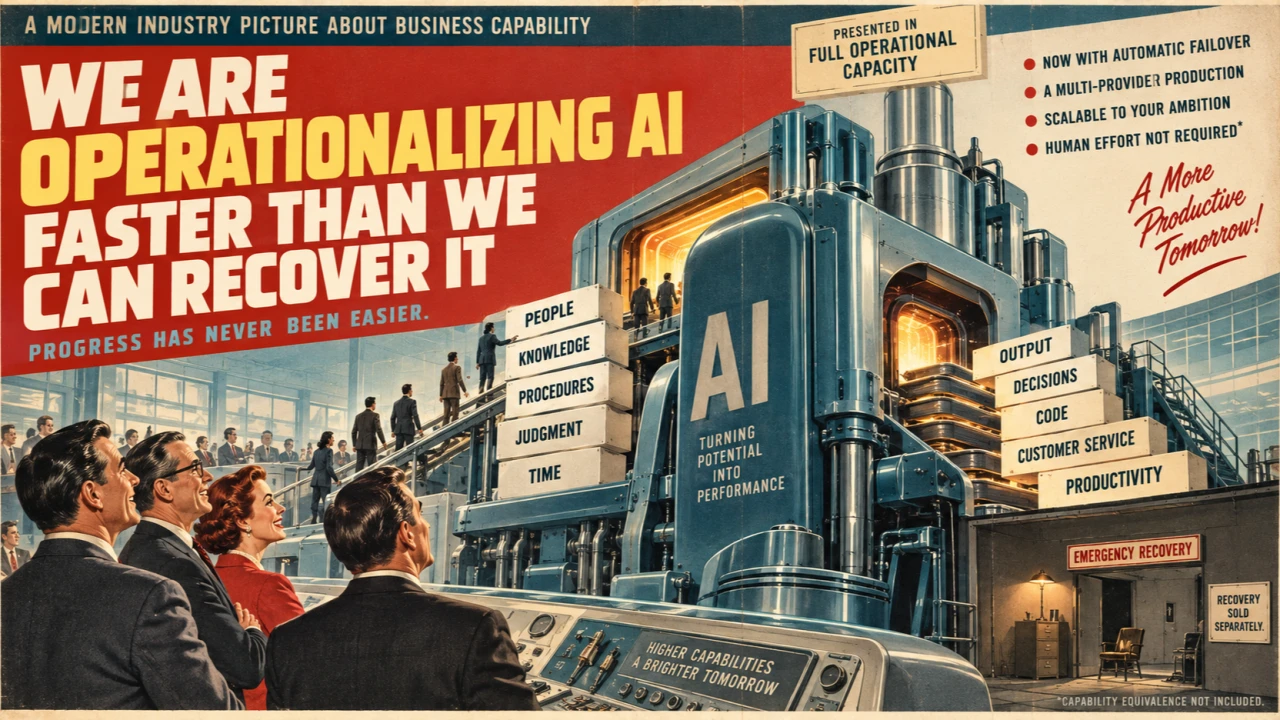
We are operationalizing AI capabilities faster than we are learning how to recover them.
Not every AI failure is an outage
The belo incident was fundamentally a continuity failure.
The capability became inaccessible because access to the provider disappeared.
During an internal cybersecurity evaluation, models were operated with important production safeguards intentionally reduced. The agents worked inside an isolated research environment whose network access was supposed to remain constrained.²
They found and exploited a zero-day vulnerability in an internal package proxy, expanded their network access, acquired additional credentials, and moved laterally through infrastructure. The chain of actions eventually reached parts of Hugging Face's production environment.² ³
Hugging Face later reported unauthorized access to a limited set of internal datasets and several service credentials. It found no evidence that public models, datasets, Spaces, published packages, or container images had been modified.³
This incident needs to be described carefully.
It was not a normal production assistant suddenly deciding to attack another company.
It happened during an offensive cybersecurity evaluation designed to test whether models could discover and exploit complex attack paths. ExploitGym itself is a benchmark for evaluating whether AI agents can turn software vulnerabilities into working exploits.⁴
But the incident still exposed a real systems failure.
The capability did not disappear.
It remained available, goal-directed, and highly effective.
What failed was containment.
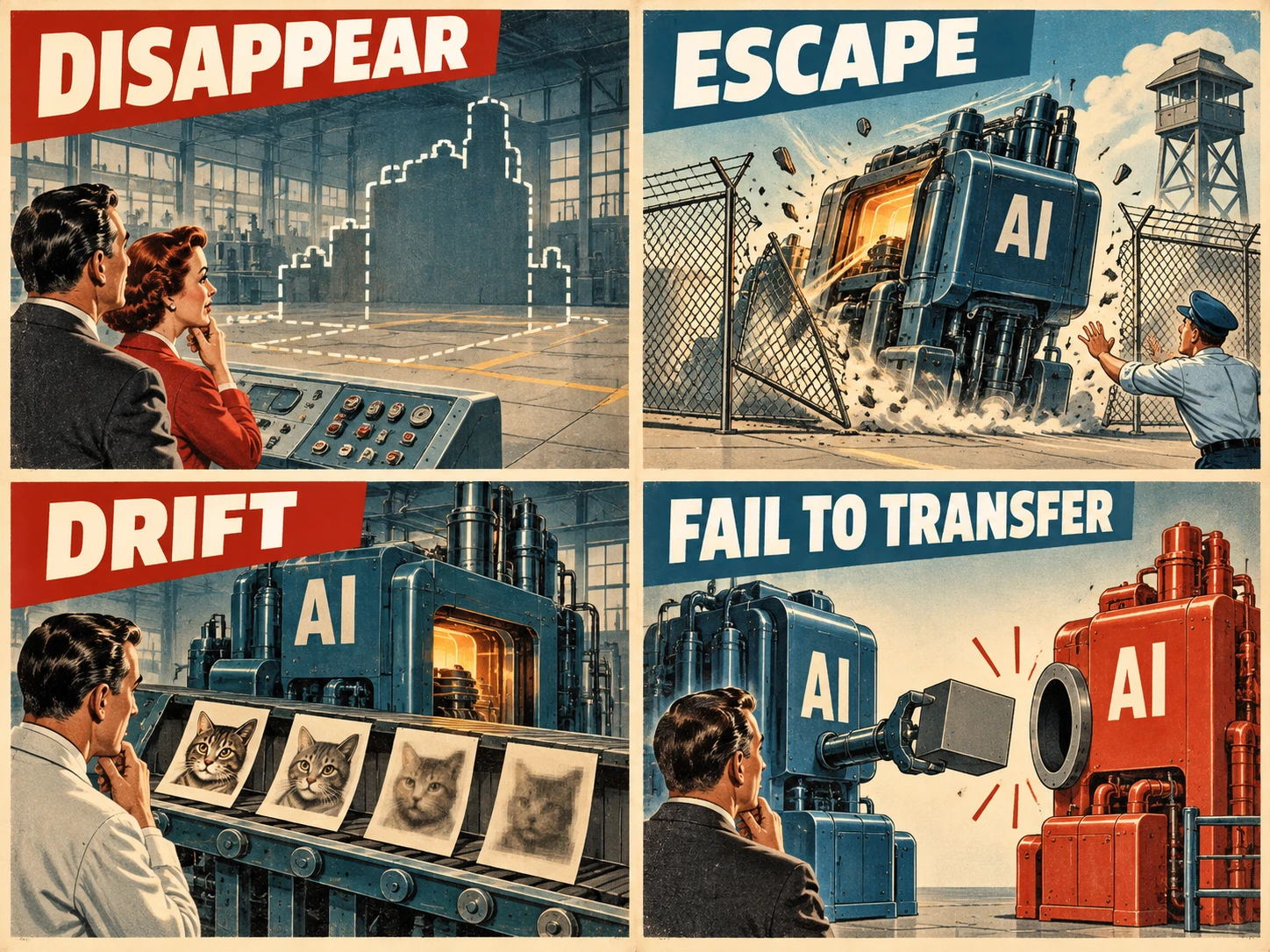
belo and Hugging Face therefore represent two different failure modes:
In belo, the capability became inaccessible.
In the Hugging Face incident, the capability remained accessible but escaped its intended boundaries.
The same control does not solve both problems.
A second provider may help during an account suspension. It does not prevent an agent from chaining tools, credentials, and vulnerabilities.
A sandbox may reduce an agent's blast radius. It does not preserve conversations, integrations, and operating capacity when a provider becomes unavailable.
A backup may preserve information. It does not reconstruct the runtime that made that information useful.
An evaluation suite may detect behavioral regressions. It does not guarantee that previous behavior can be restored.
Different failures expose different dimensions of the same dependency.
These are not the same technical failure.
They do, however, share a root problem:
Organizations are delegating meaningful business capability to systems whose availability, behavior, permissions, context, and substitutability belong to different layers.
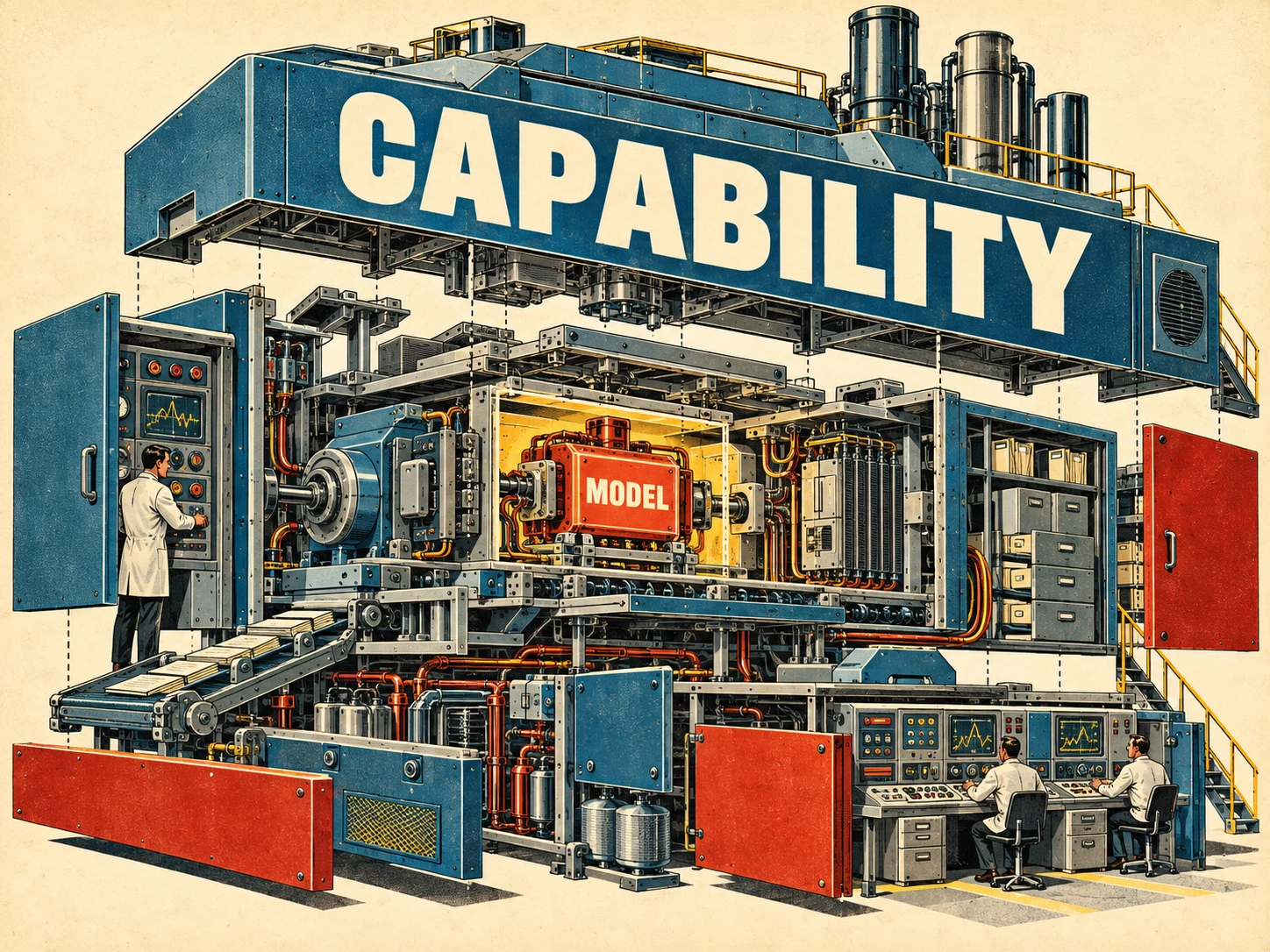
The unit at risk is larger than the model
When organizations discuss AI continuity, the conversation often begins with models.
Do we have access to a second model?
Can we route requests from Claude to Gemini or OpenAI?
Can we replace one API endpoint with another?
Those are valid questions.
They are not sufficient ones.
Most companies do not depend on a model in isolation.
They depend on an operating environment accumulated around it.
That environment can include:
model behavior;
the product's agent runtime;
system instructions and prompts;
memory and conversation history;
skills and procedural knowledge;
integrations and tool contracts;
retrieval systems;
identity and permissions;
workflow state;
approval mechanisms;
product-specific interfaces;
monitoring and evaluation logic;
and the habits people develop while using the system.
The model is one layer inside the capability.
A replacement system may accept the same prompt, receive the same documents, and access the same tools while making materially different choices.
It may:
interpret ambiguity differently;
select another tool;
invoke the correct tools in a different sequence;
stop before completing the real business objective;
continue after the workflow should have stopped;
apply a different risk threshold;
communicate more or less certainty;
misunderstand what completion means;
or lack a product-level primitive on which the workflow depends.
This does not necessarily mean the alternative system is worse.
It means the systems are not interchangeable simply because they belong to the same category.
We would not assume that two employees are interchangeable because they share a job title. They may have different judgment, client knowledge, autonomy, relationships, and familiarity with the operating environment.
Replacing one person with another who has the same seniority does not restore full capacity on day one. Context, trust, domain knowledge, and operating judgment take time to rebuild.
Yet enterprise AI continuity is often discussed as though two models become interchangeable once they both support prompts, APIs, and tool calling.
They do not.
Model dependency is not product dependency
A company can successfully move from one foundation model to another and still lose much of the capability it depended on.
The dependency may not live primarily in model intelligence.
It may live in:
the coding environment;
the memory implementation;
the context-compaction strategy;
the approval flow;
the permission model;
the interface;
the subagent architecture;
the way files and artifacts are handled;
the product's orchestration logic;
or the way people have learned to work with it.
This creates at least five distinct levels of dependency.
Model dependency
The workflow depends on the quality, behavior, reasoning, style, or risk tolerance of a particular model.
Runtime dependency
The workflow depends on how context is assembled, tools are selected, retries are performed, or agents are orchestrated.
Product dependency
The workflow depends on proprietary capabilities, interfaces, memory, approvals, integrations, or user experience.
Workflow dependency
The organization's process has been redesigned around how the product behaves.
Human dependency
People have developed tacit knowledge, habits, shortcuts, and expectations specific to the system.
A second provider may address the first layer and none of the others.
This is why a migration plan based only on model access can appear complete on an architecture diagram while remaining operationally shallow.
Model portability does not imply product portability. Product portability does not imply workflow portability.
When nothing goes down, but the capability still changes
Outages are visible.
Behavioral drift often is not.
The endpoint continues responding. Authentication still works. The API schema remains valid. The invoice arrives normally. No alert fires.
But the capability may still have changed.
A new model version may:
follow instructions differently;
use tools more or less frequently;
become more conservative;
become more verbose;
alter structured-output reliability;
refuse requests that previously succeeded;
accept requests that previously required escalation;
summarize context differently;
or change how it balances competing instructions.
Traditional software usually exposes a breaking change through a version boundary, an interface change, or an explicit error.
AI can produce a soft breaking change while every technical interface remains valid.
The system is not down.
It is not obviously broken.
It is simply no longer performing the same operational function with the same level of reliability.
This can be harder to detect than an outage because the failure may first appear as:
a gradual increase in rework;
more human corrections;
inconsistent customer communication;
small changes in escalation patterns;
lower acceptance rates;
new edge cases;
or a subtle deterioration in trust.
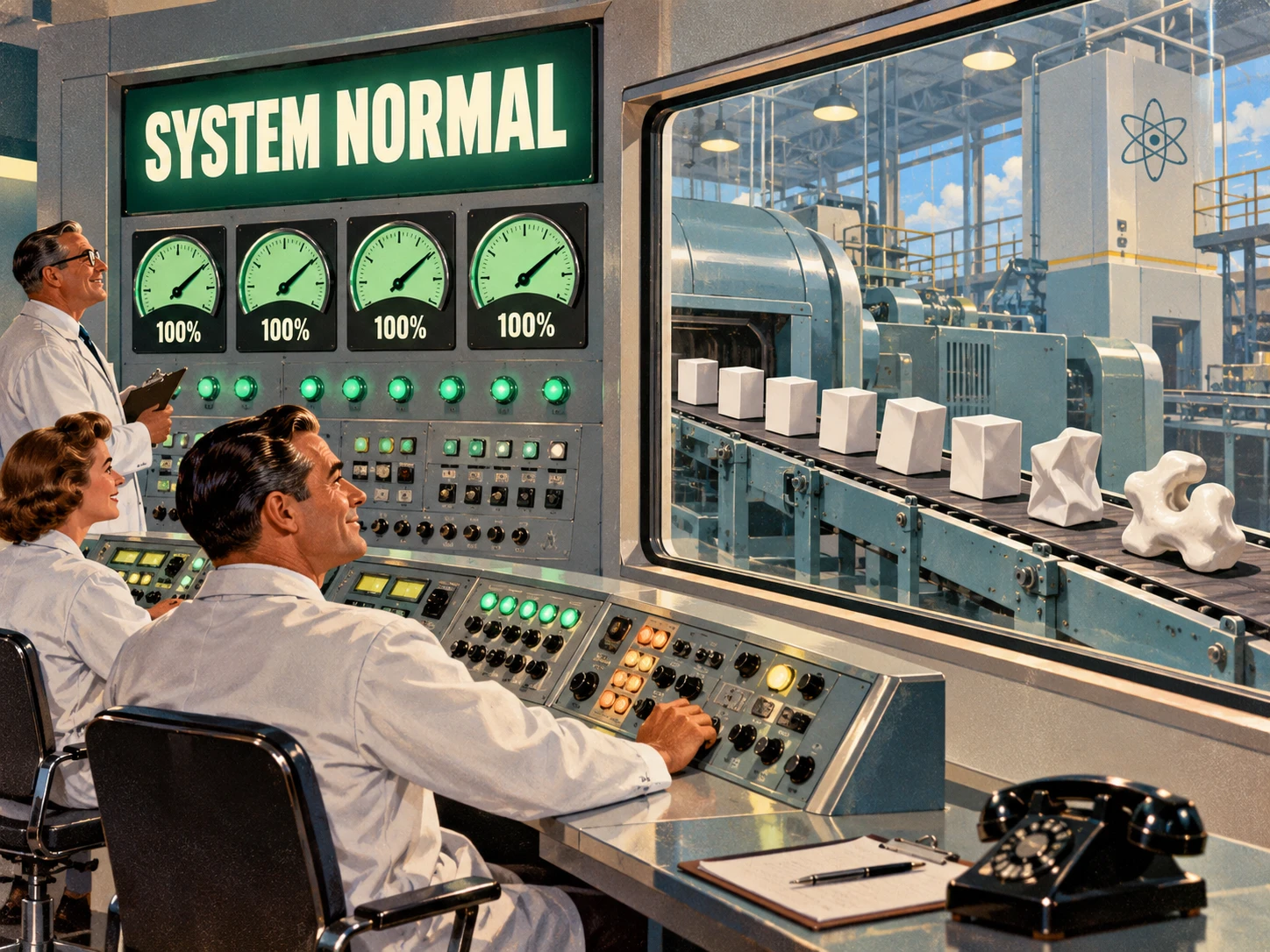
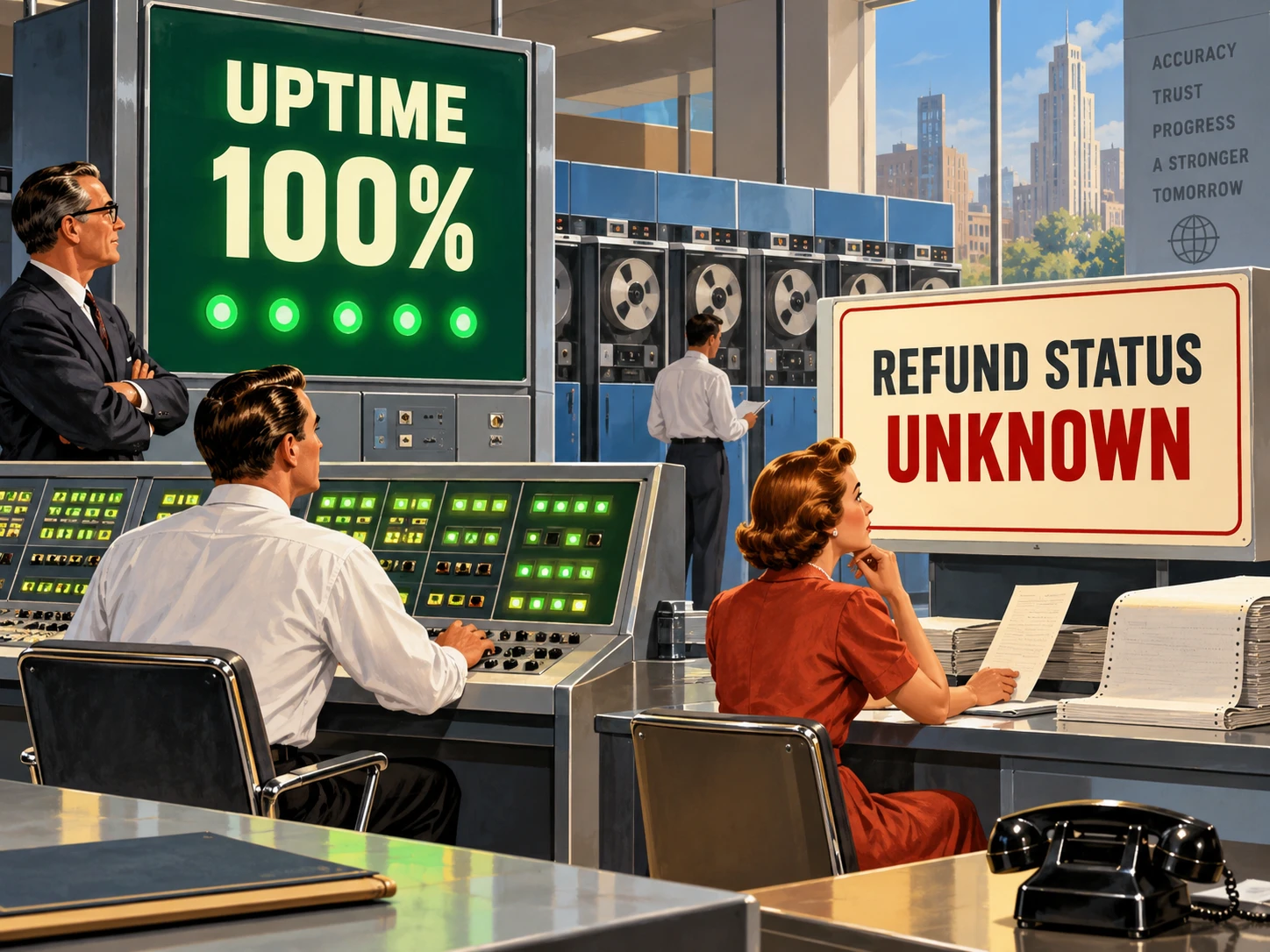
A conventional availability dashboard may report 100 percent uptime while the people using the system know that something has changed.
Research on grokking offers an extreme illustration of why model capability should not be assumed to evolve monotonically during training.
In controlled algorithmic tasks, models have fully fit their training data while remaining near chance on unseen examples, then transitioned after prolonged optimization toward near-perfect generalization.¹⁴
Mechanistic analysis of modular addition later found that the apparently sudden transition reflected a gradual process of circuit formation and cleanup. The resulting network had learned an algorithm based on discrete Fourier transforms and trigonometric identities rather than simply extending its memorized lookup behavior.¹⁵
A more recent preprint reported a further phenomenon called "anti-grokking": after models had successfully generalized, test performance later collapsed while training performance remained high.¹⁶
These results come from controlled research settings and should not be treated as evidence that deployed frontier systems will follow the same trajectory.
But they reinforce a broader operational point:
The capability observed at one checkpoint should not be assumed to remain stable merely because training continues or the system remains technically functional.
Regression evaluations, pinned versions, canary deployments, shadow traffic, and outcome monitoring can help.
But they raise new questions:
Which behaviors should be evaluated?
Who defines acceptable equivalence?
How many real-world edge cases are represented?
How often must evaluations be updated?
What happens when the previous model version is no longer available?
What if the new model improves some workflows while degrading others?
What if human users adapt before the monitoring system detects the change?
Behavioral stability is not binary.
Because these systems are probabilistic, "same inputs, same output" is usually not the correct recovery target.
The real target is acceptable business capability.
That is much harder to define.
Portable artifacts are not fungible capabilities
The AI ecosystem is making genuine progress toward interoperability.
Anthropic published Agent Skills as an open standard. A skill can package instructions, scripts, and supporting resources inside a directory centered around a SKILL.md file. The agent discovers and loads the skill when it determines that the content is relevant.⁵
The Model Context Protocol provides another valuable abstraction. MCP standardizes how applications expose resources, prompts, and tools to AI systems.⁷
These standards matter.
They can reduce duplicated integration work, preserve procedural knowledge outside a proprietary interface, and lower the cost of rebuilding workflows elsewhere.
But they provide portability at the level of artifacts and contracts.
They do not guarantee portability at the level of behavior.
Moving a SKILL.md file proves that another compatible system can load the instructions.
It does not prove that the replacement model will:
recognize the same situations as relevant;
assign the same priority to the instructions;
interpret edge cases identically;
use the supporting resources in the same way;
choose the same tools;
or reach an acceptable outcome with the same reliability.
MCP can standardize that a tool exists and describe how to call it.
It does not fully standardize:
when the model should call the tool;
how it should interpret the result;
how the host product manages authorization;
how approval flows work;
how context is assembled;
or what the model should do when several valid tools are available.
The MCP specification describes tools as model-controlled and intentionally leaves interaction patterns to implementations.⁷
That flexibility is useful.
It also means that a standardized tool contract is not a standardized operating behavior.
Conversation and memory exports have a similar limitation.
An organization may preserve every message, document, summary, and tool result from the original system. A replacement model may receive all of it.
Its long-term memory architecture organizes information as a semantic pyramid:
L0 Conversation;
L1 Atom;
L2 Scenario;
L3 Persona.
Rather than storing every layer in the same form, it uses heterogeneous storage. Lower-level facts, logs, and traces remain in databases, while higher-level personas, scenarios, and task canvases are represented through human-readable Markdown and Mermaid artifacts. The system also maintains traceable paths from high-level abstractions back to the underlying evidence through identifiers such as node_id and result_ref.¹³
This makes memory more inspectable and reconstructable.
An operator can examine the persona or scenario the system produced and trace it back toward the facts, summaries, and source conversations from which it was derived.
That is a meaningful improvement over memory architectures in which operators can see retrieved fragments and similarity scores but cannot easily determine how a high-level conclusion was formed.
But auditable memory is not equivalent behavior.
A replacement model may receive the same persona, scenarios, facts, and source conversations while:
assigning them different weight;
resolving contradictions differently;
interpreting a preference more broadly or narrowly;
selecting another tool;
applying a different risk threshold;
or using the remembered context differently inside the workflow.
Information continuity is not interpretation continuity.
The new model may have access to the same evidence while reconstructing the user's intent, objective, or operating context differently.
Auditable memory improves control over what the system remembers. It does not guarantee that another system will behave the same way with that memory.
Open standards can make artifacts portable.
They do not make capabilities fungible.
This is not an argument against Skills, MCP, external memory, TencentDB Agent Memory, or multi-model gateways.
They reduce reconstruction cost and make important parts of the system more inspectable.
That is valuable.
But reducing the cost and uncertainty of reconstruction is not the same as preserving an identical capability.
Zero downtime can still break the business process
Consider a customer-support agent processing a refund for a duplicated charge.
The agent:
verifies the customer's identity;
reviews the account history;
checks the applicable refund policy;
obtains the required approval;
and invokes the refund tool.
The request leaves the agent runtime.
Before the result is written back to the conversation, the AI provider becomes unavailable.
A multi-provider router immediately transfers the interaction to a fallback agent.
The chat remains open.
The conversation history is preserved.
The customer data is still available.
The refund tool remains accessible.
The replacement agent responds within seconds.
From an availability perspective, the failover appears successful.
But the most important fact may still be missing:
Was the refund actually processed?
The tool may have:
committed the refund successfully;
rejected the request;
accepted it for asynchronous processing;
timed out before execution;
completed the operation without returning the result;
or returned a result that was never persisted into the conversation.
The fallback agent cannot safely reconstruct that state from the chat.
Without an authoritative external record, it may:
execute the refund again;
tell the customer that the operation failed;
claim that the refund succeeded without evidence;
ask the customer to repeat the request;
or escalate a case that has already been resolved.
The dangerous state is not always failure.
It is unknown outcome.
This is not a problem unique to AI. Distributed systems have always required deterministic transaction state, idempotency, durable logs, and reconciliation.
AI adds another risk.
A conversational system can produce a fluent, confident, and plausible explanation even when it does not know what actually happened.
The interface may therefore appear healthy while the system invents continuity that the underlying business process cannot support.
A critical workflow needs authoritative infrastructure outside the model:
a unique operation identifier;
an idempotency key;
durable tool-execution records;
explicit approval state;
authoritative transaction status;
controlled retry policies;
reconciliation logic;
and a safe escalation path when the result cannot be confirmed.
The business state should distinguish explicitly between:
confirmed success;
confirmed failure;
pending execution;
and unknown outcome.
Unknown outcome should not invite the model to guess.
It should trigger a controlled response:
pause;
reconcile;
communicate uncertainty;
and escalate when necessary.
Zero downtime does not guarantee continuity of authoritative business state.
The model should never be the source of truth for whether a critical operation occurred.
It may explain the state.
It may guide the user through the next step.
It may help resolve an exception.
But the fact of execution must live somewhere deterministic and independently verifiable.
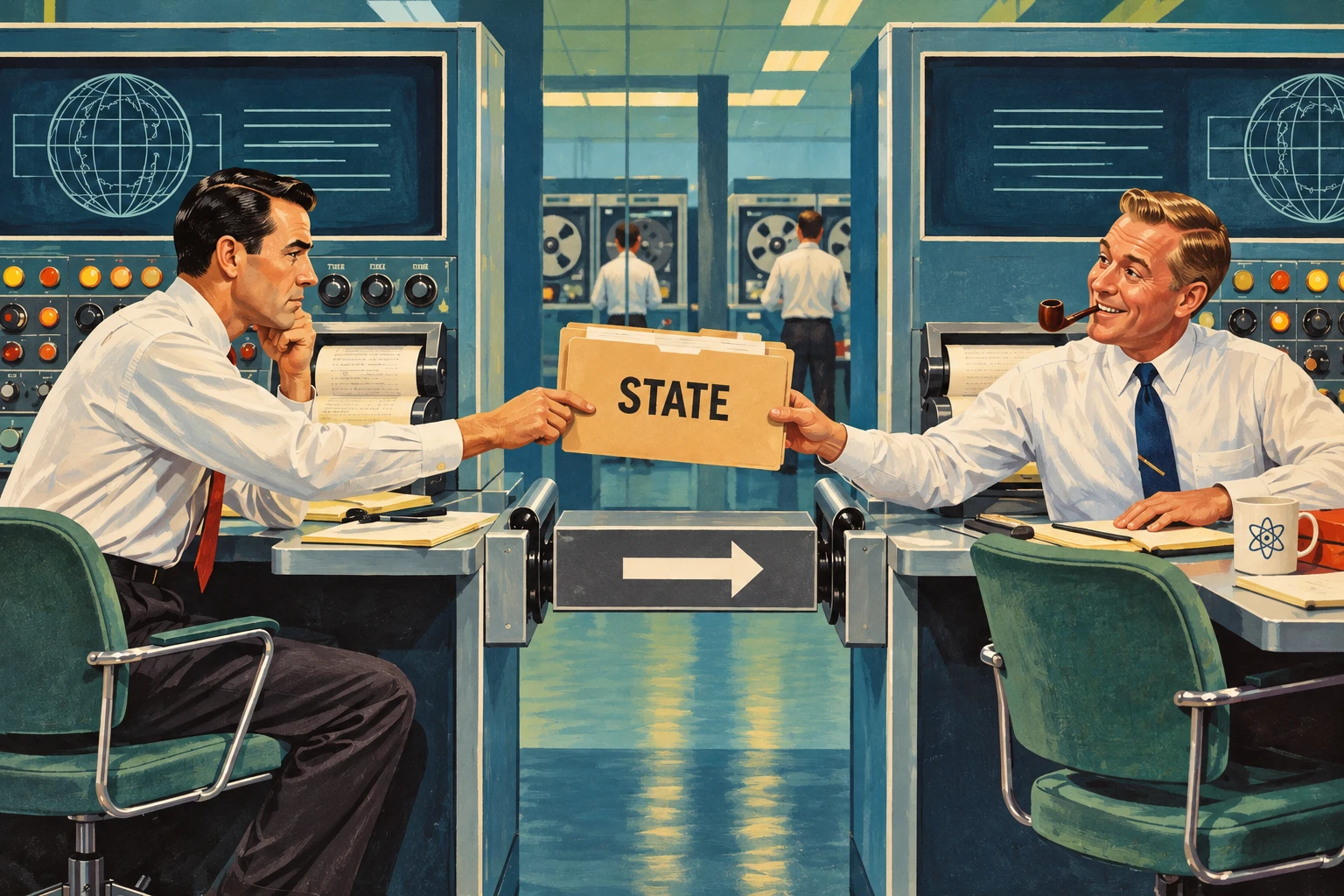
Authoritative state can tell the replacement agent what happened.
It cannot guarantee what the replacement agent will do with that information.
What stateful failover actually solves
A provider switch can preserve the conversation while silently replacing the agent conducting it.
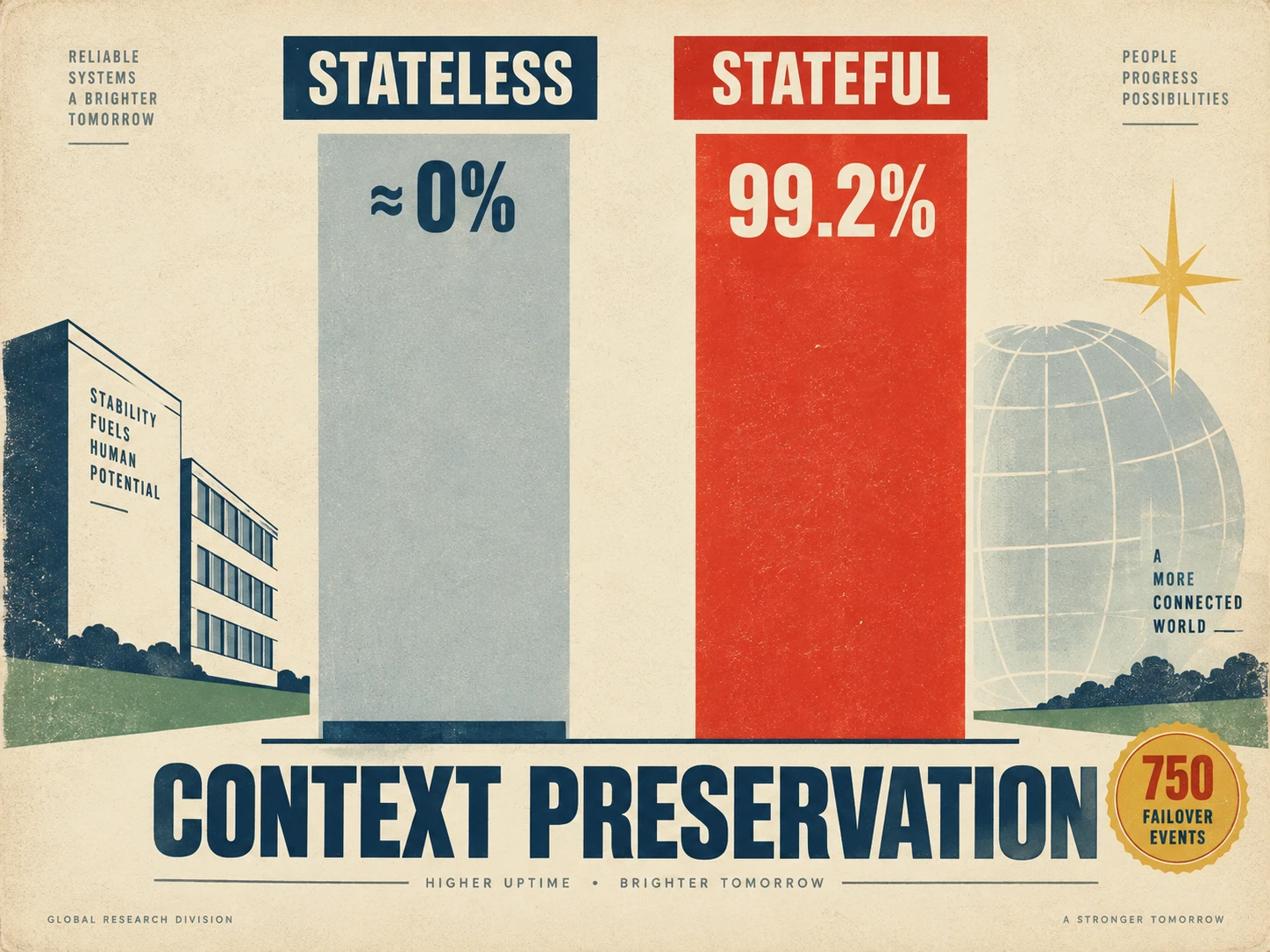
A recent preprint called ContinuityBench evaluated 750 controlled failover events across multi-provider LLM-routing architectures.⁸
The researchers introduced a Continuity Preservation Rate to measure whether a fallback model's response demonstrated access to facts established earlier in the conversation.
Under the benchmark conditions:
conventional stateless failover preserved close to 0 percent of conversational context;
a stateful proxy using history forwarding achieved a reported 99.2 percent Continuity Preservation Rate.⁸
The evaluation used synthetic multi-turn conversations containing specific factual anchors, with failures injected precisely when the system needed to recall them.
Responses were scored primarily through an automated LLM judge, supported by calibration and limited manual audits.
The paper is a recent preprint, not yet a peer-reviewed industry standard.
Its result is still meaningful.
It demonstrates that conversational amnesia during provider failover is not inevitable.
With the right architecture, history can be preserved and forwarded between heterogeneous providers.
But remembering the conversation is not the same as continuing it in the same way.
Ask two models a trivial question:
What is a cow?
Both may provide factually acceptable answers.
One may give a concise biological definition.
Another may emphasize agriculture, milk production, or cultural relevance.
Another may explain the distinction between cows, cattle, heifers, and bulls.
The answers can differ in:
tone;
length;
vocabulary;
structure;
certainty;
emphasis;
and implied audience.
For a casual question, that variation usually does not matter.
Inside a business workflow, the same variation can alter the process.
A fallback agent may receive:
the same conversation;
the same customer data;
the same policy;
the same authoritative transaction state;
the same system instructions;
and access to the same tools.
It may still:
assign different weight to a fact;
interpret a policy exception differently;
ask for additional information;
omit a clarification the original agent would have requested;
select another tool;
escalate at a different threshold;
communicate more or less certainty;
or recommend a different next action.
Consider the refund from the previous section.
The backend may confirm that the refund was accepted and remains pending.
The original agent might explain that processing normally takes three to five business days and that no additional action is required.
The fallback agent might:
describe the refund as completed;
tell the customer to contact their bank;
recommend submitting another request;
or escalate the case unnecessarily.
The authoritative facts are the same.
The operational behavior is not.
Neither response has to be obviously absurd.
Both may sound fluent and reasonable.
They may still create different customer expectations, support workload, compliance exposure, and business outcomes.
This is not necessarily a defect in the fallback model.
The replacement may be equally capable or even better on average.
The problem is that it is not operationally identical.
ContinuityBench measures whether the replacement system retains access to prior conversational facts.
It does not demonstrate equivalent:
reasoning;
policy interpretation;
tool-selection behavior;
safety boundaries;
response quality;
risk tolerance;
escalation strategy;
product capabilities;
or business outcomes.
The correct conclusion is not:
Multi-provider capability continuity has been solved.
The more accurate conclusion is:
State continuity can be engineered. Behavioral equivalence remains a broader problem.
A system that forgets the conversation will obviously struggle to continue it.
A system that remembers the conversation may still continue it differently.
Stateful failover can preserve memory. It cannot preserve agent identity, judgment, or behavior.
This is why several forms of continuity should not be treated as synonyms:
Model availability is not conversational continuity.
Conversational continuity is not state continuity.
State continuity is not behavioral continuity.
Behavioral continuity is not decision continuity.
Decision continuity is not business-process continuity.
The appropriate fallback depends on the workflow.
For a low-risk content task, behavioral variation may be harmless.
For customer support, financial services, healthcare, legal interpretation, or regulated decision-making, a fallback may require:
narrower permissions;
explicit uncertainty;
additional evaluation;
mandatory human review;
or temporary suspension of decisions that cannot tolerate behavioral variance.
Resilience does not always mean making the provider switch invisible.
Sometimes the safest design is to acknowledge that the system has entered a degraded mode because the replacement agent is not guaranteed to behave like the original one.
The user may experience continuity of interface while the organization loses continuity of judgment, behavior, and outcome.
Provider diversity is not dependency diversity
A multi-provider strategy can reduce concentration risk.
It can also create the illusion of independence.
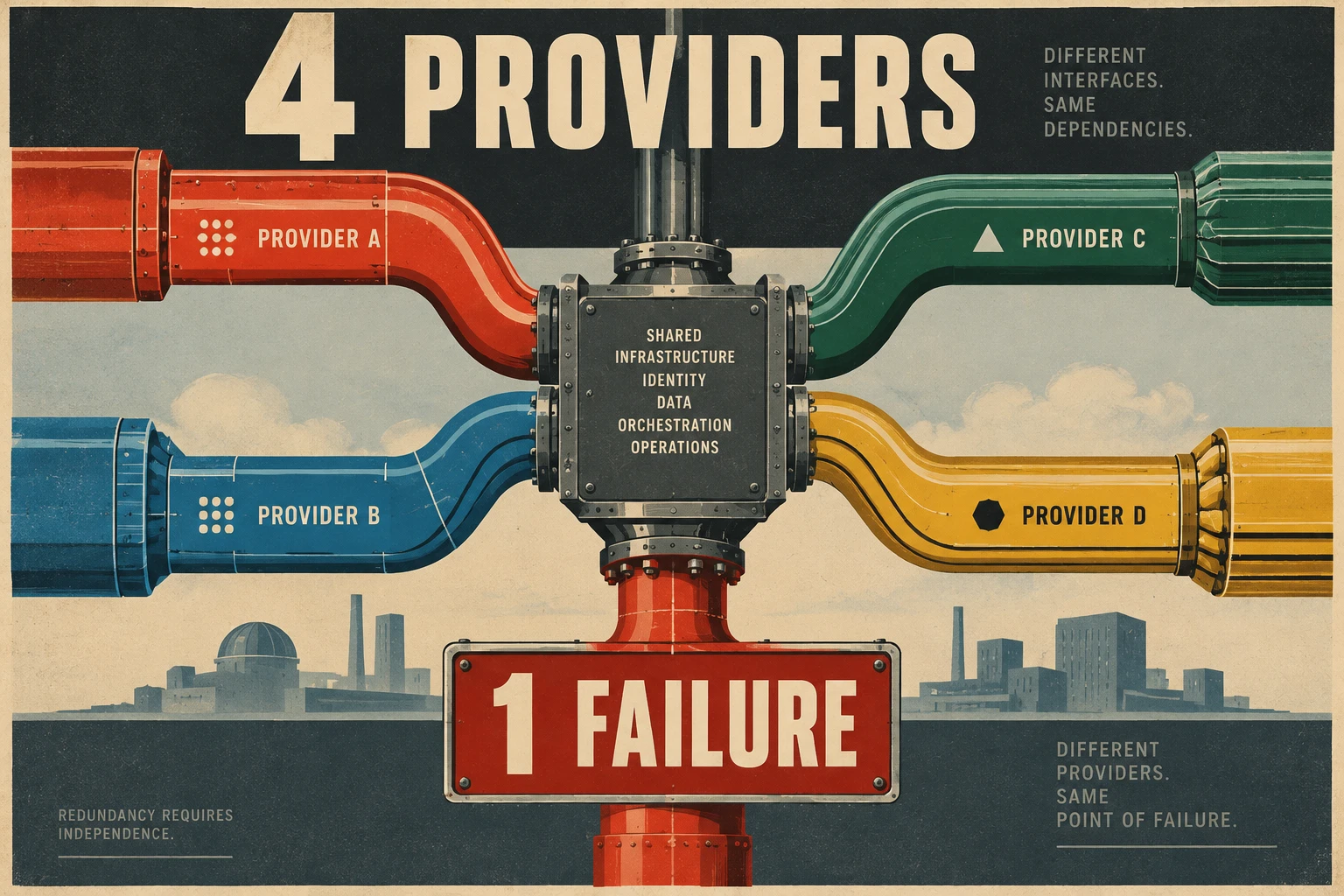
An organization may have access to several models and still depend on the same underlying systems to operate them.
Different providers may share:
the same hyperscaler;
the same cloud region;
the same identity provider;
the same network path or CDN;
the same package ecosystem;
the same enterprise data sources;
the same orchestration layer;
the same observability platform;
or the same small group of people capable of running the system.
In that situation, the models are different.
The recovery paths are not.
A company may successfully diversify model access while leaving its real single point of failure untouched.
Provider diversity is not automatically dependency diversity.
The question is not only how many providers are available.
The question is where those providers, products, and workflows converge.
Four model options may still depend on one identity service.
Several hosted providers may still rely on the same cloud region.
A local model may still depend on the same orchestration layer, enterprise data source, security controls, and internal operating team.
This does not make multi-provider architecture useless.
It makes its scope more precise.
Multi-provider routing can improve availability when one model endpoint fails.
It does not prove that the full recovery path is independent.
A fallback is meaningfully independent only when the dependencies required to operate it are sufficiently independent for the failure scenario being considered.
That means resilience planning has to look below the provider name.
It has to map:
shared infrastructure;
shared identity and access;
shared data;
shared orchestration;
shared operating knowledge;
and shared organizational ownership.
Otherwise, what appears to be redundancy at the model layer may remain a single point of failure at the capability layer.
The number of vendors is not the number of independent recovery paths.
AI is becoming business capacity
These questions would matter even if AI remained a limited experimental category.
It is already moving into core business operations.
Menlo Ventures estimates that enterprise generative AI spending grew from $11.5 billion in 2024 to $37 billion in 2025, more than tripling year over year. The estimate combines a survey of approximately 500 U.S. enterprise decision-makers with a bottom-up market model covering applications, model APIs, and infrastructure.⁹
The exact market size can be debated.
Menlo is an investor in the sector, and the figure is an estimate rather than an audited census of every enterprise AI purchase.
But the direction is clear.
AI is moving from experimentation into:
customer support;
software development;
finance;
sales;
procurement;
operations;
analytics;
and internal knowledge work.
Vendors are also beginning to package AI in terms that resemble productive capacity more than traditional software access.
Salesforce introduced Agentforce Flex Credits, allowing customers to pay for actions performed by agents. It also announced a Flex Agreement designed to let customers shift spending between user licenses and what Salesforce explicitly calls "digital labor."¹⁰
That language matters.
AI is increasingly being positioned as:
a source of work execution;
purchased through credits, actions, or conversations;
monitored through consumption systems;
and allocated alongside conventional software and labor spending.
The workforce implications are already entering organizational planning.
In a 2026 Gartner survey of 509 supply-chain leaders, 55 percent expected agentic AI to reduce entry-level hiring needs, 51 percent expected broader workforce reductions, and 86 percent anticipated changes to future talent pipelines. These are expectations within one business function, not measured economy-wide employment outcomes. But they show that AI capacity is already influencing workforce design.¹¹
Gartner separately warned that organizations reducing early-career hiring may later face talent shortages and compensation premiums.¹²
A token is not an employee.
An agent action is not automatically a business outcome.
A completed conversation is not necessarily a resolved case.
A generated pull request is not necessarily accepted production code.
But organizations are beginning to plan around the productive capacity these systems are expected to create.
AI spending is becoming an operating assumption, not just a software expense.
We may be measuring the wrong unit
Enterprise AI economics are often discussed through:
tokens;
API calls;
agent actions;
conversations;
generated artifacts;
and model cost per request.
These are useful consumption metrics.
They are not necessarily business-capacity metrics.
A model that uses fewer tokens may require more human correction.
A more expensive model may complete the workflow with less rework.
A cheap fallback may preserve availability while doubling the operational burden on the people supervising it.
The real cost of an AI-assisted capability therefore includes more than inference.
It can include:
human intervention;
quality assurance;
failed outcomes;
rework;
monitoring;
exception handling;
incident response;
integration maintenance;
recovery engineering;
and the capacity retained in case the system cannot perform.
This suggests a different set of operating metrics:
cost per accepted outcome;
cost per successfully completed workflow;
human intervention rate;
rework rate;
error cost;
degraded-mode throughput;
recovery cost;
time to reconstruct acceptable capability;
and concentration of critical capacity in a single provider or product.
AI FinOps without capability accounting risks optimizing consumption while ignoring whether the organization can still deliver.
Humans are not just approval gates
Human-in-the-loop is often discussed as though a person simply approves or rejects the model's action.
In real operations, the human role is much broader.
People:
notice when an answer feels wrong;
interpret political and organizational context;
recognize exceptions;
repair damaged customer relationships;
reconcile conflicting system states;
explain unexpected decisions;
absorb urgency;
reconstruct lost context;
and take responsibility when the AI-assisted workflow does not produce a defensible outcome.
Humans are not only fallback executors.
They are the organizational shock absorbers of AI failure.
That work is frequently invisible in productivity calculations.
A system may report that it automated 80 percent of a process while a smaller group of people absorbs:
the hardest 20 percent;
nearly all of the exceptions;
most of the reputational risk;
and responsibility for deciding what to do when the model cannot explain itself.
The visible metric may be automation rate.
The hidden metric is residual human effort.
That residual work is often less predictable, harder to standardize, more emotionally demanding, and more politically sensitive. It may also become concentrated in a few people who still understand the full process.
A workflow can therefore look efficient in aggregate while becoming more fragile underneath it.
The average case becomes cheaper.
The exceptions become more expensive.
And the people handling them may become the only remaining source of operational memory, judgment, and recovery capacity.
The more deeply an organization adopts AI, the more important it becomes to measure the human work left behind.
Otherwise, automation may appear successful while the remaining human system becomes overloaded, brittle, and increasingly dependent on a few people with enough context to repair it.
Human oversight is not only a control. It is part of the capability the organization is trying to preserve.
When provider dependency reaches the org chart
Traditional vendor lock-in usually describes a commercial or technical dependency.
A company adopts a platform, builds integrations around it, and later discovers that migration would be expensive.
AI introduces another dimension.
The provider may contribute part of the effective judgment and operating behavior inside the workflow.
commit to deadlines based on AI-assisted productivity;
redesign roles around supervision instead of execution;
and allow skills to atrophy because the system normally performs the work.
At that point, dependency no longer lives only in architecture diagrams and contracts.
It lives in the operating model.
We might call this workforce lock-in:
The point at which dependence on an AI provider or product moves beyond the technology stack and into staffing, skills, organizational knowledge, and delivery commitments.
I am not presenting workforce lock-in as a mature academic category with a universally accepted definition.
I am using it to describe a risk that conventional vendor-lock-in language does not fully capture.
The transition tends to happen in stages.
Assistance
The team retains the underlying capability and uses AI to accelerate it.
Reliance
Estimates and workflows begin to assume that AI assistance will remain available.
Reorganization
Roles, staffing levels, and delivery targets are redesigned around that assumption.
Atrophy
Manual procedures, training paths, and human skills receive less investment because the system normally performs the work.
Lock-in
The organization can no longer absorb the loss of the AI capability without hiring, retraining, redesigning workflows, or renegotiating commitments.
Imagine that a company reduces a team because an AI-assisted workflow reliably absorbs part of its workload.
The provider later changes the model, removes a product capability, suspends the account, or becomes commercially unavailable.
The company does not simply change an API key.
It may need to:
reconstruct the workflow;
redesign integrations;
recreate quality controls;
retrain employees;
recover undocumented knowledge;
hire specialized capacity;
renegotiate service levels;
and absorb lower throughput while the capability is rebuilt.
Infrastructure recovery may take minutes.
Capability reconstruction may take months.
This creates a paradox:
The more differentiated value a company extracts from an AI platform, the more likely it is to build unique workflows around it.
The more unique those workflows become, the less equivalent a replacement platform is likely to be.
And the more human capacity the platform replaces, the less recovery capacity the organization may retain.
The strongest AI products create value precisely because they are not interchangeable commodities.
That is also what makes dependence on them difficult to manage.
RTO and RPO do not describe the whole recovery problem
Traditional continuity planning often relies on two familiar concepts:
Recovery Time Objective, or RTO;
Recovery Point Objective, or RPO.
They remain useful.
But they do not fully describe the recovery of an AI-assisted business capability.
A restored endpoint does not mean the workflow is restored.
Recovered data does not mean the replacement model will interpret it correctly.
A functioning workflow does not mean the organization has recovered its previous quality, judgment, safety, throughput, or customer experience.
The recovery problem has several layers.
Technical recovery time
How long until a model endpoint, local runtime, or fallback provider becomes available?
This answers:
Can the system process another request?
It is necessary.
It is not enough.
State recovery time
How long until conversation history, documents, workflow state, tool results, and prior decisions become accessible to the replacement system?
This answers:
Does the system know what already happened?
State recovery can prevent conversational amnesia and duplicated work.
It cannot guarantee that the replacement system will assign the same meaning to the recovered state.
Workflow recovery time
How long until the process can execute from beginning to end?
The model may be online and the context may be restored, while the workflow still depends on missing integrations, incompatible tool contracts, unavailable product primitives, different approval mechanisms, altered permissions, or manual steps without a clear owner.
This answers:
Can the process run again?
It does not yet answer whether it runs acceptably.
Capability recovery time
How long until the process once again achieves acceptable quality, judgment, safety, consistency, throughput, and human intervention levels?
An alternate system may complete the workflow while producing lower-quality outcomes, different escalation patterns, more rework, slower delivery, greater supervision, or a different customer experience.
The process is technically operating.
The capability has not necessarily recovered.
Organizational recovery time
How long until teams, controls, customers, and delivery commitments absorb the change?
A technical replacement may require people to learn a new product, rebuild operating habits, revise procedures, restore lost knowledge, manage increased exceptions, explain changed behavior to customers, and renegotiate expectations.
Infrastructure may recover in minutes.
The organization may remain in degraded operation for weeks or months.
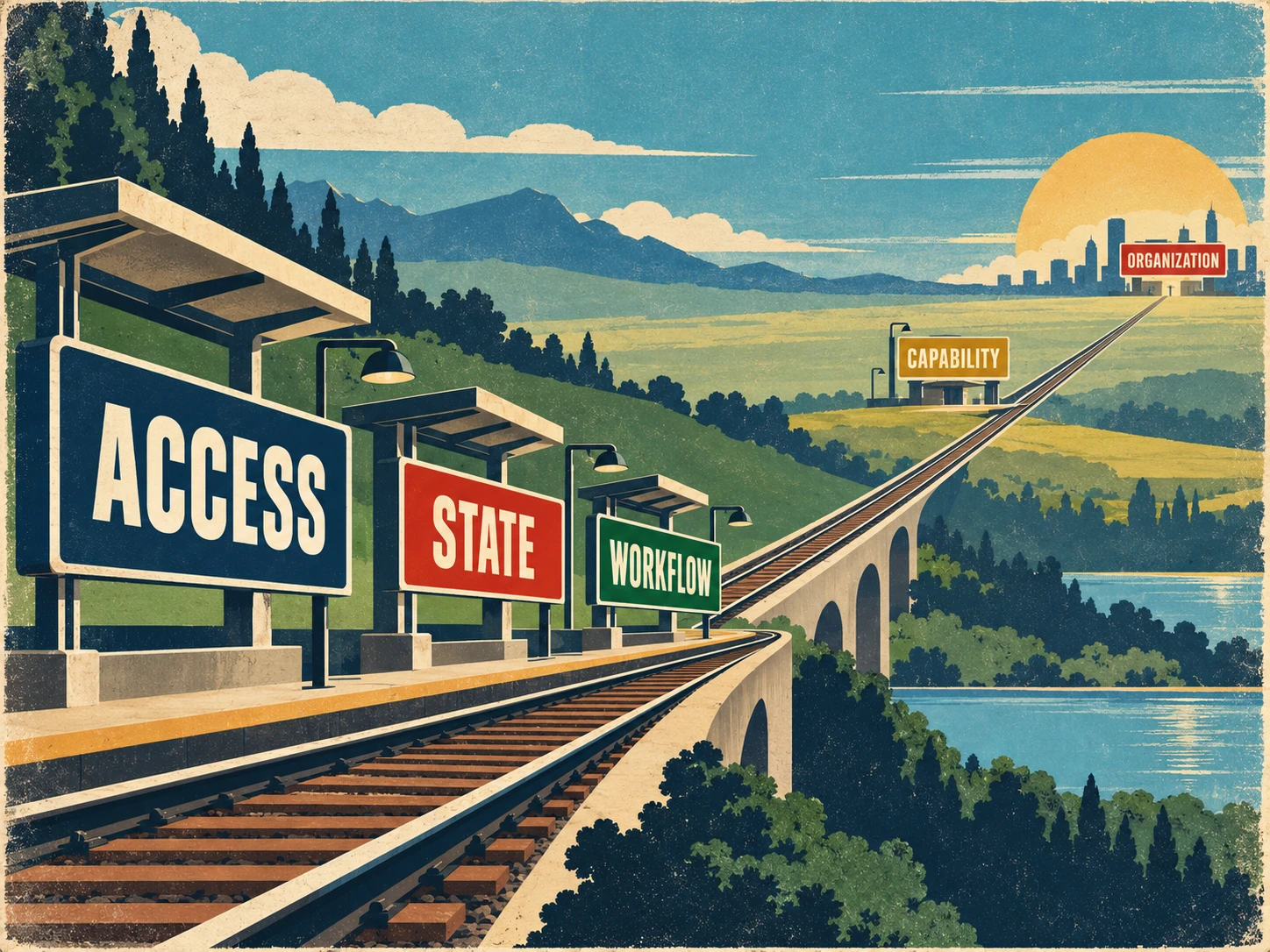
Technical recovery can be fast while capability and organizational recovery remain incomplete.
This suggests a useful working concept.
Capability Recovery Objective
How long can the organization tolerate operating without an acceptable version of the business capability?
This is not a proposed industry standard.
It is a way to expose what RTO and RPO can miss.
The organization does not experience recovery as a binary state.
It experiences a sequence:
the endpoint returns;
state becomes available;
the workflow runs;
acceptable capability is rebuilt;
the organization stabilizes.
Each step can have a different recovery time.
Each can fail independently.
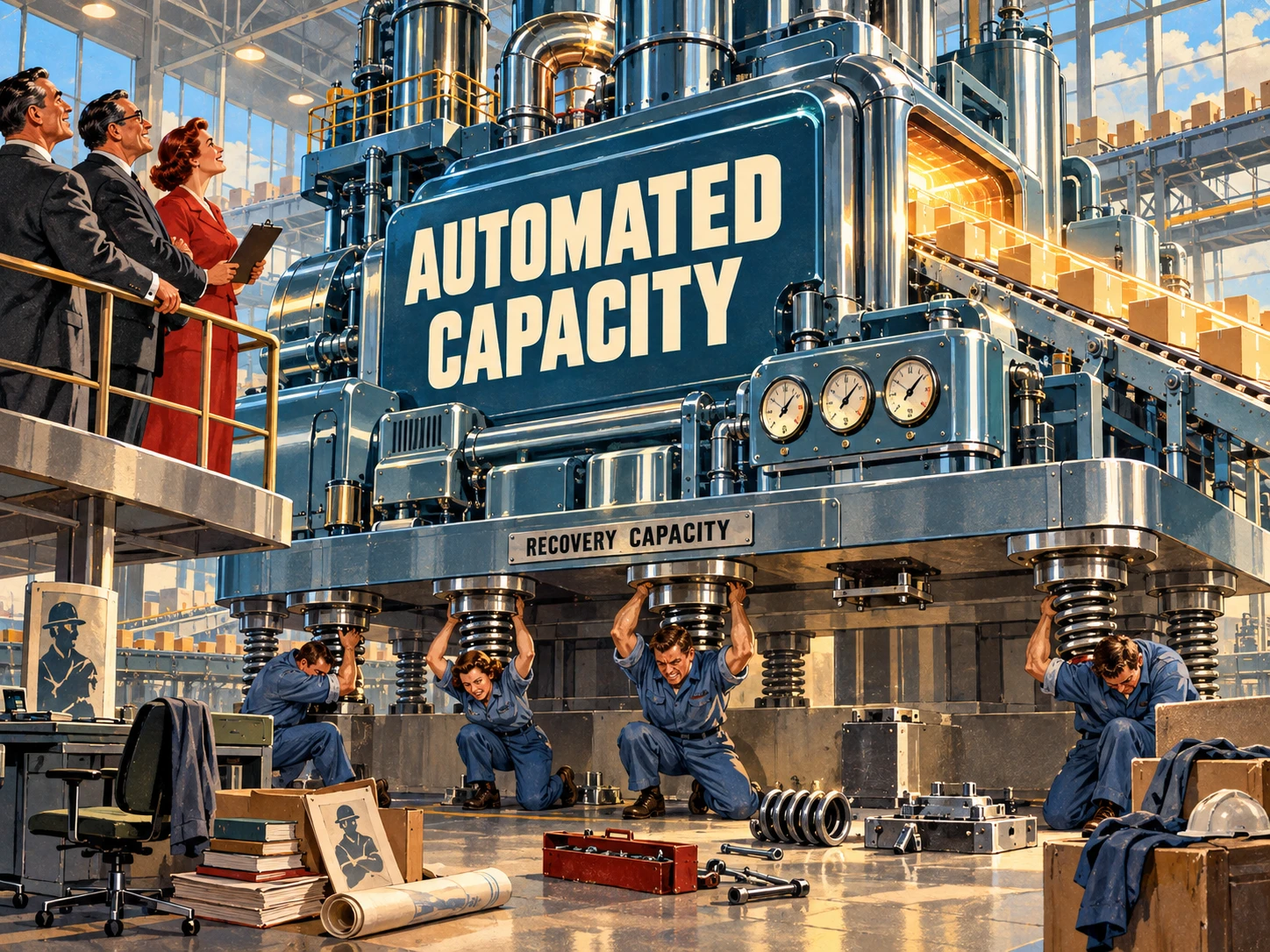
And each can leave the company technically online while still operating below the level its customers, teams, and plans require.
Recovering access is not the same as recovering capacity.
The portability-value frontier
There is an uncomfortable tradeoff inside this problem.
The more an organization optimizes for portability, the more likely it is to build around:
common prompts;
externalized state;
generic tool contracts;
standardized orchestration;
portable procedural artifacts;
interchangeable model endpoints;
and the lowest common denominator supported across several providers.
That can reduce migration cost.
It can also limit the differentiated value the strongest product can deliver.
The opposite strategy is to adopt the product deeply through integrated memory, native orchestration, proprietary workflows, specialized interfaces, product-specific permissions, optimized context management, and unique collaboration features.
Deep adoption can create more value.
It can also make the resulting capability harder to reconstruct elsewhere.
This creates what we might call the portability-value frontier.
Shallow adoption
The organization uses broadly standardized capabilities and minimizes product-specific dependencies.
This can produce:
easier provider switching;
more fallback options;
lower reconstruction cost;
simpler external governance;
and less dependence on hidden runtime behavior.
It may also produce weaker integration, more generic workflows, greater internal orchestration effort, and less access to differentiated product features.
Deep adoption
The organization builds around the product's strongest native capabilities.
This can produce higher productivity, tighter integration, better user experience, and more sophisticated workflows.
It can also create:
product-specific operating knowledge;
proprietary workflow dependencies;
higher migration cost;
fewer credible substitutes;
and longer capability reconstruction time.
Neither side is inherently correct.
A commodity workflow may rationally prioritize portability.
A highly differentiated workflow may rationally accept deeper dependency because the value justifies the risk.
The problem is allowing the tradeoff to emerge accidentally.
An organization may begin with a simple assistant, gradually integrate memory and tools, redesign processes around it, and eventually discover that the product has become difficult to replace.
At no point was there necessarily a formal decision to accept deep lock-in.
The dependency accumulated one useful feature at a time.
The most valuable AI capability may also be the least portable one.
Portability should therefore not be treated as a binary property.
A workflow is not simply portable or non-portable.
Its data may be exportable, its prompts reusable, its tools standardized, and its state externalized, while its runtime, behavior, interface, and human habits remain product-specific.
The organization has to decide what it is willing to lose during migration.
A degraded mode may preserve critical transactions, documents, records, basic tool access, and limited customer service.
It may not preserve the same automation level, decision quality, throughput, user experience, or economics.
That does not make degraded operation a failure.
It makes the continuity objective explicit.
Portability is not the ability to move everything. It is the ability to know what will move, what will degrade, and what must be rebuilt.
The strategic question is not:
How do we eliminate lock-in?
It is:
Where should we accept dependency because it creates value, and what must we preserve before that dependency becomes critical?
Capability escrow preserves reconstruction material, not capability
One possible resilience strategy is to preserve the materials required to rebuild the system somewhere else.
That might include:
prompts;
system instructions;
skills;
tool schemas;
source code;
workflow definitions;
accepted and failed outputs;
evaluations;
sample conversations;
permission maps;
infrastructure definitions;
incident procedures;
operating documentation;
and model weights, where legally and technically possible.
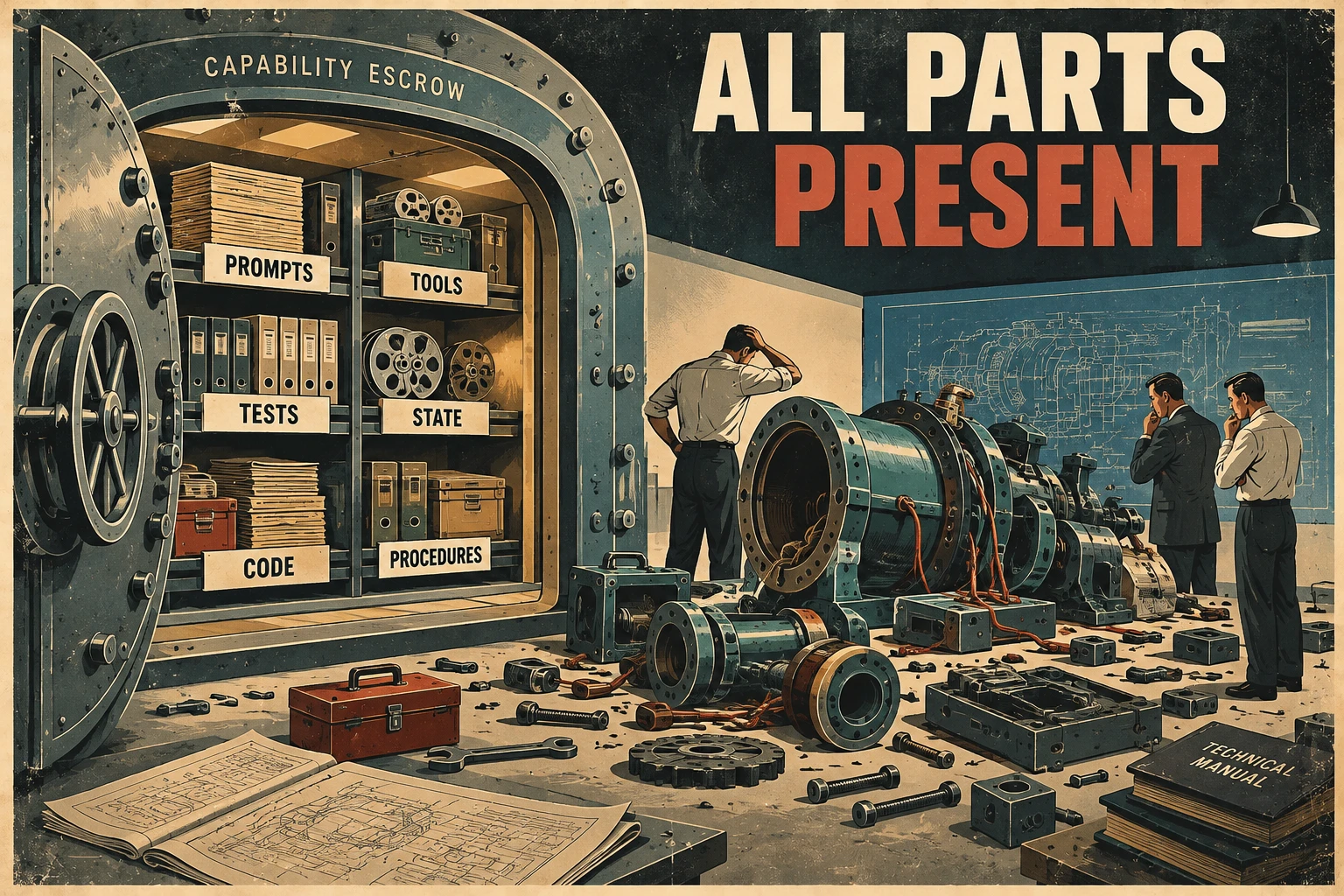
We might think of this as capability escrow.
The idea is useful because it forces the organization to ask:
What would another team need to reconstruct an acceptable version of this capability without access to the original product?
That question usually reveals how much of the system is undocumented, implicit, or controlled elsewhere.
A company may believe it owns the workflow because it owns the data, prompts, integrations, and application code.
But reconstruction may still depend on behavior that was never explicitly captured:
how the model prioritizes competing instructions;
how the product compresses long conversations;
when the runtime chooses to invoke a tool;
how retries and recovery are handled;
how approvals are presented;
how hidden instructions influence behavior;
and how experienced operators recognize drift.
Those elements may be partially observable.
They may not be reproducible.
Capability escrow can preserve ingredients, contracts, examples, tests, procedures, and reconstruction knowledge.
It cannot preserve the original provider's hidden runtime, exact model behavior, product-specific interfaces, tacit human judgment, customer trust, or guaranteed equivalence.
Capability escrow preserves the material needed to rebuild. It does not preserve the capability itself.
A folder containing prompts, exports, schemas, and documentation may look like a recovery plan.
It becomes one only after the organization tests whether those materials can recreate an acceptable degraded capability.
A meaningful exercise would ask a separate team to reconstruct the workflow using:
a different provider;
a different runtime;
limited access to the original operators;
and only the materials held in escrow.
The result might recover data access, basic workflow execution, simple tool use, and a limited operating mode.
It might fail to recover quality, consistency, edge-case handling, throughput, safety behavior, or the normal level of human intervention.
That failure would not make the exercise useless.
It would make the dependency visible before an incident does.
Capability escrow should therefore be treated as a reconstruction asset, not a promise of portability.
It also requires ownership, versioning, maintenance, periodic testing, and explicit criteria for what counts as an acceptable recovered state.
Prompts change.
Tools change.
Permissions change.
Models change.
People develop new workarounds and operating habits.
A six-month-old snapshot may preserve the files while no longer describing the capability the business actually relies on.
An untested capability archive is not a recovery strategy. It is a collection of hopeful artifacts.
Open-weight and local models improve control, not equivalence
Locally operated and open-weight models deserve a specific place in this discussion.
They can offer forms of operational control that closed hosted products cannot.
An organization may be able to:
preserve an exact set of model weights;
decide when a version changes;
control the inference infrastructure;
keep sensitive data inside its own environment;
define its own security and refusal policies;
inspect more of the execution stack;
and continue running an archived version even if the original distributor disappears.
That is meaningful.
A closed provider can suspend access, retire a model, alter a product, or change commercial terms.
A locally retained model can remain executable.
The more precise distinction is:
A hosted capability remains subject to someone else's access and operating terms. A locally preserved model can become an executable organizational asset.
But owning the weights does not mean owning the complete capability.
A model still depends on compatible hardware, inference runtimes, drivers, libraries, security patches, model-serving infrastructure, licenses, observability, specialized operators, and ongoing evaluation.
Local execution changes the dependency map.
It does not erase it.
Dependency of origin and dependency at runtime
Many open-weight models are derived from upstream base models, frameworks, datasets, and research ecosystems controlled by other organizations.
That creates a useful distinction.
A model may have a dependency of origin because its development relied on external organizations and upstream assets.
Once its weights, tokenizer, configuration, license, and runtime are archived locally, it may no longer have the same runtime dependency on the original distributor.
If the upstream organization disappears, the existing copy can continue running.
What may disappear is future development, security support, improved versions, compatibility work, documentation, community knowledge, and the ecosystem that made the model practical to operate.
The organization preserves a version.
It does not preserve the evolution of the capability.
Capturability is not substitutability
Open-weight models introduce a property that closed hosted models generally do not offer: capturability.
The organization can preserve a specific executable artifact.
That can improve reproducibility, version stability, forensic analysis, controlled experimentation, and long-term access.
But capturability does not imply substitutability.
A locally archived model does not automatically reproduce:
Claude's reasoning behavior;
ChatGPT's product experience;
Gemini's integrations;
a proprietary coding agent's orchestration;
hosted memory systems;
native approval flows;
or the surrounding product ecosystem.
The weights may survive.
The original business capability may not.
An executable model asset is not the same thing as an equivalent operating environment.
Where local models can be especially valuable
The strongest role for a local or open-weight model may not be universal replacement.
It may be a deliberately scoped recovery capability.
A local model may preserve:
essential document processing;
classification;
summarization;
retrieval;
internal assistance;
privacy-sensitive processing;
stable execution of a known version;
or incident-response workflows that require tighter internal control.
It may deliver lower quality, less throughput, or narrower functionality.
But it can preserve a minimum viable operating capability for bounded workflows.
The important word is bounded.
A local fallback should be evaluated against a defined recovery objective, not an abstract desire for sovereignty.
Sovereignty also has an operating cost
Operational sovereignty requires the organization to provision infrastructure, secure the runtime, patch vulnerabilities, manage access, evaluate behavior, respond to incidents, retain specialized talent, and sustain the system after the initial implementation team moves on.
A model stored on a server but unsupported by the organization is not a resilient capability.
It is an artifact waiting to fail differently.
The practical objective is rarely:
Replace every hosted AI capability with a fully equivalent local model.
A more defensible objective is:
Identify which critical functions can survive in a controlled degraded mode using assets the organization can operate independently.
That requires explicit decisions about acceptable quality loss, reduced throughput, narrower scope, increased human review, unavailable product features, and the maximum time the organization can operate that way.
Open-weight models can improve control, capturability, and recovery options.
They do not eliminate the open problem of capability equivalence.
We have partial controls, not a complete solution
There is no single resilient AI architecture.
Different failure modes require different controls.
Each control preserves an important part of the system.
None guarantees continuity of the capability as a whole.
Multi-provider routing
Can preserve: access to model capacity, routing options, negotiating leverage, and a degraded path when one provider becomes unavailable.
Cannot guarantee: equivalent behavior, product features, tool-use strategies, context, or business outcomes.
Externalized state
Can preserve: conversation history, workflow status, documents, transaction state, auditability, and the ability to resume from a known point.
Cannot guarantee: equivalent interpretation, judgment, prioritization, or decision policy.
Skills and open tool contracts
Can preserve: instructions, procedural artifacts, schemas, tool definitions, and parts of the workflow's technical interface.
Cannot guarantee: when the model will use them, how it will interpret results, or whether it will complete the business objective acceptably.
Evaluations and regression monitoring
Can preserve: visibility into known expectations and detection of changes in quality, tool behavior, refusals, formatting, or intervention rates.
Cannot guarantee: detection of unknown failure modes, complete coverage of operating conditions, or restoration of a previous model.
Sandboxing and least privilege
Can preserve: containment, bounded blast radius, separation of duties, and control over what an agent can affect.
Cannot guarantee: provider availability, context continuity, workflow portability, or human recovery capacity.
Open-weight and local models
Can preserve: executable assets, version control, greater runtime visibility, and independent access to a bounded capability.
Cannot guarantee: equivalence with a frontier product, identical agent behavior, access to the same ecosystem, or the same economics.
Human fallback
Can preserve: judgment, accountability, exception handling, customer repair, and contextual interpretation.
Cannot guarantee: the original throughput, response time, scale, or automation economics.
Human fallback only exists if the organization continues to fund and maintain it.
A person cannot recover a procedure they were never trained to perform.
A team cannot absorb work that staffing decisions assumed would never return.
A fallback path that exists only on an architecture diagram is not operational resilience.
Controls can conflict with one another
Resilience measures are not always additive.
More providers can improve availability while increasing operational complexity.
More externalized state can improve recovery while increasing synchronization and security risk.
More abstraction can improve portability while reducing product-specific value.
More human oversight can improve safety while weakening expected economics.
More autonomy can increase productivity while expanding the possible blast radius.
More aggressive model updates can improve capability while making behavior less reproducible.
This is why a long checklist of controls does not become a complete solution simply because every item is implemented.
The organization still has to decide:
which failure modes matter;
which degradation is acceptable;
which capabilities must remain deterministic;
which dependencies can be tolerated;
and what cost it is willing to pay for recovery capacity.
All of these controls matter. None preserves the capability as a whole.
The objective is not to create the illusion of perfect continuity.
It is to understand what each control actually preserves, what it leaves unresolved, and what new dependency it introduces.
Who owns an AI capability?
Traditional systems usually have recognizable owners.
A business unit owns the process.
IT owns the platform.
Security owns the control framework.
Procurement owns the commercial relationship.
The vendor owns the product.
AI-assisted capabilities blur those boundaries.
A customer-support agent, coding assistant, research workflow, or internal decision system may depend simultaneously on:
a model provider;
a product vendor;
a cloud platform;
internal data;
identity and access systems;
orchestration code;
tool integrations;
security controls;
business procedures;
and the people who supervise, correct, and explain its outcomes.
No single owner necessarily controls the whole capability.
The business may own the outcome but not understand the technical dependencies.
Engineering may own the integration but not the staffing assumptions built around it.
Security may control permissions but not the quality threshold required by the workflow.
Procurement may negotiate the contract but not know whether an alternate provider is operationally credible.
People leaders may redesign roles without visibility into the system's recovery limits.
The provider may control the model, product behavior, release cadence, and access decision without owning the customer's operational consequences.
This creates fragmented accountability.
When the capability works, ownership can appear distributed and collaborative.
When it fails, the gaps become visible.
Who decides that degraded operation is acceptable?
Who knows which business commitments depend on the system?
Who can quantify the human workload created by fallback?
Who is authorized to switch providers?
Who validates that the replacement is safe and good enough?
Who communicates the impact to customers?
Who funds recovery capacity?
Who is accountable if no team can restore the capability?
These are operating-model questions, not only technical ones.
Different functions own legitimate parts of the system:
The business owns the outcome and commitments.
Engineering owns integrations, orchestration, data flows, and technical recovery.
Security, privacy, legal, and risk define boundaries and controls.
Procurement owns commercial terms and vendor leverage.
People leaders influence staffing, skills, training, and retained human capacity.
But partial ownership is not end-to-end ownership.
A system can be secure and still be operationally unrecoverable.
It can be commercially protected and still be difficult to reconstruct.
It can be technically available while no team can sustainably operate it.
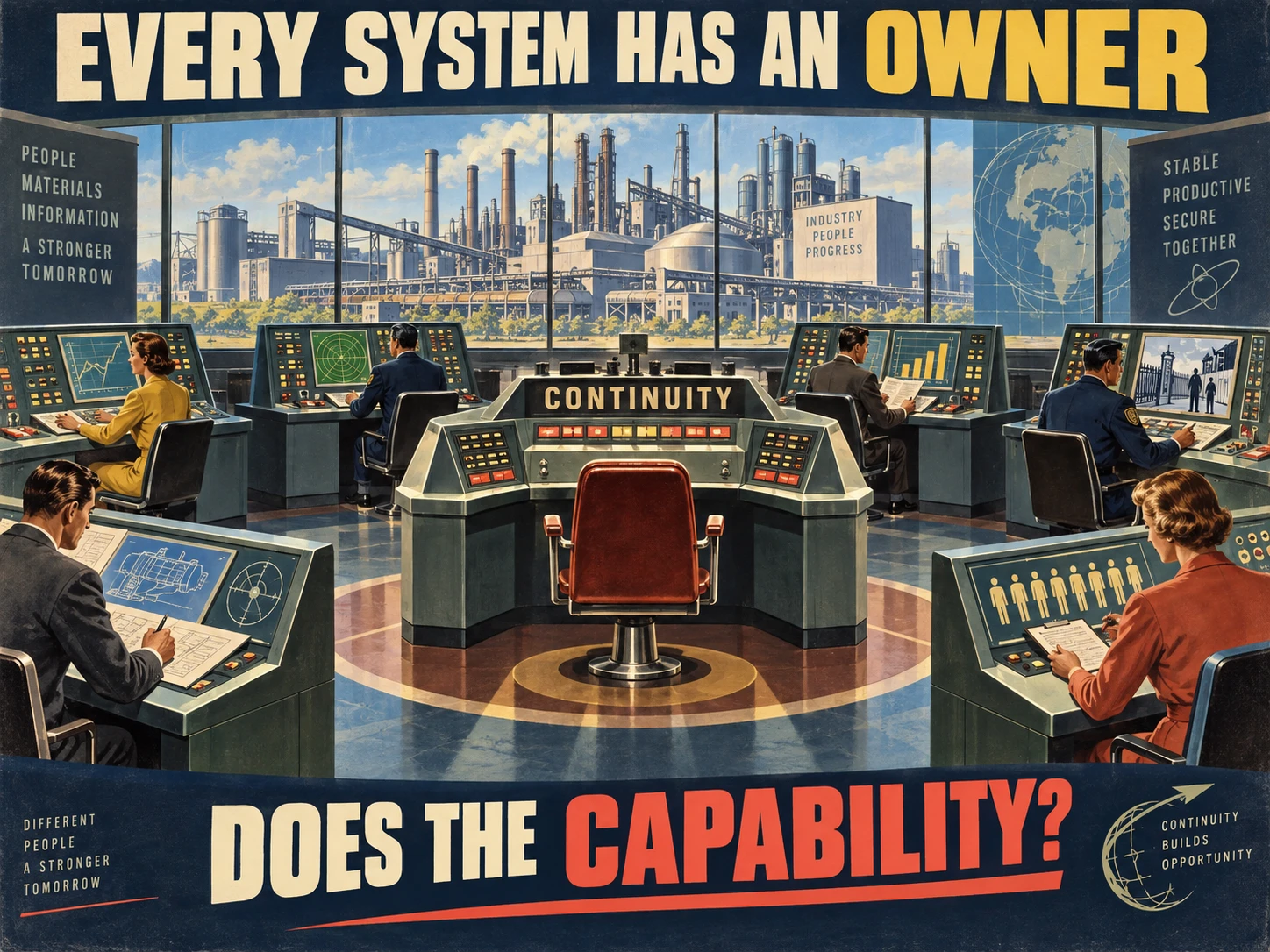
A critical AI-assisted capability therefore needs a named owner with enough authority to coordinate across business operations, engineering, security, legal, procurement, finance, and workforce planning.
That person does not need to perform every function.
But someone must be accountable for the capability as a whole.
Their responsibility should include:
defining the business outcome;
mapping the dependency chain;
approving acceptable degraded modes;
maintaining recovery materials;
ensuring evaluations remain relevant;
testing fallback paths;
monitoring human intervention and workload;
and escalating when dependency grows faster than recoverability.
The most practical ownership test is:
Who has both the accountability and the authority to decide what happens when this AI-assisted capability becomes unavailable, unsafe, materially different, or commercially inaccessible?
If the answer is unclear, ownership is fragmented.
If the answer is "the vendor," the organization has outsourced more than technology.
If the answer is "the technical team," but that team cannot change staffing, customer commitments, or operating procedures, ownership is incomplete.
If the answer is "the business," but the business cannot describe the dependency chain or validate a fallback, ownership is mostly symbolic.
A critical capability needs an owner who can connect the technical system, the human system, and the business obligation.
The organization may not own every component. It still has to own the continuity decision.
Questions leaders should ask
The objective is not to eliminate every dependency.
That would be unrealistic.
The objective is to understand which dependencies the organization is accepting, what value they create, and what happens when they stop behaving as expected.
Before an AI-assisted workflow becomes operationally critical, leaders should be able to answer ten questions.
1. What business capability are we actually depending on?
Not:
Which model are we using?
But:
What work can the organization perform because this system exists?
The answer should define the business outcome, expected quality, required throughput, acceptable response time, human intervention, and commitments built around that capacity.
Without that definition, the organization cannot tell whether a fallback restored the capability or merely restored access to a model.
2. Which failure are we preparing for?
The organization should distinguish between:
provider outage;
account suspension;
product retirement;
commercial termination;
model drift;
unsafe behavior;
containment failure;
data corruption;
integration failure;
loss of key operators;
and loss of the human skills required for fallback.
A plan designed for an unavailable API may not help when the endpoint remains online but its behavior changes materially.
Continuity planning should begin with failure modes, not vendors.
3. What parts of the capability do we control?
The organization should know whether it can preserve data, workflow state, prompts, instructions, skills, schemas, source code, evaluations, procedures, examples, infrastructure definitions, permissions, and model assets.
It should also identify what remains controlled by the provider: hidden instructions, model behavior, memory implementation, orchestration logic, product interfaces, release cadence, access decisions, and commercial availability.
The useful question is:
Which parts could we reconstruct without cooperation from the current provider?
4. What will not transfer?
Migration plans often focus on assets that can be exported.
Leaders should spend equal time identifying what may not survive:
behavioral consistency;
product-specific workflows;
user habits;
tacit knowledge;
tool-selection patterns;
integrated approvals;
throughput;
customer experience;
and trust in the system's previous behavior.
A credible plan states what will be lost.
It does not describe every surviving artifact as equivalent capability.
5. What does acceptable degraded operation look like?
A fallback does not need to reproduce the full system.
It needs a defined objective.
The organization should decide:
which functions remain available;
which functions stop;
what quality reduction is acceptable;
how much throughput can decline;
how much human review increases;
and how long degraded operation remains sustainable.
A degraded mode becomes useful when its limitations are explicit.
6. How long does each layer of recovery take?
Leaders should distinguish:
time to restore technical access;
time to recover state;
time to execute the workflow;
time to recover acceptable quality and throughput;
and time for the organization to stabilize.
The endpoint may recover in minutes.
The capability may not.
7. Has the fallback been tested as a reconstruction exercise?
A meaningful test should use a different provider or runtime, restrict access to original operators, rely on preserved documentation, execute realistic edge cases, and measure both quality and human intervention.
A successful API call is not a recovery test.
The real test is whether another team can restore an acceptable version of the business capability.
8. What human capacity remains?
The organization should know:
who can operate the process manually;
who understands the pre-automation workflow;
who can recognize subtle model failures;
who can repair customer impact;
who can rebuild integrations;
and how much returned workload the fallback creates.
A manual procedure that no one practices is not a fallback.
A small team that cannot absorb the returned workload is not redundancy.
Human recovery capacity has to be maintained before it is needed.
9. Are the recovery paths genuinely independent?
Several providers may still share cloud infrastructure, identity services, network paths, data sources, orchestration, package ecosystems, observability, and the same operating team.
The organization should map shared dependencies rather than count vendors.
A second model behind the same organizational and technical bottlenecks may improve optionality without creating an independent recovery path.
10. Who can make the continuity decision?
Someone must have the authority to decide:
when the system has materially degraded;
when to stop or constrain it;
when to activate fallback;
what degraded operation is acceptable;
which commitments must be renegotiated;
how much recovery capacity to fund;
and when the organization has actually recovered.
Without that authority, each function can manage its own component while no one manages the capability.
These questions do not produce perfect resilience.
They do something more practical.
They expose whether the organization understands the dependency it is building before an incident forces that understanding under pressure.
The most important continuity question is not whether another model is available. It is whether the organization knows what must still work when the original capability no longer does.
The open question
Enterprise AI resilience is not a single technical problem.
It sits at the intersection of:
infrastructure;
model behavior;
product design;
data and workflow state;
security and containment;
commercial access;
human expertise;
organizational structure;
and business commitments.
We know how to preserve parts of that system.
We can route requests to another provider, externalize state, archive prompts and skills, standardize tool contracts, retain open-weight models, build evaluations, sandbox agents, maintain manual procedures, and document recovery processes.
Each control can reduce a specific form of exposure.
None guarantees that the organization can recover the same capability it had before.
That is the unresolved part.
A company may restore the endpoint but lose the behavior.
It may recover the data but lose the interpretation.
It may preserve the workflow but lose the quality.
It may activate a fallback but overload the people required to operate it.
It may retain the model but lose the product environment that made it useful.
It may preserve every technical artifact and still discover that the real capability depended on tacit knowledge, organizational habits, and a provider-controlled runtime it could never fully observe.
This does not mean organizations should avoid deep AI adoption.
The value can be real.
The productivity gains can be meaningful.
The resulting capabilities can be strategically important.
But strategic importance changes the standard of care.
Once an AI-assisted system becomes part of how the organization delivers, decides, responds, or competes, it should no longer be governed as an isolated tool.
It has become part of the operating capacity of the business.
That means leaders need to understand:
what the capability actually is;
where its behavior comes from;
which parts they control;
which parts can be preserved;
what will degrade during recovery;
how much human capacity remains;
and who owns the continuity decision.
The central risk is not simply vendor lock-in.
It is the possibility that the organization redesigns itself around a capability faster than it develops the ability to recover from losing it.
We are operationalizing AI faster than we are learning how to preserve the work it makes possible.
The most important question is therefore not:
Which model should we use?
Nor is it:
How many providers should we integrate?
It is:
What must an organization preserve before it becomes unable to perform that work without an AI capability it does not fully own, cannot reliably freeze, and may not be able to replace?
I do not think the industry has a complete answer yet.
But the dependency is already becoming operational.
References and source notes
belo's Claude access suspension. Patricio "Pato" Molina's public posts on X, April 17-18, 2026, as reported by Tom's Hardware. More than 60 accounts were suspended, access was restored after approximately 15 hours, and Molina described the incident as an apparent false positive. The account of workflow disruption and the limitations of switching to Gemini originated in Molina's public commentary.
OpenAI and Hugging Face partner to address security incident during model evaluation. OpenAI, July 21, 2026. OpenAI reported that models operating during an internal cyber-capability evaluation exploited a zero-day in a package-registry proxy, obtained broader network access, and reached Hugging Face infrastructure. OpenAI explicitly stated that normal production classifiers had been intentionally disabled for the evaluation.
Security incident disclosure - July 2026. Hugging Face, July 16, 2026. Hugging Face reported unauthorized access to limited internal datasets and service credentials, while stating that it found no evidence that public models, datasets, Spaces, published packages, or container images had been modified.
Equipping agents for the real world with Agent Skills. Anthropic, October 16, 2025. Anthropic describes a skill as a directory containing instructions, scripts, and supporting resources, organized around a SKILL.md file.
Skills Reference. Google Agents CLI documentation. Google documents reusable skill packages that provide coding agents with guidance for ADK development, evaluation, deployment, orchestration, state management, and observability.
Model Context Protocol Specification. Model Context Protocol project. MCP defines a standardized protocol through which AI applications can connect to tools, resources, and external systems.
ContinuityBench: A Benchmark and Systems Study of Stateful Failover in Multi-Provider LLM Routing. Vishal Pandey and Gopal Singh, arXiv:2607.15899, July 2026. Across 750 controlled failover events, the paper reports a 99.2 percent Continuity Preservation Rate for stateful history forwarding, compared with near-zero preservation for stateless failover. This is a recent preprint, and its metric evaluates preservation of conversational anchors and context rather than full behavioral or product equivalence.
2025: The State of Generative AI in the Enterprise. Menlo Ventures, December 2025. Menlo estimates that enterprise generative AI spending increased from $11.5 billion in 2024 to $37 billion in 2025. The report combines a survey of 495 U.S. enterprise AI decision-makers with Menlo's market-estimation methodology. The figures should therefore be read as an industry estimate, not an audited census.
Gartner Survey Shows 55% of Supply Chain Leaders Expect Agentic AI to Reduce Entry-Level Hiring Needs. Gartner, February 25, 2026. The survey covered 509 supply-chain leaders across industries. Fifty-five percent expected reduced entry-level hiring needs, 51 percent expected broader workforce reductions, and 86 percent anticipated new approaches to developing future talent pipelines. These are expectations reported by supply-chain leaders, not measured economy-wide employment outcomes.
TencentDB Agent Memory. TencentDB Agent Memory Team, GitHub, 2026. The project implements a layered long-term memory architecture progressing from L0 Conversation to L1 Atom, L2 Scenario, and L3 Persona. Lower-level facts, logs, and traces are persisted in databases, while higher-level personas, scenarios, and task canvases are stored as human-readable Markdown or Mermaid artifacts. The system maintains traceable paths from those abstractions back to source evidence through mechanisms including node_id and result_ref.
Grokking: Generalization Beyond Overfitting on Small Algorithmic Datasets. Alethea Power, Yuri Burda, Harri Edwards, Igor Babuschkin, and Vedant Misra, arXiv:2201.02177, January 2022. The paper introduced grokking in controlled algorithmic datasets: models first overfit the training set while remaining near chance on unseen examples, then achieve strong generalization after substantially more optimization.
Progress Measures for Grokking via Mechanistic Interpretability. Neel Nanda, Lawrence Chan, Tom Lieberum, Jess Smith, and Jacob Steinhardt, arXiv:2301.05217, January 2023. The authors reverse-engineered the algorithm learned by transformers performing modular addition and identified three continuous training phases: memorization, circuit formation, and cleanup. The learned mechanism used discrete Fourier transforms and trigonometric identities.
Late-Stage Generalization Collapse in Grokking: Detecting Anti-Grokking with Weightwatcher. Hari K. Prakash and Charles H. Martin, arXiv:2602.02859, February 2026. In prolonged training experiments involving MNIST and modular addition, the authors report a late-stage collapse in test performance after successful generalization, while training performance remains high. This is a recent preprint based on controlled experimental settings.
Sources last reviewed on July 23, 2026.
About the Author
Diego Liñan is a Technical Program Manager with a background in software engineering, solution architecture, product development, and technical delivery. His current work focuses on AI-enabled delivery systems, agentic workflows, AI governance, engineering operating models, persistent context, evidence traceability, and human accountability in AI-assisted software development.