Operational AI Literacy #01 - What happens when the conversation continues but the world doesn't wait
Evidence reviewed through September 7, 2026.
Once upon a time in the future, this article was completely useless.
I hope so.
Because parts of what follows are already being engineered away.
But as of September 7, 2026, there is a peculiar assumption hiding inside a lot of professional AI use.
You open a conversation on Friday.
You work for hours.
You come back Monday.
The conversation is still there. Enough continuity survives for the interaction to feel resumed. The system may remember the project, the decisions, your preferences, the files you were discussing.
So naturally, almost invisibly, you assume something else survived too:
The weekend happened.
That turns out to be a much more interesting assumption than it sounds.
"I use AI." Good. How?
There is a meaningful difference between:
"I ask ChatGPT questions."
and:
"I have been working inside the same persistent AI conversation for three weeks."
Throughout this piece, I use persistent conversation somewhat loosely.
Sometimes that means literally resuming the same thread.
Sometimes it means a product carrying conversational context, memory or prior work across sessions or chats.
Those are different mechanisms.
They create a similar user expectation:
continuity.
And that kind of use is increasingly supported and encouraged.
OpenAI describes Projects as spaces for work that continues over time.¹ Anthropic describes Cowork threads as a "single persistent thread", the "same conversation, same context", and explicitly tells users they can "pick up where you left off."² Gemini can draw on past chats.³ Perplexity has built persistence and memory into its products.⁴
That does not mean the entire visible transcript is necessarily sitting inside the model's context window every time you type.
It does not mean every connector refreshed while you were away.
It does not mean every old observation has been revalidated.
And it certainly does not guarantee that every layer underneath the chat shares the same representation of time.
But persistence strengthens the expectation of continuity.
The interface says: continue.
The harder question is what, exactly, continued.
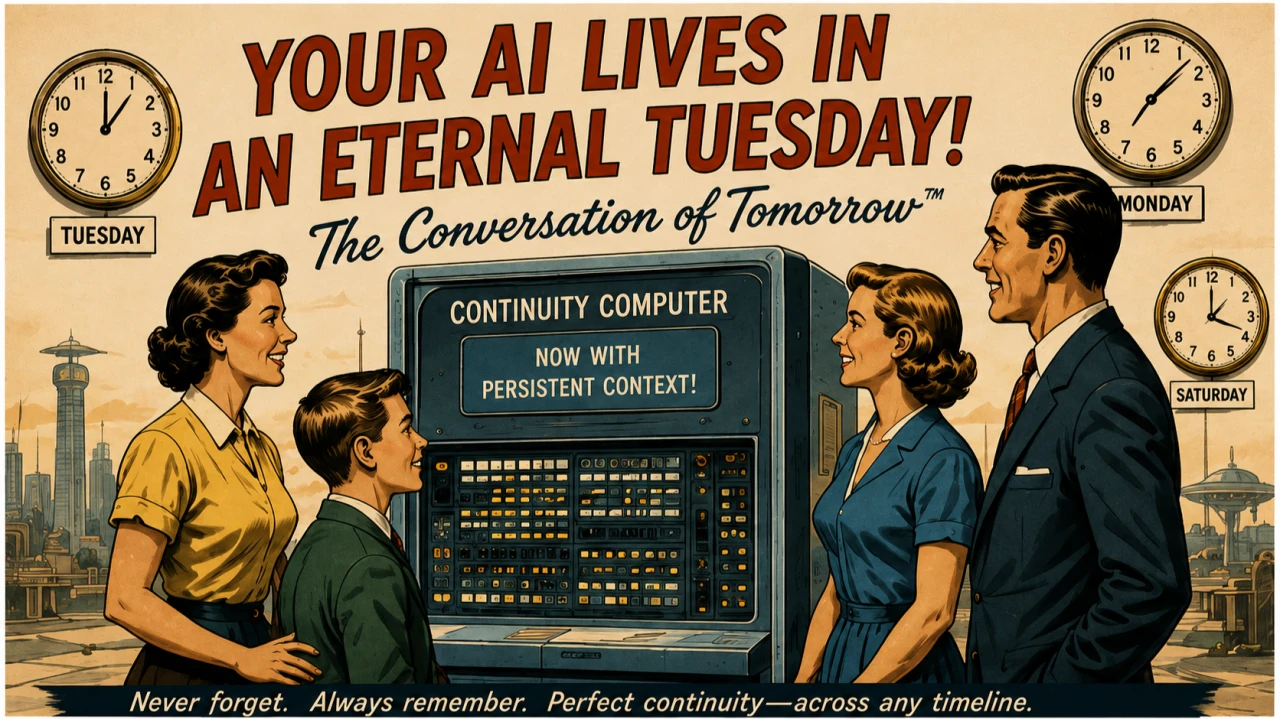
Welcome to Eternal Tuesday
The interesting failure is not simply:
"The model got the date wrong."
Models get things wrong.
The more peculiar case is when a conversation remains coherent while its temporal frame does not.
The project still makes sense.
Previous decisions still make sense.
The system still appears to know where everyone left off.
And somewhere inside that otherwise convincing continuity, Friday survives into Monday.
I call that surface symptom:
Eternal Tuesday.
Not a technical diagnosis.
Not one underlying mechanism.
A name for what several different failures can look like from the chat window.
That distinction matters, because the obvious explanation is:
The AI doesn't know what time it is.
Sometimes the product-level failure really is almost that simple.
Sometimes it very much isn't.
Saturday survived until Monday
One of the cleanest examples I found appeared in Cursor's community forum in March 2026.
A user started an agent conversation on Saturday.
They returned Monday and asked about the stock market.
The agent continued reasoning as though it were Saturday and therefore treated the market as closed.⁵
Normally, a bug report like that gives us an observation and several competing theories.
This one gave us something better.
A Cursor staff member responded that, at the time, current date and time were not being passed to the agent prompt.
For once, the implicated layer was unusually clear.
The product harness simply wasn't exposing the relevant temporal signal to the agent.
The user knew Monday.
The agent prompt did not.
Product state is not automatically model-visible state.
This is why phrases like "the AI has no clock" are intuitively useful and technically dangerous.
There are several systems hiding behind the thing we casually call "the AI."
The host can know something.
Stored conversation data can contain something.
The prompt assembled for the next turn can expose something.
And the model can then use, ignore or misinterpret whatever it receives.
So the easy fix appears obvious.
Give the agent the date.
Except that date availability solves only one part of the problem.
Knowing today's date does not tell you when the previous message happened
Consider two facts:
Today's date is 2026-07-21.
and:
That proposal was discussed 31 minutes ago.
The first does not imply the second.
Anthropic documents current-date injection for claude.ai and its mobile apps through the system prompt.⁶ Those documents do not automatically describe Claude Code, Cowork or API runtime behavior.
Separately, Claude Code users have requested model-visible timestamps on conversation messages, arguing that conversational context may otherwise fail to expose enough information to distinguish recent turns from much older ones.⁷
Those are user-authored feature requests, not Anthropic documentation of Claude Code's architecture.
But the distinction itself is straightforward:
current date and per-message temporal metadata are different information.
A July Claude Code report illustrates why that can matter.
A user reported Fable 5 referring to a same-session discussion from roughly 30 minutes earlier as:
"yesterday's discussion"
despite the correct current date appearing in the reported context. After being challenged, the transcript shows Claude checking the clock and correcting itself.⁸
The report is intermittent and does not establish a mechanism.
It does not need to.
Knowing "now" does not necessarily tell the system when everything in its retained context happened.
Unfortunately, part of this has a name
Temporal reasoning in language models is not a 2026 discovery.
TimeDial exposed substantial gaps between humans and models on temporal commonsense in dialogue in 2021.⁹ TimeBench broadened temporal-reasoning evaluation in 2024.¹⁰ Other research has investigated temporal ordering, duration and event relations.
But one 2026 paper gets unusually close to the operational question behind Eternal Tuesday.
Cheng and colleagues call the phenomenon they study temporal blindness.
Their benchmark is called TicToc.¹¹
And importantly, TicToc does not mainly ask:
"What day is it?"
It does not mainly test calendar trivia.
It does not simply test whether a model can subtract timestamps.
It asks something much more useful.
Suppose an AI agent obtained information from an external tool.
Real time passes.
Another relevant request arrives.
At what point should the agent stop trusting the earlier observation and call the tool again?
A flight status.
A restaurant wait.
A server metric.
A stock price.
A relatively stable fact.
Different information has different temporal sensitivity.
So the question is not:
"Did time pass?"
Of course it did.
The question is:
Did enough relevant time pass that the previous observation should no longer be reused without checking?
The researchers built 76 scenarios and evaluated 18 proprietary and open-weight models against human preferences about whether to answer directly or call the tool again.
When timestamp information was available, no tested model exceeded 65% normalized alignment with those human preferences.¹¹
That number is not "65% time awareness."
It is not a general reasoning score.
And the benchmark is not comparing the models with some universal external ground truth.
TicToc uses designed scenarios and human judgments about appropriate tool use. Its target scenarios also assume a particular kind of staleness: a longer gap should not reverse a preference from checking again back toward blindly reusing the old result.
That is appropriate for the problem it sets out to measure.
It is not a universal law.
Processes can finish.
Markets can close.
Deadlines can expire.
Old state can become irrelevant.
TicToc is also deliberately synthetic. The researchers designed scenarios and exemplars, generated candidate multi-turn trajectories and then filtered and validated them.
That gives us controlled experimental evidence, not naturalistic production telemetry.
Important difference.
Not a reason to discard the benchmark.
Fine. We'll tell you exactly how much time passed.
There is an obvious objection to timestamps.
Maybe the model sees:
14:03:19
17:41:52
and just isn't reliably doing the arithmetic.
Fair enough.
So TicToc's authors tried taking the arithmetic away.
The host directly supplied Δt, the elapsed interval.
Conceptually:
2 minutes passed.
or:
8 hours passed.
No timestamp subtraction required.
For most tested models, explicit Δt did not increase alignment over absolute timestamps alone.
For the few that improved, the gains were only around one to four percentage points.¹¹
That sounds devastating until you overinterpret it.
So let's not.
It does not mean timestamps are useless.
It does not mean models cannot represent elapsed time.
It does not mean explicit temporal feedback is generally ineffective.
And it does not mean prompting cannot help.
TicToc itself contains counterevidence to those interpretations.
Structured few-shot guidance substantially improved some advanced reasoning models, particularly o3 and o4-mini. Targeted post-training produced much larger improvements in trained open models.¹¹
The interesting result is narrower:
Knowing how much time passed is separable from knowing what that passage of time should make you do.
In its controlled synthetic tool-use scenarios, TicToc separates availability of temporal information from alignment with human judgments about an elapsed-time-sensitive action policy.
That's much more useful than teaching a chatbot to say Tuesday.
Conversation order preserves sequence. It does not necessarily preserve elapsed time.
What TicToc shows, and what it doesn't
The experimental claim is narrow:
reuse previously obtained information vs call the tool again.
TicToc demonstrates a problem in that particular kind of elapsed-time-sensitive decision.
The broader systems implication is different.
Persistent professional workflows create many other places where the same separation between sequence, elapsed time and current evidence may matter.
Tickets.
Deployments.
Branches.
Documents.
Approvals.
Calendars.
External systems.
TicToc does not experimentally validate every one of those cases.
It gives us a reason to ask the question.
That distinction matters.
And here's where "temporally blind" gets dangerous
There is a nice headline hiding in the idea that language models simply cannot perceive time passing.
Unfortunately, research has already ruined it.
Which is good.
In "Discrete Minds in a Continuous World: Do Language Models Know Time Passes?", Wang and colleagues tested whether models could develop proxies for physical duration and modify their behavior under time pressure.¹²
They found evidence that some models can.
The authors propose a Token-Time Hypothesis.
Roughly, properties of the token stream may act as proxies for physical duration.
They also found models adapting response length to urgency and changing behavior under progressive time pressure.
The capability varied by model and task.
That is not what a system with absolutely no temporal adaptation should look like.
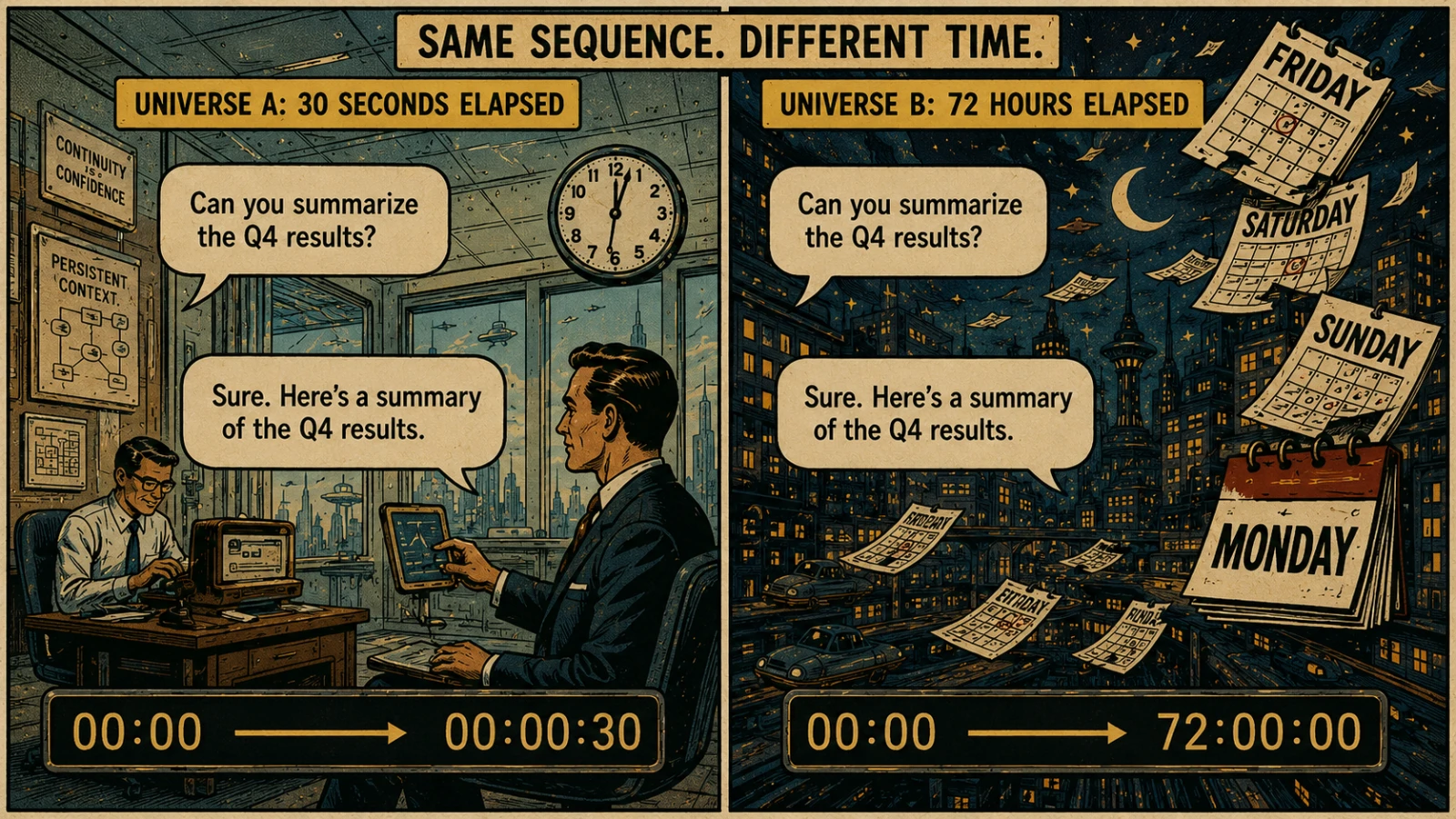
But it also does not establish that a model can distinguish:
last user message 30 seconds ago
from:
last user message 72 hours ago
after 72 hours of idle time if nothing representing that gap reaches the model.
Different problem.
Another 2026 study provides even stronger counterevidence against simplistic conclusions.
In the controlled preprint study currently listed by arXiv as "Real-Time Deadlines Reveal Temporal Awareness Failures in LLM Strategic Dialogues", researchers put models into negotiations with actual real-time deadlines.¹³
GPT-5.1 performed badly when it only received the deadline at the start.
Then the researchers explicitly told it how much time remained at each turn.
Deal closure jumped from 4% to 32%.
Offers became more than six times as likely to be accepted.
Under turn-based rather than wall-clock limits, the same model achieved at least 95% closure.
So:
Explicit temporal feedback can matter enormously.
That does not contradict TicToc.
It tells us something more interesting.
"Temporal reasoning" is not one capability.
"Time awareness" is not one switch.
In one setting, explicit temporal state dramatically changes strategy.
In another, explicit elapsed time still does not reliably produce the benchmark-preferred decision about whether information should be refreshed.
Both can be true.
The useful question is therefore not:
Can an LLM ever react to time?
Clearly, yes.
The question is:
Does this particular system have the temporal information relevant to this particular state, and does that information produce the behavior this particular decision requires?
Less mystical.
More annoying.
Much more useful.
Conversation distance is not elapsed time
TicToc found another curious effect.
Conversation length itself could influence tool-calling behavior.
That raises a plausible heuristic:
many turns happened → maybe a lot of time passed → maybe old information is stale.
Sometimes that will accidentally work.
But twenty turns can happen in ten minutes.
Two adjacent messages can be separated by a weekend.
A conversation has order.
Real life has duration.
Those are related.
They are not interchangeable.
Conversation distance is not elapsed time.
A large context window does not solve that by itself.
It can preserve an enormous amount of sequence.
It does not inherently encode an idle gap during which no conversational tokens existed at all.
A longer gap can change the decision without making the old fact false
Imagine this:
"The deployment is still failing. Let's check again later."
Then:
"I'm back. Should we check?"
The second message could arrive thirty seconds later.
Five hours later.
Five days later.
The transcript ordering is identical.
The appropriate decision may not be.
But:
may not be.
Five days do not automatically make every old assumption false.
The deployment could still be failing.
The environment might be frozen.
A process may even have hard temporal boundaries that make its later state more predictable.
Elapsed time does not monotonically rot reality.
What a longer gap can change is whether another check is warranted.
Time can make an old observation worth questioning.
It cannot make the new observation for you.
The reports get stranger when conversations survive longer
On August 12, a Claude Code/Cowork user reported reopening work after 83 days.¹⁴
According to the issue, the current <env> date showed August 12.
The reporter also showed a shell date check returning August 12.
But the resumed conversation reportedly reasoned about a large cloud-storage sync as though it were still underway.
It had completed almost three months earlier.
The reporter says they encountered eight related stale-session incidents that day across gaps of roughly one to three months.
That is unusually detailed evidence for a bug report.
It is still a bug report.
We do not have Anthropic telemetry or an independent reproduction.
The useful observation remains:
Correct current-date information and old conversational state were reportedly present at the same time, while an old in-progress condition continued to govern the response.
Anthropic changed memory behavior across Chat and cloud Cowork thirteen days later.¹⁵
I found no public source connecting that update to this report.
So the August 12 observation belongs in history, not in a claim about current Claude behavior.
Which is, inconveniently, part of the point.
An observed AI failure at T1 is itself a piece of state. At T2, it may need revalidation.
Cursor gives us a historical harness problem with a confirmed missing input.
The Claude reports give us observational surface behavior with mechanisms we do not know.
TicToc gives us controlled evidence about a specific elapsed-time-sensitive tool policy.
They resemble each other from the chat window.
They are not demonstrations of one shared internal defect.
How Soon Is Now?¹⁶
The Smiths asked the question in 1984 for entirely different reasons.
Forty-two years later, it turns out to be surprisingly useful for debugging professional AI workflows.
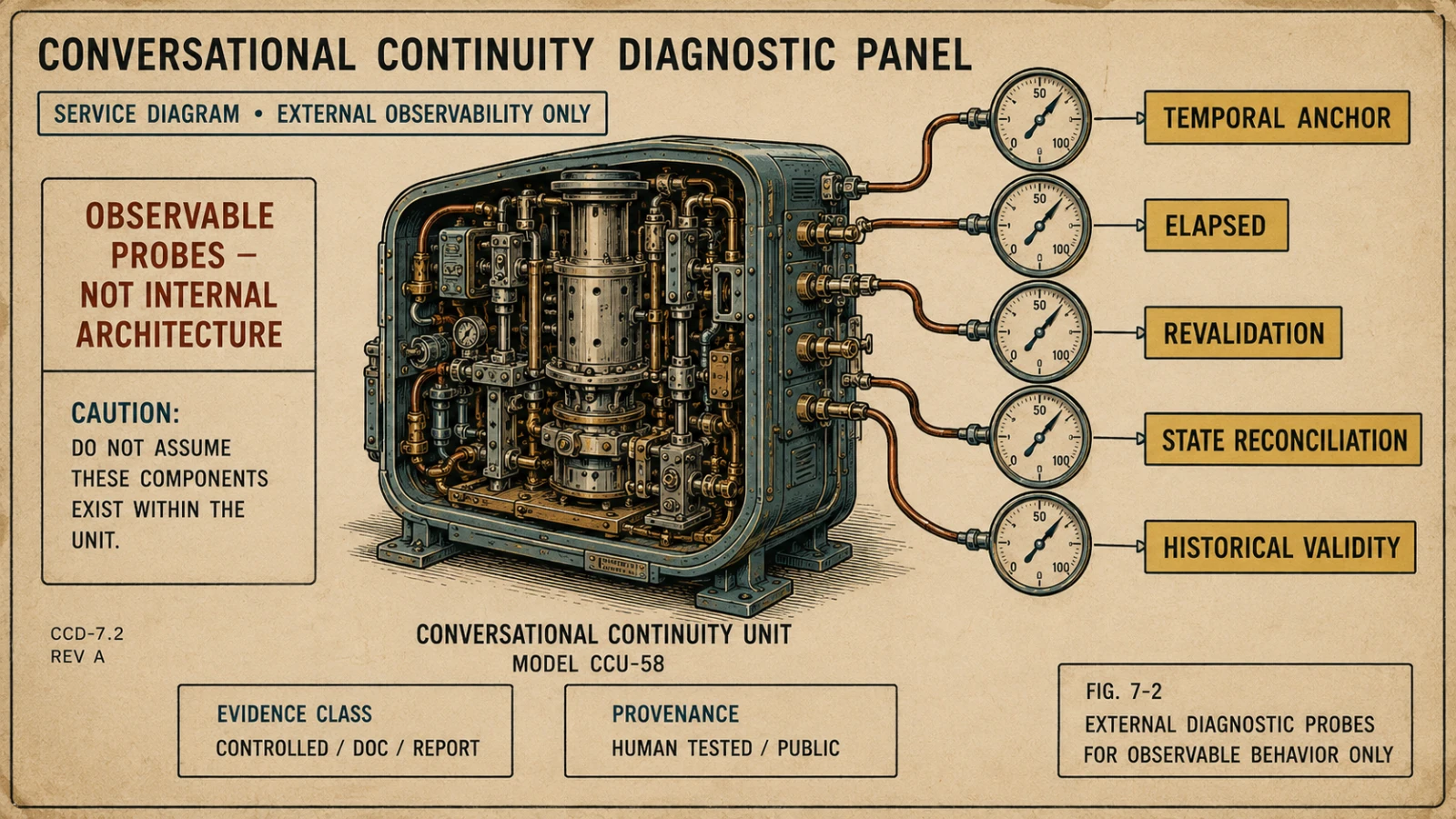
There are several questions hiding inside what we casually call "continuity":
What time frame am I operating in?
How much real time passed?
Should I still trust what I learned before?
What state should control my behavior now?
What used to be true?
These questions cross different technical layers.
They are not five fundamental organs of some universal AI "time awareness" architecture.
Unfortunately, calling all five "memory" does not make the distinctions disappear.
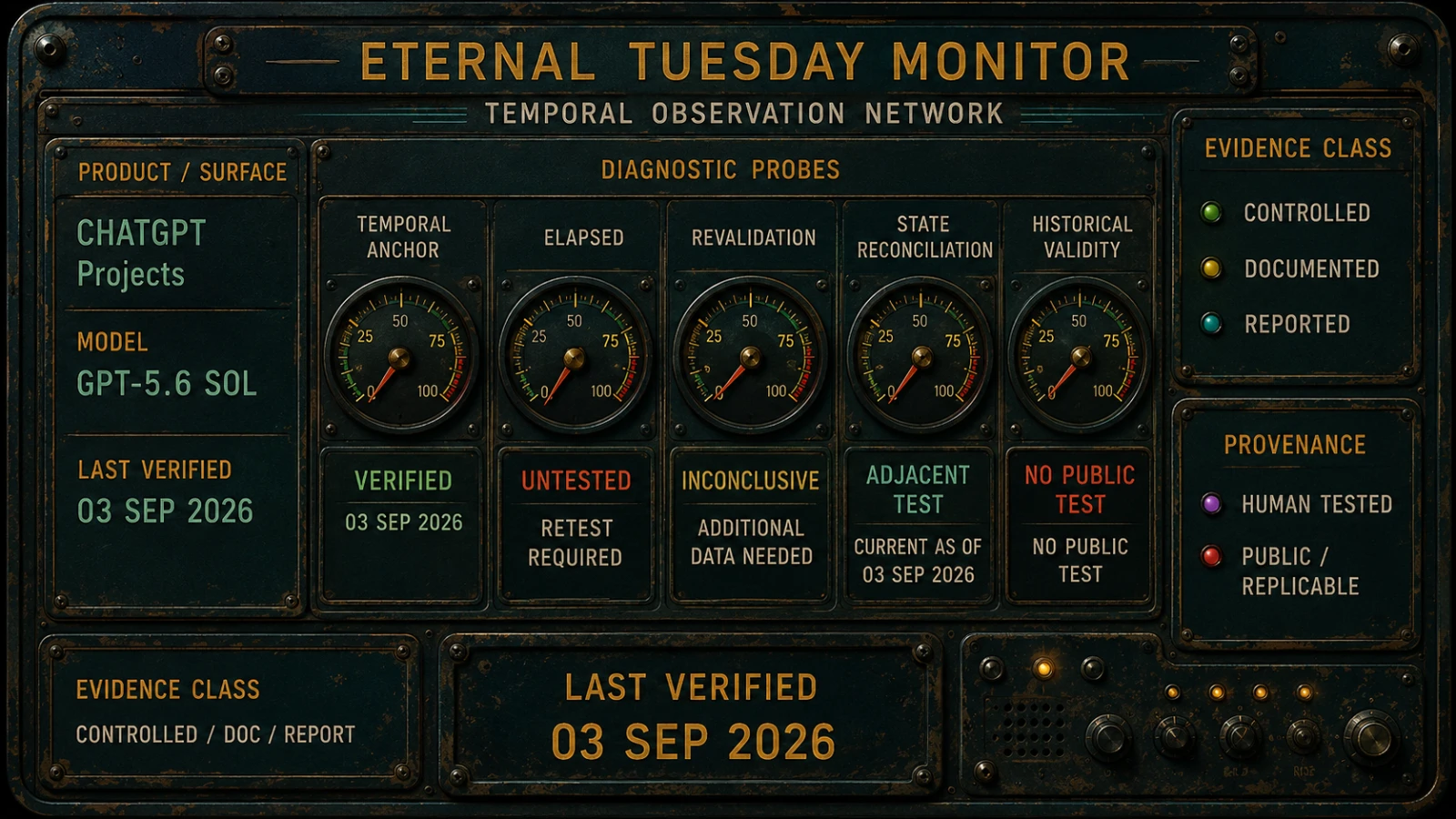
Five questions I use to diagnose temporal continuity failures from the outside. They are not claims about five independent components inside the product.
For this article, they divide into two groups.
TEMPORAL TESTS
Temporal Anchor
Elapsed
Revalidation
Those sit closest to the evidence examined here.
Then come two ADJACENT STATE TESTS:
State Reconciliation
Historical Validity
Those extend beyond the narrower experimental argument.
They matter after revalidation produces new evidence.
What should the new state supersede?
What historical information should survive?
Legitimate questions for the Monitor.
Not conclusions derived from TicToc.
To be fair, I don't know what time it is either
There is an obvious objection to the entire discussion.
Why should an AI continuously know what time it is?
I don't.
Suppose I leave home without my phone or a watch.
At some point I need the exact time.
I ask someone.
They don't magically know either.
They look.
"15:42."
Now we know.
Neither of us needs an atomic clock running consciously in our heads.
Humans externalize temporal precision constantly.
Watches.
Calendars.
Alarms.
Timers.
Reminders.
And we are not particularly heroic at managing time without them.
Research on prospective memory shows that people strategically consult clocks and external reminders, but also that we use those tools precisely because our own monitoring is imperfect.¹⁷
Humans even show systematic confusion among weekdays, especially Tuesday, Wednesday and Thursday.¹⁸
Apparently Eternal Tuesday has a human edition.
But this changes what we should demand from an AI system.
I do not need it to experience a weekend.
I do not need an inner clock ticking inside the model.
I need something more operational:
When prior assumptions may no longer be safe to reuse, the system should be able to obtain the relevant current evidence and reconcile it with what it already knows.
Elapsed time can trigger revalidation. It cannot perform revalidation.
The arithmetic is infrastructure.
The decision to look again is policy.
Whatever comes back becomes new evidence.
The conversation continued. The world didn't wait.
This is where the experiment turns into a broader systems implication.
A conversation can remain coherent while the environment around it changes.
A deployment finishes.
A ticket gets closed.
A branch changes.
A colleague replies.
A price moves.
A calendar event passes.
A file gets replaced.
An approval expires.
A person changes their mind.
TicToc does not experimentally validate all of those cases.
What it demonstrates is narrower: an elapsed-time-sensitive tool-reuse problem.
The implication is that persistent workflows operating against mutable external systems create other places where sequence, elapsed time and current evidence may need to be distinguished.
The longer such a workflow persists, the more opportunity there is for something outside the conversation to change.
Not necessarily more uncertainty.
Not monotonically increasing staleness.
Opportunity.
The interesting question is what happens when that matters.
Does the system know previous evidence may need checking?
Can it reach the authoritative source?
If the source disagrees with old context, which one wins?
That is why this stops being a cute calendar bug once AI systems begin carrying work across days.
Recall is not current-state tracking
Persistent AI products make this discussion confusing because we use memory for too many different things.
A product remembering that you prefer Python over JavaScript is one problem.
A transcript retaining something you said six weeks ago is another.
Retrieving that turn into current model context is another.
Knowing when it happened is another.
Knowing whether the state described inside it still applies is another.
You do not need to understand every vendor's memory architecture to use these products professionally.
You do need to stop treating those properties as synonyms.
A useful compression is:
Recall asks whether prior information can be recovered.
And for our narrower temporal problem:
Content persistence does not imply temporal metadata persistence or correct temporal reasoning.
A system can be excellent at preserving what was said on Friday.
That alone does not determine what should still govern Monday.
The strongest evidence against this article is that vendors are already fixing parts of it
If this piece implied that AI vendors had built persistent chats and then forgotten that clocks exist, it would already be obsolete.
OpenAI provides perhaps the strongest counterweight.
On June 4, 2026, OpenAI announced Dreaming, a production memory architecture designed around continuity, relevance and freshness over long periods.²⁰
The company explicitly describes staleness, correctness and scalability as challenges.
It includes an evaluation objective around staying current over time and describes cases where passage of time changes what a useful memory should represent.
One example involves a future trip eventually becoming a historical trip rather than remaining perpetually upcoming.
OpenAI's summary is almost unfairly perfect for this article:
"Time doesn't stop when your chat ends."
That is meaningful counterevidence against any simplistic claim that current ChatGPT memory is just a static pile of old conversational facts.
It is also vendor evidence.
Its evaluations establish what OpenAI reports those evaluations showed.
They are not independent validation of every temporal behavior we might care about.
Then, on August 21, ChatGPT release notes announced "More time-aware answers", improving awareness of the user's local time for time-sensitive responses.²¹
That is narrower still.
Local-time grounding is not per-message timestamping.
It is not elapsed-gap representation.
It is not revalidation policy.
Anthropic documents current-date injection on claude.ai/mobile and continues evolving persistent memory across other product surfaces.⁶ ¹⁵
Perplexity Brain is another interesting counterexample, currently in Research Preview.²²
Rather than waiting until a user returns and hoping the next turn detects stale state, Perplexity describes background maintenance that revisits sessions, connector updates, artifacts and corrections, reinforcing what remains true, updating what changed and marking stale information.
A product does not necessarily need the base model to become astonishingly good at intuiting elapsed-time consequences.
The system around the model can maintain fresher state.
That is not cheating.
That is engineering.
And it is a reminder that Eternal Tuesday is a product-level observable, not a theory about transformer consciousness.
The evidence rules need to stay symmetrical.
Vendor claim ≠ independent proof of resolution.
User report ≠ independent proof of mechanism.
Benchmark result ≠ timeless property of every future model.
If we're going to ask AI systems to keep provenance straight, we should probably make an effort ourselves.
And then the frontier moved
There is a nasty practical problem with writing about AI in 2026.
The evidence ages while you're writing the article.
TicToc is a 2026 paper.
Its evaluated models are already not the frontier I am using as I write this.
As of September 7:
OpenAI's flagship is GPT-5.6 Sol.²³
Anthropic has Claude Opus 5 and Fable 5.1.²⁴
Google released Gemini 3.8 Flash yesterday, September 7, and positions it for complex agentic workflows.²⁵
xAI released Grok 4.6 in August with an explicit focus on long-running agents.²⁶
So I went looking for the obvious next piece of evidence.
A TicToc replication on those systems.
A controlled GPT-5.6 elapsed-time test.
A Gemini 3.8 persistent-session evaluation.
A Grok 4.6 temporal-grounding benchmark.
A contemporary experiment that would justify writing:
The newest frontier systems still have this problem.
I could not find one.
Then I looked for evidence strong enough to write:
The newest frontier systems have solved it.
I could not find that either.
There is plenty of current evidence about coding, browsing, long-horizon tasks, computer use, memory and general agentic performance.
The gap is much more specific:
I could not find public standardized evidence answering this particular behavioral question across today's frontier products.
That is not evidence of failure.
It is not evidence of success.
The defensible statement on September 7, 2026 is:
Temporal information can be mishandled in persistent multi-turn AI systems. In TicToc's controlled synthetic tool-use setting, timestamps and even explicit elapsed intervals did not by themselves reliably align model decisions with the benchmark's human judgments about when old information should be refreshed. Other experiments show that models can adapt to temporal pressure and can benefit dramatically from explicit temporal feedback. The status of this specific failure class in the newest frontier products is not yet publicly established.
That's annoyingly nuanced.
Good.
Persistence is an affordance, not a synchronization guarantee
This is where criticism of users becomes too easy.
4. Perplexity - persistent conversational context. Product documentation describing continued context and persistent memory behavior. Vendor documentation is treated as evidence of product design, not independent behavioral validation. https://www.perplexity.ai/help-center/en/articles/10354769-what-is-a-thread
5. Cursor Community - "Agent doesn't know what day it is", March 2026. User report followed by a Cursor staff response indicating that current date/time were not then passed to the agent prompt. This is the strongest causal product example in the article and describes Cursor at that time, not necessarily today. https://forum.cursor.com/t/agent-doesnt-know-what-day-it-is/154920
6. Anthropic - Claude system prompt documentation. Anthropic documents current-date information supplied to claude.ai and mobile applications. The documentation should not be generalized to all Anthropic surfaces or the Claude API. https://platform.claude.com/docs/en/release-notes/system-prompts/overview
8. Claude Code issue #79731 - Fable 5 same-session "yesterday" report, July 2026. Detailed but intermittent user report in which an event roughly thirty minutes old was described as "yesterday" despite the correct current date appearing in the reported context. Subsequent commands and corrections come from the submitter's transcript. The model's generated causal explanation is not treated as evidence. https://github.com/anthropics/claude-code/issues/79731
9. Qin et al. - "TimeDial: Temporal Commonsense Reasoning in Dialog", ACL-IJCNLP 2021. Earlier benchmark showing that temporal reasoning in dialogue predates the current generation of persistent agents. https://aclanthology.org/2021.acl-long.549/
10. Chen et al. - "TimeBench: A Comprehensive Evaluation of Temporal Reasoning Abilities in Large Language Models", ACL 2024. Broader temporal-reasoning benchmark. Included as background, not evidence for Eternal Tuesday specifically. https://aclanthology.org/2024.acl-long.66/
11. Cheng et al. - "Your LLM Agents are Temporally Blind: The Misalignment Between Tool Use Decisions and Human Time Perception", Findings of ACL 2026. TicToc benchmark. Primary experimental backbone for elapsed-time-sensitive tool-use decisions. It uses controlled synthetic multi-turn trajectories and human preference labels under designed staleness assumptions. Includes timestamp, explicit Δt, few-shot and post-training experiments. https://aclanthology.org/2026.findings-acl.1848/https://aclanthology.org/2026.findings-acl.1848.pdfhttps://github.com/chengez/TicToc
12. Wang et al. - "Discrete Minds in a Continuous World: Do Language Models Know Time Passes?", Findings of EMNLP 2025. Peer-reviewed counterevidence against treating temporal blindness as absence of all temporal adaptation. The authors propose a Token-Time Hypothesis in which token information can act as a proxy for physical duration and report model-dependent adaptation to urgency and progressive time pressure. This does not establish awareness of idle gaps without temporal metadata. https://aclanthology.org/2025.findings-emnlp.1016/
13. Sehgal, Guntuku & Ungar - "Real-Time Deadlines Reveal Temporal Awareness Failures in LLM Strategic Dialogues", arXiv preprint, 2026.Controlled preprint study showing that explicit remaining-time feedback can dramatically change model behavior in a different temporal task. GPT-5.1 deal closure increased from 4% to 32% under per-turn remaining-time feedback. The title follows current arXiv metadata. https://arxiv.org/abs/2601.13206
14. Anthropic Claude Code issue #86219, August 12, 2026. User-submitted report involving a resumed session after approximately 83 days, with reportedly correct current environment date but stale operative conversational state. Treated as historical observational evidence only. https://github.com/anthropics/claude-code/issues/86219
18. Ellis et al. - "Mental Representations of Weekdays", PLOS ONE, 2015. Research showing systematic structure and confusion in human weekday representations. Included because Eternal Tuesday apparently has prior art in biology. https://journals.plos.org/plosone/article?id=10.1371/journal.pone.0134555
20. OpenAI - "Dreaming: Better memory for a more helpful ChatGPT", June 4, 2026. OpenAI describes staleness, correctness and scalability challenges, a production memory architecture intended to stay current over time and vendor-run evaluations involving passage-of-time-sensitive answers. Substantive vendor evidence, not independent validation. https://openai.com/index/chatgpt-memory-dreaming/
21. OpenAI - ChatGPT Release Notes, August 21, 2026. "More time-aware answers", specifically describing improved awareness of the user's local time during a conversation. It is not cited here as evidence of historical timestamps, elapsed gaps, resumption boundaries or revalidation policy. https://help.openai.com/en/articles/6825453-chatgpt-release-notes
22. Perplexity - Brain. Research Preview documentation describing background maintenance that can reinforce current information, update changed information and mark stale knowledge. Architectural counterexample to the assumption that temporal reconciliation must wait for the next user turn. Vendor-described architecture, not independent validation. https://www.perplexity.ai/help-center/en/articles/19700001-what-is-brain
26. xAI - Grok 4.6, August 12, 2026. Current-frontier snapshot. xAI explicitly positions Grok 4.6 around long-running agents. https://x.ai/news/grok-4-6/
About the Author
Diego Liñan is a Technical Program Manager with a background in software engineering, solution architecture, product development, and technical delivery. His current work focuses on AI-enabled delivery systems, agentic workflows, AI governance, engineering operating models, persistent context, evidence traceability, and human accountability in AI-assisted software development.