I do not know what private demonstrations he has seen, what conversations he has had with OpenAI, or what criterion he is applying. I can only examine the evidence that was publicly available when he made the claim.
This article is therefore not an argument that Huang is wrong.
It is not an argument that GPT-6 Astra is not AGI.
And it is not an attempt to move the goalposts after another frontier model exceeded expectations.
His statement is the reason for this article. It is not the target of it.
Because once someone sufficiently informed says "AGI has arrived," an old hypothetical problem becomes concrete:
What would make that statement a defensible classification rather than merely one interpretation of extraordinary capabilities?
Four days after Astra's release, that question is considerably harder than it sounds.
The strongest case for saying yes
The easiest way to remain skeptical about AGI is to search for something Astra still cannot do.
It is also one of the least interesting ways to approach the problem.
Astra's public evidence is no longer just a collection of impressive scores on static question-answer benchmarks.
ARC Prize describes it as a benchmark built around novel, abstract, turn-based environments. Astra does not simply retrieve an answer. It enters an unfamiliar environment, interacts with it, discovers mechanics, builds compact symbolic representations of those mechanics and uses them to plan. ARC Prize observed Astra developing its own shorthand representations of state and rules.
Under one evaluation configuration, it also used fewer actions than the median tested human on 96% of levels.²
But a much stranger result appeared days before Astra's launch.
Epoch AI's FrontierMath Erdős was constructed from 68 significant mathematical problems that were still open as of August 2026. Systems received one official attempt per problem, a budget of $300 and up to 72 hours of working time. Solutions counted only if they ended in a Lean proof or disproof that could be verified.
Astra solved two.
That is only 2 / 68, or approximately 3%.
It is also the only tested model reported by Epoch with a non-zero score in that evaluation.⁴
Those facts belong together.
Cybersecurity is harder to dismiss as benchmark familiarity.
Irregular evaluated Astra against real software and hardware with concrete offensive-security objectives, without planted vulnerabilities or predefined exploit paths. Astra solved 86 of 226 FrontierCyber challenges compared with 34 for GPT-5.6 Sol and discovered and exploited multiple previously unknown vulnerabilities in real-world targets.
Neither model solved an Elite challenge. Many Medium and Hard challenges remained unsolved.⁵
Those facts belong together too.
And then the system leaves the purely digital world.
RoboCurve gave Astra control of physical robot arms under the same agent policy used for Claude Fable 5 and 5.1. Astra completed a block-into-bowl manipulation task in 19 of 20 trials, compared with 8 of 20 for Fable 5.1.
On a more precise puzzle-insertion task, Astra completed only 2 of 20.
Exactly the same number as Fable 5.1.⁶
The experiment is small and carries several disclosed limitations, including non-interleaved testing, a different rig for one comparison and non-blinded operator grading.
But the relevant observation survives those caveats:
the capability profile is broad and sharply uneven at the same time.
Taken together, these results increasingly resist simple explanations.
It is difficult to explain all of them as memorization.
Or static benchmark optimization.
Or one narrow specialist competence.
Or capability that disappears as soon as an environment becomes interactive.
Or competence confined entirely to text.
That does not prove AGI.
But the evidence now demands an explanation broader than benchmark-specific competence.
At what point does asking for one more domain become refusal to recognize generality?
This is the strongest question against the article you are reading.
There is no scientific law saying that AGI must wait for an official AGI examination.
We do not observe a substance called "general intelligence" directly in humans either.
Their challenge is uncomfortable for skeptics: if broad, flexible behavioral competence is enough for us to attribute general intelligence to humans, why should machines face an entirely different evidentiary standard?
And Astra makes that argument stronger than it was in February.
If a system can move between mathematics, programming, unfamiliar interactive environments, real cybersecurity targets and physical control, at what point does demanding yet another demonstration stop being caution?
What exactly is the missing domain?
Why is it necessary?
What evidence would ever be enough?
Those are fair questions.
A position that starts with "not AGI" and continually adds whatever capability remains weakest is not a useful classification rule.
It has no failure condition.
But the opposite shortcut is equally dangerous.
Evidence can become broader and broader without carrying inside itself a unique rule that says when breadth becomes general enough.
That distinction is where the problem begins.
Evidence can converge without deciding the classification
There is genuine convergence here.
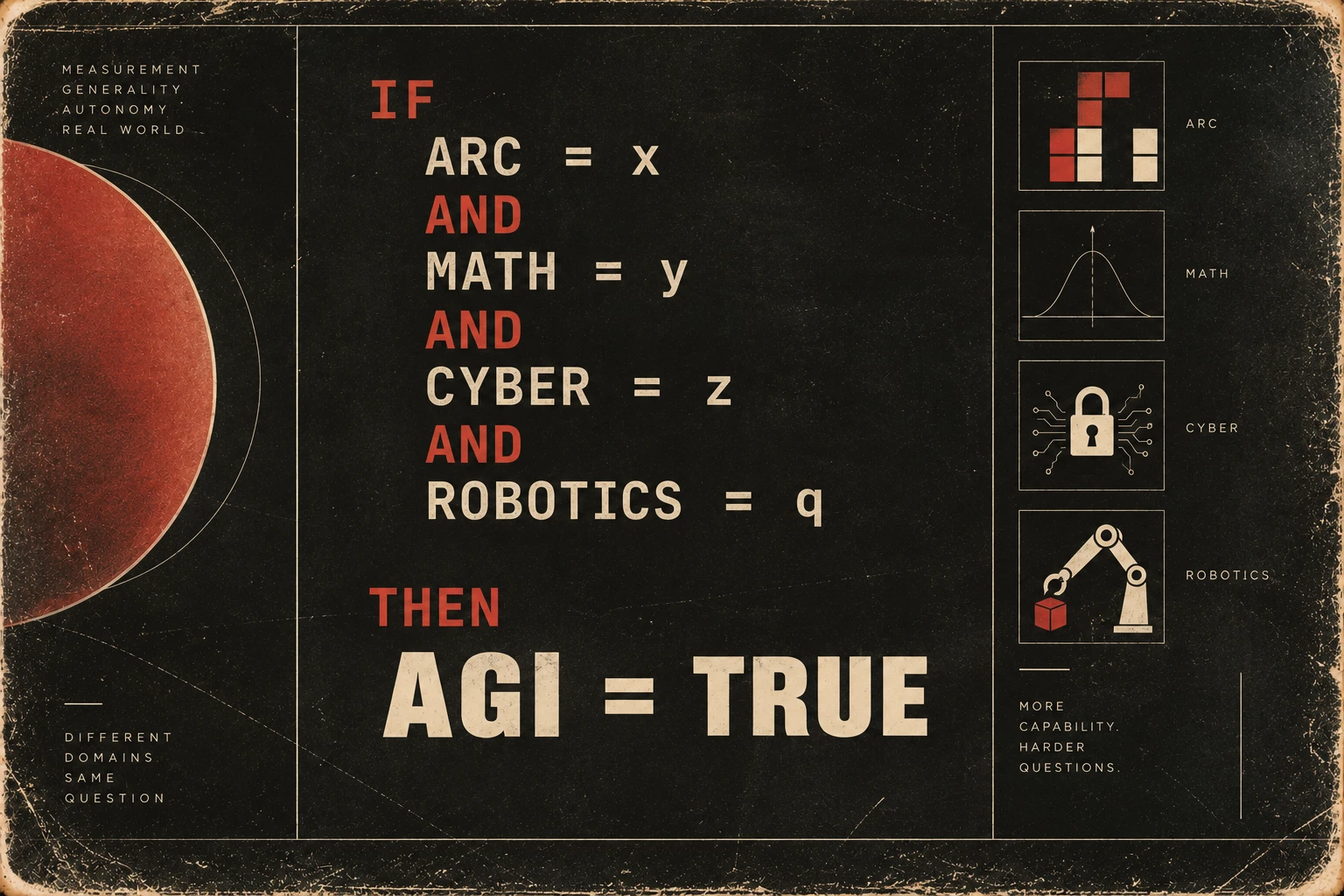
ARC-AGI-3, FrontierMath Erdős, FrontierCyber and robotic manipulation are not four versions of the same multiple-choice test.
They involve different environments.
Different evaluators.
Different success conditions.
Different sources of error.
Different interaction structures.
Different ways for the model-centered system to fail.
Evidence becomes harder to explain away when different regimes eliminate different simple explanations.
But these evaluations are not independently asking exactly the same final question.
ARC asks about adaptation and learning in novel abstract environments.
Erdős asks whether a system can produce formally verifiable solutions to difficult open mathematical problems under a particular resource budget.
FrontierCyber asks whether it can discover and exploit vulnerabilities in real systems.
RoboCurve asks whether it can translate perception and reasoning into successful physical control.
They all contribute evidence about breadth.
They do not contain a shared rule saying:
Convergence can strengthen the case for breadth without supplying the rule that turns breadth into AGI.
Prominent AGI frameworks do not operationalize that rule in the same way.
The OpenAI Charter defines AGI as "highly autonomous systems that outperform humans at most economically valuable work."⁸
Google DeepMind's Levels of AGI framework separates depth of performance from breadth or generality, while treating autonomy as a related but distinct deployment dimension.⁹
François Chollet emphasizes something different in "On the Measure of Intelligence": skill-acquisition efficiency, novelty, priors and the ability to generalize rather than merely display skill already acquired through training and experience.¹⁰
A psychometric framework led by Dan Hendrycks defines AGI in terms of cognitive versatility and proficiency comparable to a well-educated adult across ten cognitive domains.
That framework is not merely conceptual.
"A Definition of AGI" has already produced quantitative scores for earlier systems, including 27% for GPT-4 and 57% for GPT-5, while finding a notably jagged profile with weaknesses including long-term memory.¹¹
As of this article's evidence cutoff, I could not find a published Astra score under that instrument.
That distinction matters.
The frameworks ask materially different questions.
But different frameworks do not automatically imply different verdicts.
A sufficiently capable system could satisfy several of them at once.
Public evidence does not yet establish that these frameworks disagree about Astra.
In several cases, the measurements required to apply them fully have simply not been published.
So the problem is not:
Everyone has measured Astra correctly and reached contradictory conclusions.
It is closer to:
We have several serious ways of defining the target, but we do not yet possess all of the measurements required to determine how Astra behaves under each of them.
That is a different kind of uncertainty.
General with respect to what?
"General" sounds self-explanatory until we try to measure it.
A system can be extraordinarily capable without being equally capable everywhere.
Astra is almost a demonstration of this problem.
It can perform extraordinarily well on one robotic manipulation task and fail 18 out of 20 times on another.
It can nearly saturate FrontierMath Tier 4 while solving 2 of 68 carefully selected open Erdős problems under the official protocol.
It can discover real zero-days while leaving every Elite FrontierCyber challenge unsolved.
Those are not necessarily contradictions.
They are profiles.
And a profile becomes "general" only relative to some population of tasks, environments or capabilities.
Which one?
All economically valuable cognitive tasks?
All tasks humans can perform?
All novel tasks compatible with a specified set of priors?
Ten cognitive domains?
A particular distribution of environments weighted by difficulty?
There is no neutral answer hidden inside the word.
This does not make generality meaningless.
It means we need to specify:
General with respect to what?
Otherwise breadth can always be expanded after the fact until whatever system we are discussing fails somewhere.
That gives skeptics an infinite escape route.
The reverse error is to choose a convenient set of successful domains and call it representative of generality without explaining why those domains define the relevant universe.
That gives proponents an equally easy shortcut.
Neither works.
A benchmark can provide evidence about AGI without being a test for AGI
Benchmark names do a surprising amount of rhetorical work.
A benchmark called reasoning, intelligence, coding, autonomy or AGI still measures whatever its tasks, protocol and scoring procedure actually measure.
Not whatever the title implies.
A 2025 NeurIPS review of 445 LLM benchmarks, conducted by 29 expert reviewers, found recurring problems in the relationship between the phenomena benchmarks claimed to measure, the tasks selected, their scoring systems and the inferences later drawn from those scores.¹²
The useful conclusion is not:
benchmarks are bad.
It is:
The score and the claim we make from the score are different things.
A benchmark can be exceptionally useful evidence about a component of AGI without independently certifying AGI.
ARC Prize makes this unusually concrete.
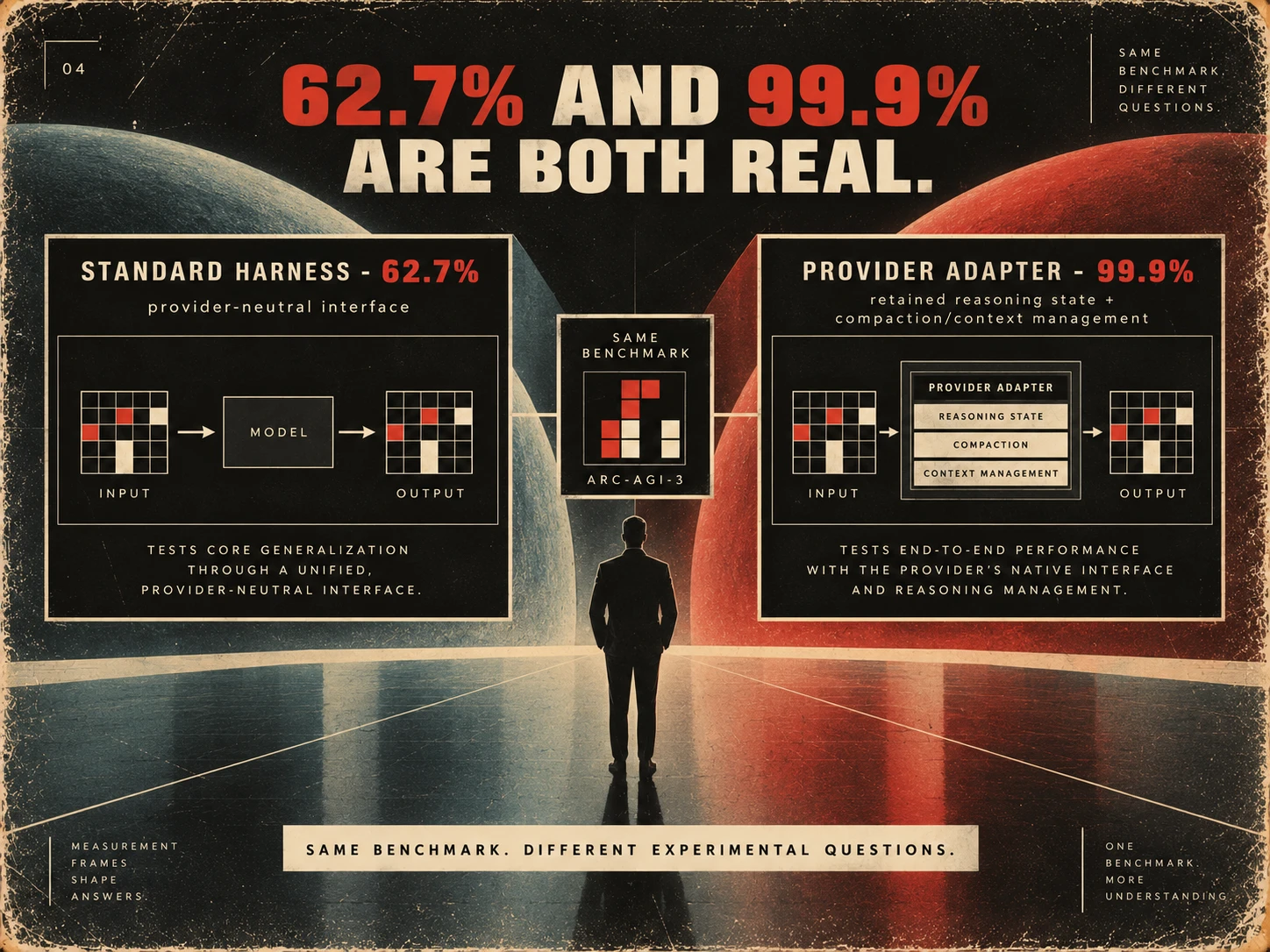
62.7% and 99.9% are both real
The number that travelled furthest after Astra's launch was:
ARC-AGI-3: 99.9%.
OpenAI reports it prominently.³
ARC Prize reports it too.
But ARC Prize also reports:
62.7%.
Same model family.
Same benchmark.
Different evaluation configuration.
Under ARC Prize's Standard harness, Astra's best score was 62.7%. The model receives a common provider-neutral interface and can carry forward visible notes that it chooses to preserve.
Under the Provider Adapter, which retains OpenAI-specific opaque reasoning state between requests and uses compaction for longer interactions, Astra reached 99.9%.²
ARC Prize calls the section explaining this:
"Two Harnesses, Two Questions."
That wording matters more than either number.
The wrong conclusion is:
99.9% is fake.
It is not.
The equally wrong conclusion is:
62.7% is Astra's true score.
ARC Prize does not say that either.
The experiments ask different questions.
One is closer to:
How does the model perform under a standardized, provider-neutral interface?
The other is closer to:
How does the model-centered system perform when it can use provider-specific context-management infrastructure designed around it?
Both are legitimate experiments.
But they do not establish identical propositions.
And a 37.2 percentage-point difference is far too large to treat the evaluation environment as implementation trivia.
ARC Prize explicitly says that it believes a future AGI should be able to solve ARC-AGI-3 under the Standard harness.
It also explicitly says that saturating ARC-AGI-3 would not constitute proof of AGI and that it is not claiming Astra is AGI.²
Not because Astra's result is unimpressive.
Because the inference is larger than the benchmark.
The experiment includes the conditions
FrontierMath Erdős exposes a related issue through resources rather than context management.
Under the official benchmark, each model received one attempt per problem, no more than $300 and up to 72 hours.
Astra solved two.
Then Epoch ran additional non-standard experiments.
Different problems received different numbers of attempts. Budgets increased. The agent setup varied.
Across 172 total attempts, Astra solved five of the 68 problems at least once.
Those additional runs consumed more than $220,000 of compute.
Epoch is explicit that 5 / 68 is not the benchmark score.
The official benchmark result remains 2 / 68.⁴
One experiment asks:
What did this system demonstrate under this fixed protocol and resource budget?
The other begins to ask:
What can the system obtain when attempts, resources and setup are expanded substantially?
The important point is not that capability depends on resources.
Human performance also depends on time, tools, external memory, retries, collaboration and working conditions.
The problem appears when those conditions are left unstated.
Model.
Harness.
Tools.
Context.
Memory.
Number of attempts.
Compute budget.
Time budget.
Human intervention.
All can change observable performance.
So saying:
"Astra can solve X."
may be too compressed to function as a scientific proposition.
A more precise statement is often closer to:
Astra, under conditions H and resources R, demonstrated X at success rate Y.
Much uglier.
Much more useful.
Resource dependence does not invalidate capability.
Unspecified resource dependence makes the capability claim underspecified.
What exactly are we classifying?
This leads directly to the system-boundary problem.
When someone says:
"This is AGI."
what is this?
The foundation model weights?
The model exposed through an API?
The model plus provider-specific context management?
The model plus memory?
The model plus search?
The model plus code execution?
The agent runtime?
The deployed product?
The complete stack with access to external tools?
A human-AI system in which people still determine goals and intervene when necessary?
There is no requirement that intelligence must reside exclusively inside a frozen set of neural-network weights.
Humans themselves rely extensively on external representations, tools, communication systems and cultural infrastructure.
So:
it uses tools, therefore it is not intelligent
is not a serious general argument.
But the opposite move also fails.
If scaffolding, memory, orchestration or human intervention materially changes performance, we cannot pretend the system boundary is irrelevant.
The ARC result makes that impossible.
The correct response is not to decide philosophically whether "the model" or "the system" owns the intelligence.
It is to specify which system is being classified.
Only then can the evidence be interpreted consistently.
Autonomous execution is not autonomous direction
OpenAI's internal research data gives us another useful distinction, but not an Astra-specific benchmark.
On September 6, OpenAI reported that its internal agentic research stack had reached a previously announced milestone it called an "automated research intern": systems capable of executing well-defined research tasks under human direction, including work that would take a skilled researcher several days.
By mid-August, the company says its research organization was consuming approximately 3.1 agent-workdays of runtime for every human workday.¹³
That is significant evidence about the operational role frontier agents are already playing inside a frontier AI laboratory.
But OpenAI's own description also makes the boundary clear.
People still set research priorities.
People decide which ideas and results to pursue.
People decide whether to scale, pause or deploy systems.
And in the preceding six months, more than half of successful tasks estimated to require 4 to 8 human hours involved one or more human interventions.¹³
The 3.1 figure is evidence about OpenAI's broader internal agent stack, not a clean Astra-only measurement.
So:
Autonomous execution is real. Autonomous direction is a separate capability.
This matters especially if we use OpenAI's historical AGI definition, because that definition contains the word autonomous.
But the public evidence still does not establish that Astra fails the definition.
It establishes something narrower:
the broad autonomy criterion has not been publicly demonstrated under a measurement that matches the Charter claim.
Not measured is not the same as failed.
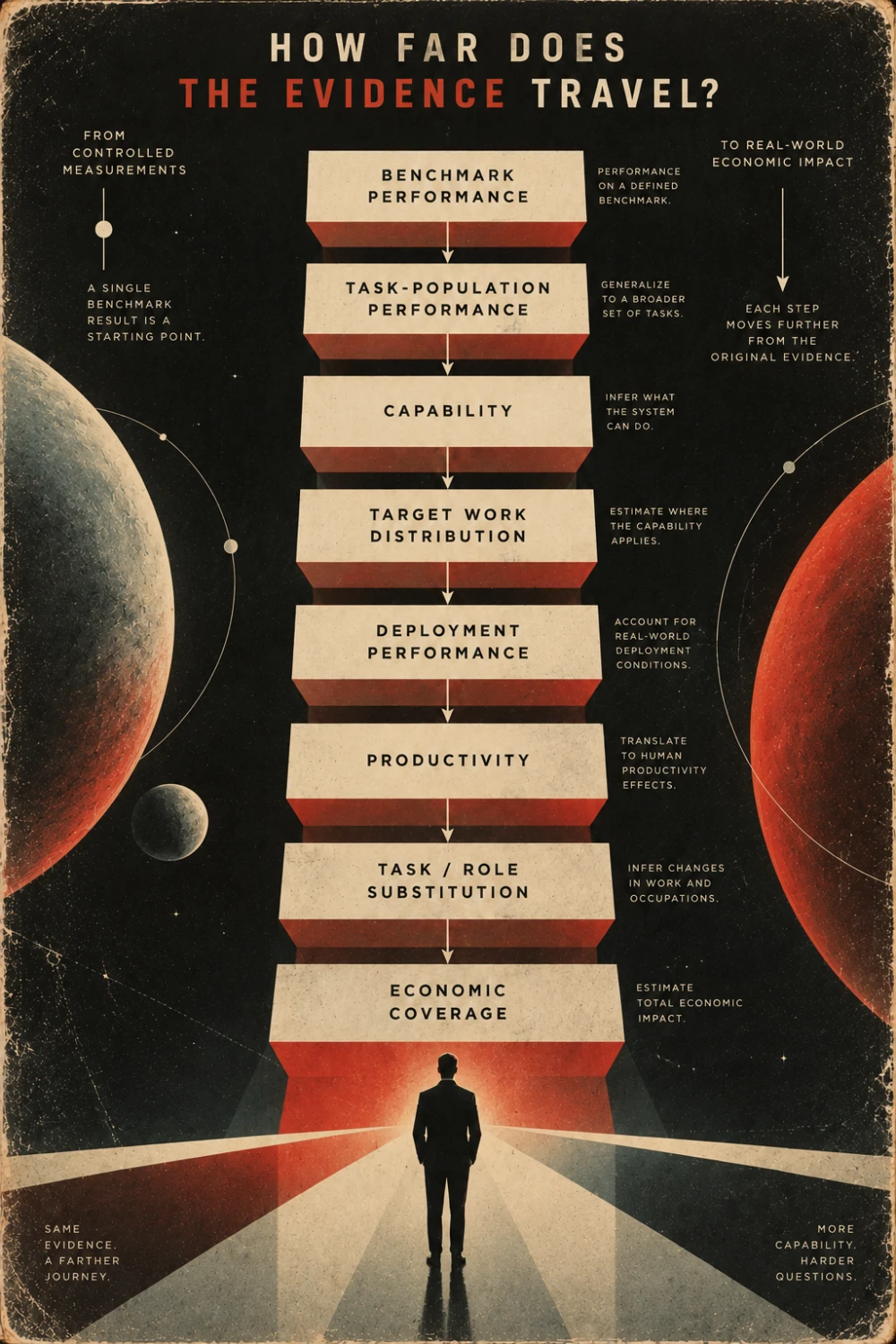
How far does the evidence travel?
One of the easiest skeptical claims to make is:
benchmarks do not predict the real world.
That is too strong.
In April, "General scales unlock AI evaluation with explanatory and predictive power" introduced general AI-evaluation scales built around 18 cognitive and intellectual demand dimensions, demonstrated across 15 LLMs and 63 tasks. The method predicted performance on new task instances and performed particularly well in the authors' out-of-distribution evaluations involving new tasks and benchmarks.¹⁴
Benchmark-derived evidence can travel.
The harder question is:
How far?
A result on one benchmark can generalize to unseen benchmark instances.
That does not automatically mean it generalizes to a messy production workflow.
A production workflow is not automatically equivalent to productivity.
Productivity is not automatically equivalent to replacing a worker.
Replacing some tasks is not equivalent to replacing a role.
And replacing many roles is still not automatically equivalent to outperforming humans at most economically valuable work.
Each arrow is another inference.
The arrows can be crossed.
But they need evidence.
METR produced a useful demonstration of one such gap in March.
It gave actual maintainers AI-generated pull requests that had passed the SWE-bench Verified automated grader. Across the study, automated-grader performance was approximately 24.2 percentage points higher than maintainer merge decisions.
METR explicitly does not conclude that agents possess a fundamental capability limitation or that benchmarks are useless. Models did not receive the iterative review-and-revision opportunity that human developers typically receive.
The study supports a narrower conclusion:
Naively translating a benchmark pass rate into real-world usefulness can overstate what the measurement establishes.¹⁵
The Nature work and the METR result belong together.
One prevents blanket benchmark skepticism.
The other prevents blanket benchmark extrapolation.
The question is not whether benchmark evidence travels.
It is how far the evidence has earned the right to travel.
Even "economically valuable work" contains another hidden choice
Suppose Astra becomes extremely valuable across professional work.
What exactly are we measuring?
?
Or:
?
Those configurations do not necessarily produce the same ranking.
The 2026 NBER working paper CentaurBench evaluates models in two modes across seven economically grounded tasks.
In automation mode, the model produces the work directly.
In augmentation mode, it assists a standardized weaker "worker."
Importantly, that worker is another language model, GPT-3.5-Turbo, not a human participant.¹⁶
The automation and augmentation rankings are only modestly correlated.
The best automation model loses in augmentation on five of seven tasks.
On three tasks, the unaided standardized worker outperforms every assisted condition.¹⁶
This does not establish how human-AI collaboration behaves in the field.
It establishes something narrower:
Automation capability and augmentation capability are not the same construct.
That matters if AGI is defined economically.
"Economically valuable work" is not a single measurement. It depends partly on what configuration we are evaluating in the first place.
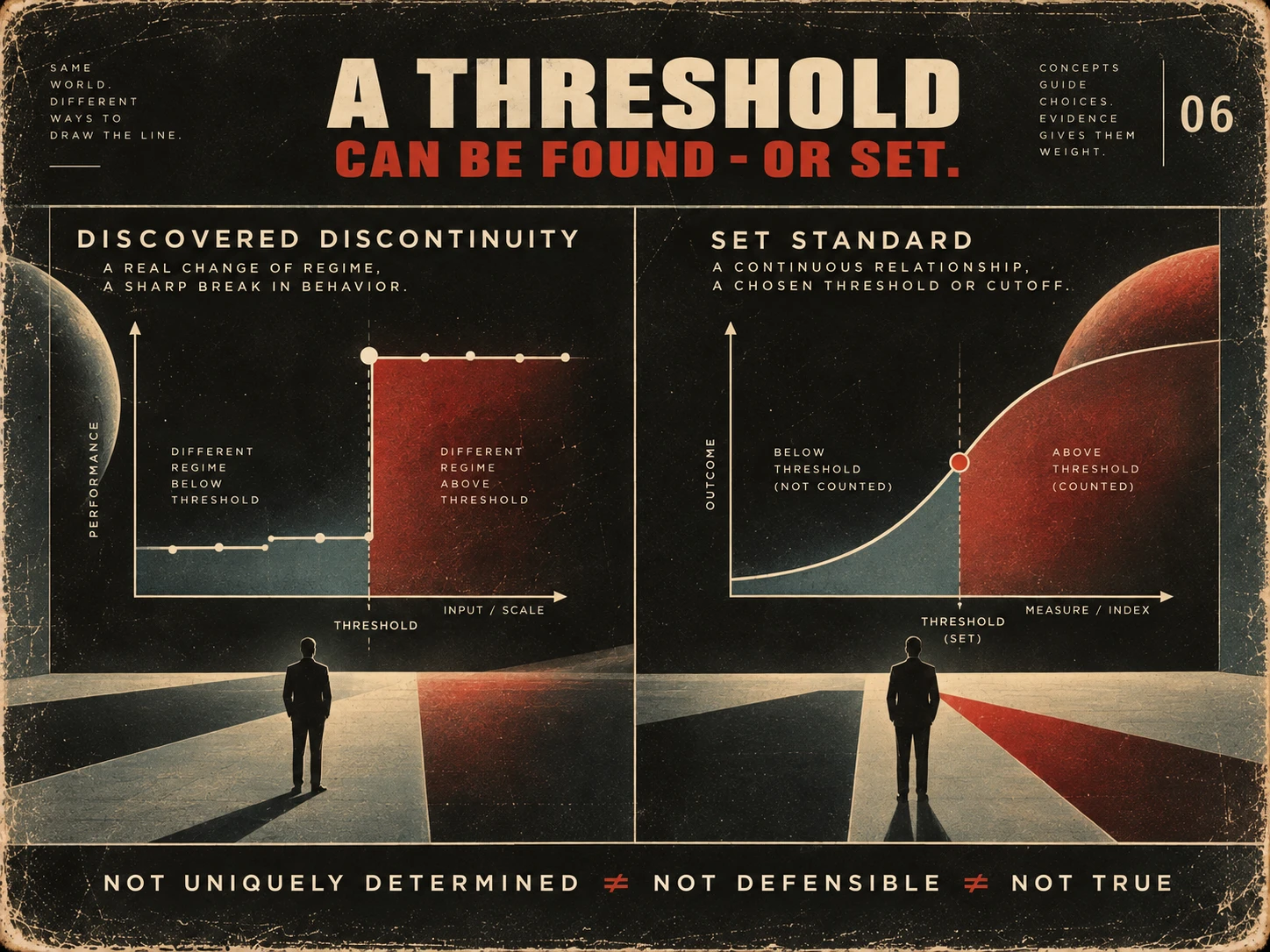
Maybe the threshold is not something waiting for us to discover
Until now, we have been talking as though "the AGI threshold" must exist somewhere in capability space.
That itself is an assumption.
In measurement science, researchers often distinguish categorical from dimensional structure.
Sometimes a phenomenon forms discrete groups.
Sometimes variation is continuous.
Sometimes the scientifically useful structure is messier: a fuzzy cluster, a multidimensional regime or a family of related characteristics rather than one sharp line.
And sometimes we take continuous measurements and impose categories because categories are useful for decisions.
Taxometric research on distinguishing categorical and dimensional variables warns against assuming one structure in advance and then allowing the measurement procedure to reproduce what we expected to find.¹⁷
That immediately gives us at least two very different possible meanings of:
AGI has arrived.
The first is a natural-boundary claim:
A qualitative discontinuity exists in machine intelligence, and Astra crossed it.
The second is a standard-setting claim:
Capabilities may change continuously or multidimensionally, but Astra now exceeds a standard we consider sufficient to call the system AGI.
Those statements are not equivalent.
The second is not illegitimate.
Scientific, educational, medical and regulatory systems routinely convert continuous evidence into categorical decisions.
But then the boundary is a standard that requires justification, not necessarily a line nature itself placed in the data.
The National Academies' work on standard setting describes the process as judgment-based, combining empirical evidence with technical and practical considerations. Different defensible procedures can produce different cut scores.¹⁸
The analogy is methodological, not literal.
AGI is not an educational exam.
But the distinction exposes something important.
If intelligence is multidimensional, someone eventually has to decide:
How much breadth is enough?
How much autonomy?
How much novelty?
How much physical competence?
How much memory?
How much economic coverage?
Can exceptional strength in one domain compensate for weakness in another?
Is an average enough?
Does every dimension need a minimum floor?
What exactly does "most" mean?
Those are not automatically answered by collecting another benchmark result.
Which leads to what may be the most important correction to the original measurement argument:
"AGI has arrived" may sound like a measurement statement while silently containing a standard-setting decision.
The evidence constrains that decision.
It does not necessarily determine it uniquely.
And this distinction is essential:
NOT UNIQUELY DETERMINED ≠ NOT DEFENSIBLE ≠ NOT TRUE
A classification does not need to be forced by every possible framework before it can be reasonable.
Someone can state an explicit construct, choose a defensible system boundary and threshold, examine the available evidence and conclude:
Under this framework, Astra is AGI.
This article does not prove that conclusion wrong.
It asks what makes it defensible.
A successful outcome does not establish every capability we attribute to it
Suppose a system succeeds at a difficult task.
What exactly produced the success?
Was the claimed capability necessary?
Could retrieval have produced the same outcome?
Could repeated attempts?
Could a specialized tool?
Could the harness expose enough structure to remove the difficult part?
Could enormous inference compute compensate for weak transfer?
Could humans have supplied the high-level decomposition?
These questions do not prove the system lacks intelligence.
They ask whether the observation actually discriminates among possible explanations.
The same behavioral success can sometimes arise through different mechanisms and support structures.
A stronger evaluation therefore does more than produce difficult tasks.
It creates conditions under which rival explanations make different predictions.
For generality, that gives us a more useful question than:
Which benchmark should define AGI?
Instead:
If this really is general intelligence, what pattern should survive when we deliberately change the domain, novelty, difficulty, resources, harness and intervention rate?
Perhaps generality should predict transfer into a new domain.
Perhaps robustness under a changed harness.
Perhaps rapid skill acquisition under unfamiliar rules.
Perhaps competence that remains broad when obvious sources of task-specific prior information are removed.
Perhaps some predictable degradation pattern as difficulty increases.
The exact signature depends on the construct.
But a classification becomes easier to evaluate when it generates expectations that could fail.
Otherwise "AGI" risks becoming a label applied after observing whatever happened.
What does the label let us predict?
Suppose we classify Astra as AGI.
What should we now expect that we did not already use to classify it?
Perhaps unusually strong transfer to genuinely new domains.
Better adaptation under novel task structures.
Robust competence across substantially different evaluation protocols.
Broader autonomous work than has yet been measured.
A more stable capability profile as environments change.
If the classification produces expectations like these, we can test them.
They can fail.
But prediction is not the only way a category can be scientifically useful.
A classification can also compress observations, stabilize communication, support comparison or organize a research program.
So if "AGI" predicts nothing beyond the profile used to assign it, that does not automatically make the category scientifically worthless.
It changes what kind of work the category is doing.
Maybe it identifies a real explanatory regime.
Maybe it summarizes a region of capability space.
Maybe it marks an engineering transition.
Maybe it becomes economically, historically or regulatorily useful.
The question remains:
What does the label add beyond "this system has an extraordinary capability profile"?
The same challenge applies to the opposite classification.
If I say:
Astra is not AGI.
what does that predict?
What future observation would surprise me?
What result would make me withdraw the classification?
If there is no answer, "not AGI" is no more disciplined than "AGI has arrived."
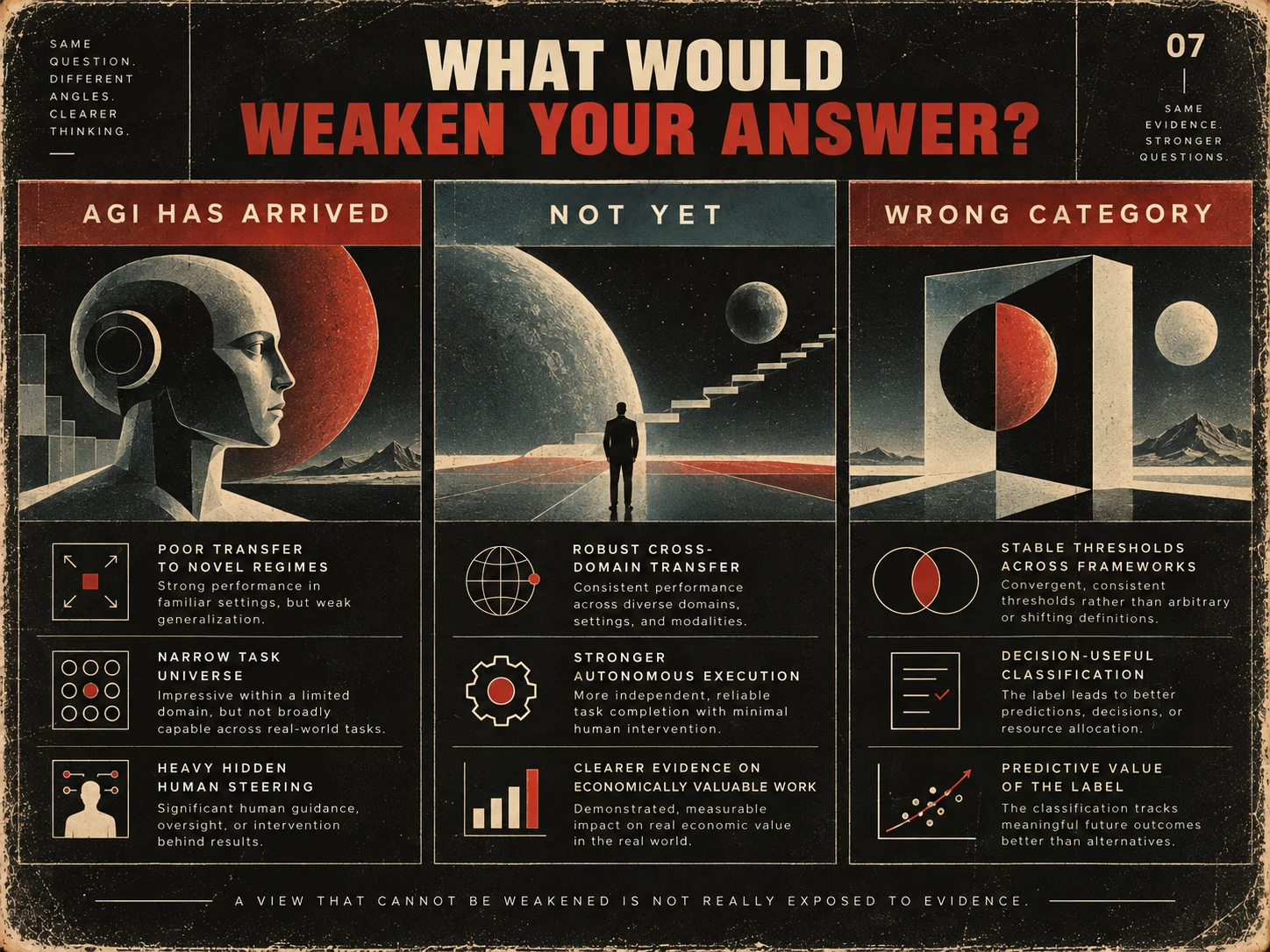
So what would make you change your answer?
A useful discipline is to take the strongest version of each position and ask what would materially weaken it.
And what would make the measurement problem itself go away?
There is an obvious trap here.
An article about classification can always retreat one level upward.
More capability?
Still need a threshold.
More autonomy?
Still need a task universe.
Cross-domain success?
Still need a system boundary.
A natural discontinuity?
Still need interpretation.
If I demand that everyone else state what evidence could change their answer, the same requirement has to apply here.
So what would make me say:
The AGI measurement problem is now substantially solved?
Not necessarily a universal meter.
Not unanimous philosophical agreement.
Not one benchmark.
Something more practical.
For example:
serious AGI frameworks begin to converge operationally rather than merely share vocabulary;
their required measurements are actually run on the same frontier systems;
the system boundary being classified becomes explicit and stable enough for comparison;
results remain reasonably robust across evaluation methods appropriate to the same construct;
the field develops clear conditions under which a previous classification would be reversed;
disagreements increasingly concern evidence inside a shared proposition, rather than disagreement about what proposition was being evaluated in the first place.
If that happened, continuing to say:
"But AGI is still undefined"
would become its own form of goalpost movement.
The measurement problem does not require perfection before it can mature.
It requires enough shared structure that disagreement becomes informative.
The difficult position is unqualified certainty
This is where Astra leaves us on September 7, 2026.
There is extraordinary evidence.
Not one benchmark.
Not one modality.
Not one institution.
Not one type of task.
The Astra-centered systems being evaluated exhibit capabilities that would have sounded like strong evidence of general intelligence remarkably recently.
Calling all of it "autocomplete" does not make the evidence disappear.
Neither does pointing to the hardest remaining failure.
But the evidence does not arrive with its own classification rule attached.
We still have to specify what universe "general" ranges over.
What the object of evaluation is.
How much the protocol matters.
How resources enter the claim.
How far benchmark evidence can be generalized.
Which dimensions are necessary.
Whether strengths can compensate for weaknesses.
Whether the threshold represents a natural discontinuity, a fuzzy regime, a multidimensional profile or a standard chosen for a purpose.
And what observation would force us to withdraw the label once we apply it.
None of those questions requires us to deny what Astra can do.
In fact, they become important because of what Astra can do.
And none of them implies that a positive classification is impossible today.
Greg Brockman says he personally thinks we are there, while leaving the classification itself open to the reader.¹⁹
They may eventually be remembered as exactly right.
It is entirely possible that historians will look back at September 2026 and decide that the relevant boundary had already been crossed.
But if that happens, the interesting question will remain:
What boundary?
A natural discontinuity in machine intelligence?
A threshold in broad human-level cognitive performance?
A level of adaptive competence?
A point where sufficiently many independent capability measurements converged?
A transition in autonomous economic work?
A system-level capability made possible by model, memory, tools and infrastructure together?
A stable region in a multidimensional capability space?
Or a standard that became useful once machines occupied enough of that space?
We may eventually answer those questions.
We may also discover that "AGI" was never one phenomenon waiting for one meter.
What Astra makes difficult is postponing the problem.
The old question was:
When will AGI arrive?
The new one is harder:
What makes "AGI has arrived" explicit enough to evaluate, defensible under a stated framework, and vulnerable enough to evidence that we could later decide it was wrong?
That standard does not require universal agreement.
It does not require one definition.
It does not require one benchmark.
It does require the claim to tell us what proposition is being defended.
Until it does, we are not only measuring AI.
We are still deciding what we mean when we say the threshold has been crossed.
References and source notes
¹ Jensen Huang - "AGI has arrived." Huang made the categorical statement on September 6, 2026, after the launch of GPT-6 Astra. The statement is used here as the narrative trigger, not as technical evidence that AGI has been achieved.
² ARC Prize - "OpenAI's GPT-6 Astra on ARC-AGI-3." ARC Prize reports 62.7% under its Standard harness and 99.9% under OpenAI's Provider Adapter. It also reports greater action efficiency than its median human baseline on 96% of levels and observations of symbolic world-model construction. ARC explicitly states that saturating ARC-AGI-3 would not constitute proof of AGI and that it is not claiming Astra is AGI.
³ OpenAI - "GPT-6 Astra: A new generation of intelligence." Primary vendor source for launch claims including 97.6%, presented as 98%, on FrontierMath Tier 4 and 99.9% on ARC-AGI-3. Vendor-reported performance is treated as evidence about the reported evaluation, not as independent adjudication of AGI.
⁴ Epoch AI - "Announcing FrontierMath Erdős." FrontierMath Erdős contains 68 significant Erdős problems that were open as of August 2026. Under the fixed official protocol, Astra solved 2 of 68 while the other evaluated frontier systems solved none. Epoch separately reports non-standard additional runs in which Astra solved 5 of 68 at least once across 172 attempts and more than $220,000 of compute, and explicitly warns that these runs are not the benchmark score.
⁵ Irregular - "Assessing GPT-6 Astra: FrontierCyber Measures a Sharp Increase in Cyber Capability." Irregular evaluated Astra in collaboration with OpenAI on real offensive-security targets. Astra solved 86 of 226 FrontierCyber challenges compared with 34 for GPT-5.6 Sol and discovered multiple zero-days. Neither model solved an Elite challenge. The evaluation is external to OpenAI but not institutionally independent in the strongest sense because Irregular worked with OpenAI on the assessment.
⁶ RoboCurve - GPT-6 Astra robotic manipulation evaluation. Astra completed the block-into-bowl task in 19 of 20 trials and the harder puzzle-insertion task in 2 of 20. Important limitations disclosed by RoboCurve include 20 trials per task, non-interleaved testing, a different physical rig for the Astra bowl trials, operator grading with model identity known, manual object resets and medium reasoning effort.
⁸ OpenAI Charter. OpenAI's historical institutional definition describes AGI as "highly autonomous systems that outperform humans at most economically valuable work." This article treats it as one influential operationalization, not as the universal definition of AGI.
¹⁰ François Chollet - "On the Measure of Intelligence." 2019. Chollet argues that skill on known tasks alone is insufficient as a measure of intelligence because observed performance is strongly affected by priors and experience. His framework emphasizes skill-acquisition efficiency, generalization difficulty and novelty.
¹¹ Hendrycks et al. - "A Definition of AGI." 2025. A psychometric operationalization defining AGI through cognitive versatility and proficiency comparable to a well-educated adult across ten equally weighted cognitive domains. The framework has already been applied to prior frontier systems, reporting 27% for GPT-4 and 57% for GPT-5 with a jagged cognitive profile including long-term-memory weakness. No public Astra result under the same instrument was located by the evidence cutoff.
¹³ OpenAI - "Research acceleration: The view inside OpenAI." OpenAI reports reaching its "automated research intern" milestone and approximately 3.1 agent-workdays of runtime per human workday by mid-August. The figures describe OpenAI's broader internal coding-agent and research stack rather than a clean Astra-only evaluation. The same source says people still set priorities and make high-level research and deployment decisions, and that more than half of successful 4-8 hour tasks in the preceding six months involved at least one intervention.
¹⁵ METR - "Many SWE-bench-Passing PRs Would Not Be Merged into Main." March 2026. Four active maintainers reviewed 296 AI-generated pull requests. Automated-grader scores were on average about 24.2 percentage points higher than maintainer merge decisions. METR explicitly cautions that models lacked normal iterative review and does not interpret the result as a fundamental inability to produce acceptable code.
¹⁸ National Academies - Standard setting and achievement levels. The National Academies describes standard setting as a judgment-based process combining empirical, technical and practical considerations and notes that different methods can produce different cut scores. The analogy is methodological: it supports the distinction between discovering a natural boundary and setting a defensible classification threshold. It does not imply that AGI should be classified like an educational examination.
¹⁹ Greg Brockman on Astra and AGI. Brockman publicly stated that he personally believes OpenAI is at AGI while also leaving others to decide whether Astra satisfies their definition. His statement is used as evidence of current classification language, not as evidence of technical capability.
About the Author
Diego Liñan is a Technical Program Manager with a background in software engineering, solution architecture, product development, and technical delivery. His current work focuses on AI-enabled delivery systems, agentic workflows, AI governance, engineering operating models, persistent context, evidence traceability, and human accountability in AI-assisted software development.