Article
AI Made It Cheaper to Be Wrong About the Analysis You Need
What changes when it becomes cheaper to discover that you chose the wrong analysis.
Originally published on LinkedIn ↗View the Cover Artwork
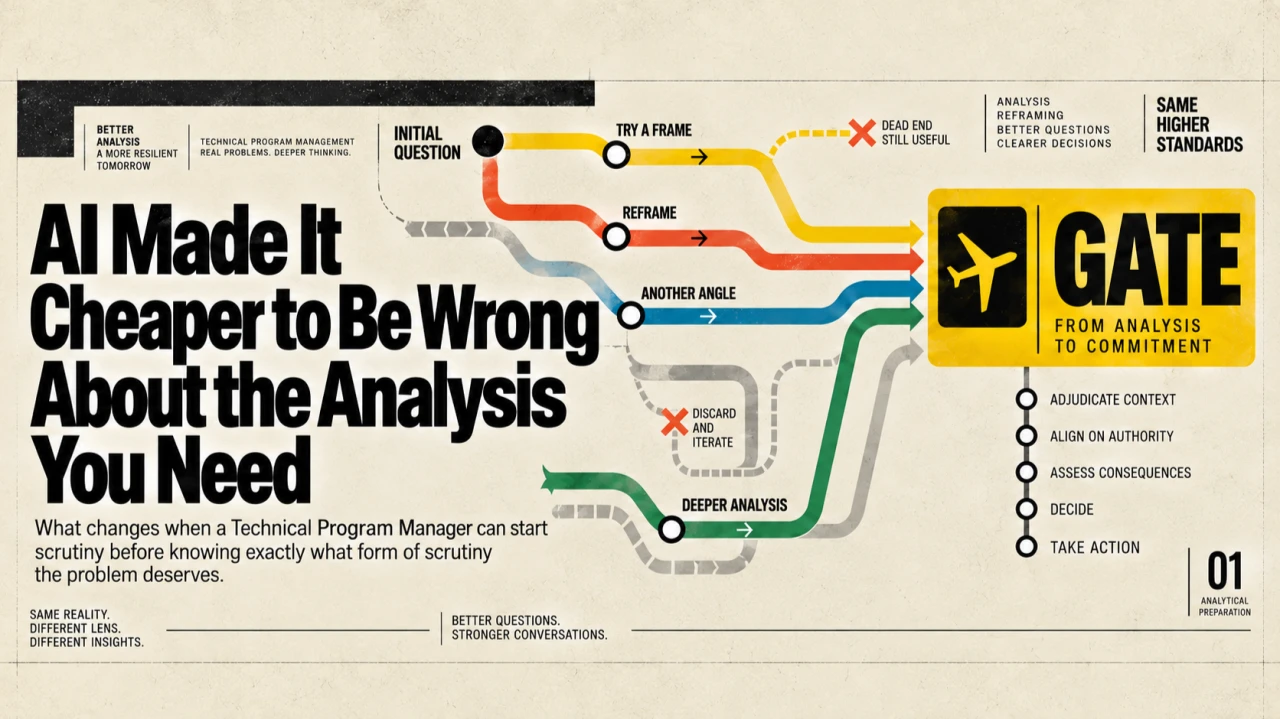
What changes when a Technical Program Manager can start scrutiny before knowing exactly what form of scrutiny the problem deserves.
The previous article in this series ended with a question:
What can I now afford to challenge more routinely?
I had premortems in mind.
I am a firm believer in them, mostly for the scientifically impeccable reason that they have been useful to me.
If you have never run one, the version I mean is simple:
Assume the plan has already failed. Work backward. What went wrong? Which assumption turned out to be false? What signal was already there? Who knew something that never made it into the plan? What would we wish somebody had challenged before everyone became committed to being right?
Gary Klein popularized the project premortem in 2007.¹ Two years later, Daniel Kahneman and Klein - coming from research traditions that disagreed about quite a lot - included it among the semi-formal methods on which they found surprisingly little to disagree.²
The underlying prospective-hindsight research predates both. Mitchell, Russo and Pennington showed in 1989 that treating a future outcome as if it had already occurred changes the explanations people generate.³ That finding is narrower than "premortems improve decisions," which is precisely why I am not claiming the latter.
The victory lap is not unanimous. More recent work has found that premortems can introduce biases of their own, including self-serving patterns in the kinds of causes people generate.⁴
Fine.
I still use them.
Am I about to turn this article into a 4,000-word trial of prospective hindsight?
No.
Whether premortem itself deserves your devotion is a completely different argument. If that is the hill you want to die on, excellent news: I have already compiled an unreasonable amount of homework for you.
It is waiting in the references at the end.
Please finish this article first.
Because premortems are not actually what became interesting.
I used to ration them.
Not because only giant programs deserved serious scrutiny, but because serious scrutiny had an admission price. Sometimes that price was preparation. Sometimes expertise. Sometimes coordinating several people who each held a different piece of the problem. Sometimes it was simply the social cost of reopening a plan everybody had already spent three meetings agreeing to.
AI changed that price.
At first, I thought the benefit was obvious: I could run more premortems.
Then I started throwing some of them away.
Not because the model had necessarily done a bad job.
Because halfway through reading the answer, I realized I had asked it to inspect the wrong problem.
That was much more interesting.
I could start an analysis before I was even sure it was the analysis I actually needed.
The useful mistake
"AI makes analysis cheaper" is true.
It is also broad enough to hide almost everything worth discussing.
Professional review was cheap long before LLMs, once somebody had already done the expensive part. Build the tool, encode the procedure, assemble the expertise, define the inputs, decide when to invoke it, and another run may cost almost nothing.
Static analysis works like that. Mature review processes work like that. Specialized decision-support systems work like that.
What was often expensive was provisioning a new kind of review in the first place.
If I needed a security review, financial challenge, architecture review, operational readiness check, or a set of skeptical people to pressure-test a plan, somebody first had to recognize the need, find the capability, prepare the material, coordinate the participants and justify the interruption.
Big decisions can pay that price.
Professional life also contains an enormous long tail of things that are not obviously big until one of them ruins your week.
A rollback rule.
An assumption hidden inside a launch plan.
A dependency everybody thinks somebody else owns.
A metric whose definition has been copied through six documents without anyone reopening the original question.
These things could always have received deeper scrutiny. They usually received the amount that was economically and socially reasonable at the time.
A general-purpose model changes that boundary because I can now instantiate a rough form of review with very little task-specific setup, inspect the result, and change the review itself.
This is not historically unprecedented critique. It is not the invention of second opinions. It is not the invention of natural-language interaction.
The shift I care about is narrower:
We are moving from cheap review after expensive provisioning toward cheap provisioning of new forms of review.
Or, in less abstract language: a kind of second look that might once have required access to another knowledgeable human can now often be started almost on demand.
That does not mean the synthetic second look is equivalent to the human one.
It means I can afford to start finding out whether I needed it.
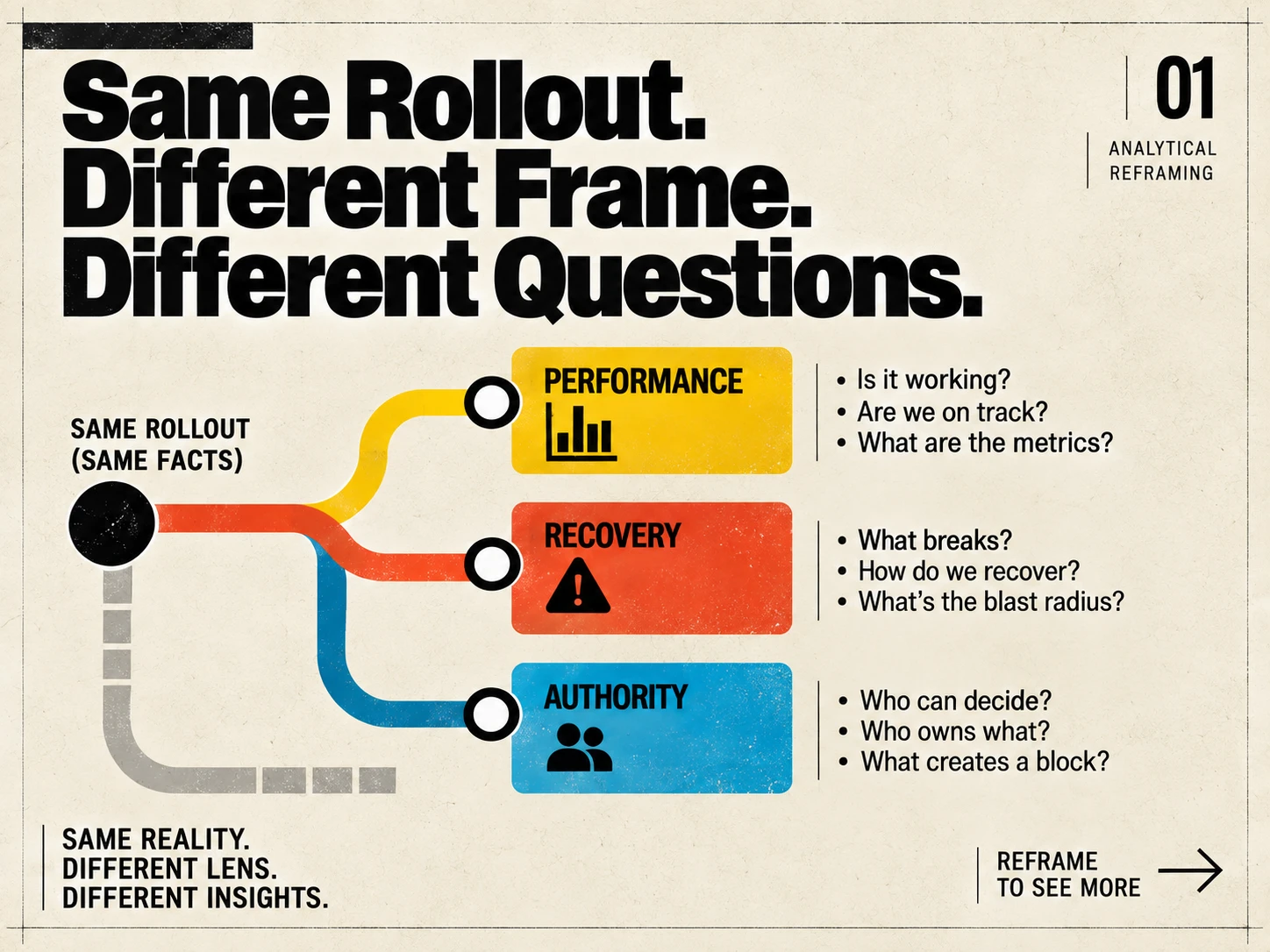
Suppose I ask a model to challenge a rollout plan.
The first pass comes back with the usual suspects: performance, integration failure, monitoring gaps, rollback problems, user confusion.
Perfectly plausible.
Also not especially useful.
Then something in that first pass makes me realize I am looking at the wrong failure surface.
Technical recoverability is not actually the interesting uncertainty.
The system can roll back.
The question is whether anyone will have the authority to declare degraded operation early enough for rollback to remain useful.
Now the problem has changed.
Or rather, my representation of the problem has changed.
I am no longer primarily inspecting performance. I am inspecting recovery.
Then recovery exposes authority.
Who can invoke it? What starts the clock? Does the operator performing the rollback also have authority to order it? Who gets consulted? How long does that consultation normally take?
A technically recoverable system can still be organizationally incapable of recovering inside the useful window.
Same rollout.
Different analysis.
This is where conversational AI is simultaneously useful and dangerous.
A conversation makes reformulation extremely cheap. It can also make an early mistake sticky.
Recent ICLR research on multi-turn interaction found substantial degradation compared with equivalent fully specified single-turn tasks, with premature assumptions and poor recovery among the recurrent failure patterns.⁵ That is not a TPM benchmark, and I am not borrowing its performance numbers as one. It is a useful reminder that "I can keep talking to the model" is not the same claim as "the model will reliably correct its own framing."
That is why my claim is smaller:
The cost of analytical mis-specification has fallen.
I can begin before perfectly classifying the problem.
The first attempt can reveal why the first question was inadequate.
Then I can throw the frame away.
Try another.
Discover that the second frame is also missing something.
Try again.
This sounds suspiciously like "iteration," because it is.
The economically interesting part is what I can now afford to iterate.
Choosing the wrong analytical approach once meant risking specialist time, another meeting, custom preparation, or enough setup effort that throwing the first attempt away hurt.
Now an initially wrong analysis can sometimes become part of discovering the right analytical question.
Problem formulation itself can become economically iterative.
That matters particularly in Technical Program Management because our problems have an irritating habit of changing category while we are looking at them.
A dependency problem turns out to be an authority problem.
A capacity problem becomes a prioritization problem.
A reliability concern becomes a decision-rights problem.
The architecture says one thing. The roadmap says another. The contract says something more carefully worded. The customer has an interpretation of all three. The people expected to operate the thing at 2 AM may quietly have a fifth.
TPM work often begins where representations stop agreeing.
And once the cost of another analytical pass falls, even surprisingly small objects can become worth inspecting.
Take one rollback rule.
Nobody is organizing a two-hour workshop around one line in a release plan.
But a ten-minute analytical pass can ask whether the technical recovery window and the organizational approval path are even compatible.
The line did not get larger.
The consequence did not get larger.
The denominator moved.
More things become economically eligible for serious scrutiny.
Eligible.
Not automatically deserving.
I still have no interest in turning every Jira ticket into an existential-risk laboratory.
More scrutiny is not better scrutiny
There is an obvious way to ruin this.
Generate more objections.
"The rollout may fail because ownership is unclear."
Wonderful.
We have manufactured a plausible sentence.
Now what?
This is where old analytical disciplines become more important, not less.
The CIA's A Tradecraft Primer is one example from a much older tradition of structured analysis that distinguishes generating possibilities from examining assumptions, competing explanations, indicators and disconfirming evidence.⁶ I am not suggesting that TPMs need to start cosplaying intelligence analysts.
The useful inheritance is simpler:
a challenge becomes valuable when it helps discriminate between possibilities.
Take our vague concern:
"Recovery will fail because decision authority is ambiguous."
Trace the mechanism.
An incident begins. The first signals are ambiguous. Nobody is sure who can declare degraded operation. Teams wait for approval. The rollback window closes.
Now we have things we can inspect.
Ask three relevant people:
"Who can stop the rollout?"
If I get three different answers, the hypothesis just became more interesting.
Open the recovery procedure. Maybe it names the operator responsible for performing rollback but never says who can order one.
Listen for "we should check with..." while the technical window for acting is already disappearing.
Then ask the question that cheap criticism often skips:
What would make me stop believing this?
Maybe authority is explicit.
Maybe everybody gives the same answer.
Maybe the path has been rehearsed.
Maybe decision latency fits comfortably inside the recovery window.
Excellent.
Kill the concern and spend attention somewhere else.
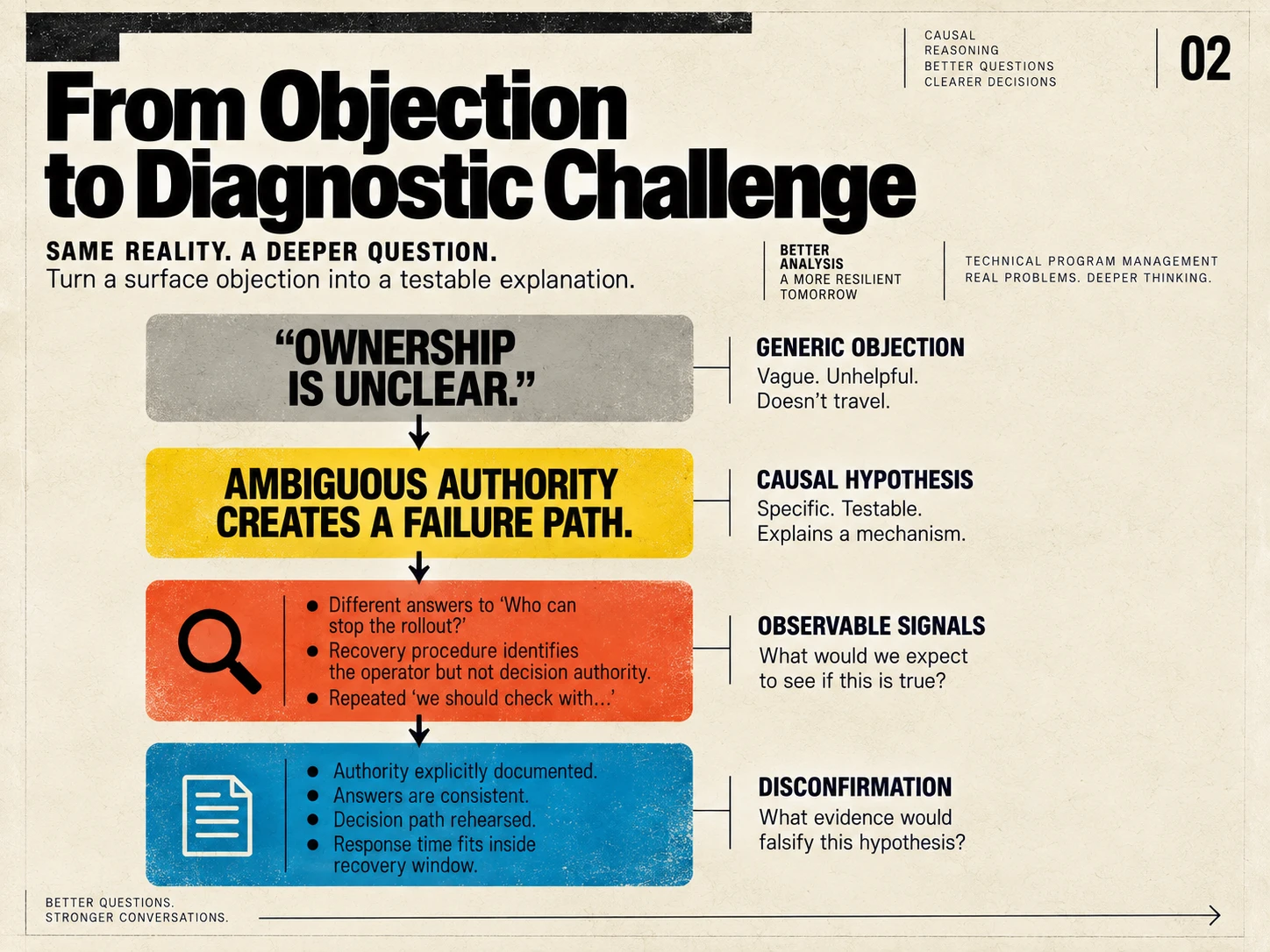
The sequence I find useful is roughly:
failure hypothesis → causal path → evidence → early signal → disconfirming evidence
There is nothing AI-native about that sequence.
That is exactly the point.
One of the more interesting effects of AI for me is not that it gives us entirely new professional practices. It is that some good existing practices become cheap enough to instantiate in places where we previously would not have bothered.
The model can generate fifty concerns.
That is not automatically useful.
The professional work begins when one of them becomes something I can observe, falsify, monitor, mitigate, escalate or deliberately dismiss.
This is why "more analysis" is not the thesis.
Diagnostic challenge is.
And this is also where experience continues to matter in a way that has nothing mystical about it.
The system can expand the search space.
A professional still has to ask which branch deserves reality.
The model can know a lot. That is not the same as knowing enough.
There is another easy way to dismiss this entire workflow:
"AI doesn't know your organization."
True.
Also not a particularly useful stopping point anymore.
What exactly do we mean by "know"?
A model does not have to begin with a blank chat and whatever I can remember while drinking coffee.
I can give it meeting transcripts, issue history, architecture notes, requirements, decision logs, a RACI, status reports, contracts and my own observations.
With enough relevant material, a capable model can sometimes reason surprisingly far over the organization represented there.
It may notice that the person formally accountable in the RACI is almost never the person who actually resolves disputed decisions in the transcripts.
It may notice that three supposedly independent risks share one hidden dependency.
It may notice that several optimistic forecasts inherited the same assumption from the same source.
It may notice a pattern no individual document states explicitly.
That is real analytical leverage.
It is also not omniscience.
What became inspectable is still not the same thing as everything that is true.
A conversation nobody captured is not suddenly in the model.
A stakeholder can change their mind.
A political constraint can exist only as tacit knowledge.
The source material can be incomplete, stale, biased or mutually inconsistent.
And the model can make a bad inference from perfectly real evidence.
There is some early project-management evidence that illustrates why this distinction matters.
A 2026 pilot experiment asked master's students in engineering management, acting as novice PMs, to produce project risk registers with and without generative AI. The AI-assisted groups produced more structured and comprehensive outputs, particularly around risk identification and monitoring. The groups without AI showed greater contextual sensitivity and stakeholder awareness, and prompt competence affected the quality of AI-assisted work.⁷
That is a small study on novices.
It would be absurd to turn it into a universal law that "AI does structure, humans do context."
But it gives us one useful warning:
Coverage and contextual adequacy are not the same property.
Suppose the system concludes:
"The sponsor may withdraw support after the first delay."
Reasonable.
Then somebody who has worked with that sponsor for seven years says:
"No. He never does that."
And then adds:
"The warning sign is when he starts saying 'Let's socialize this.' By then he has already decided he wants out."
That datum may exist nowhere in the material.
The model did not fail because it lacked a mystical human essence.
It lacked the datum.
But that does not make the analytical pass useless.
It can ask:
Which failure paths depend on information we do not have?
Who would know?
What does Operations know that Engineering probably does not?
What assumption are we treating as factual because every available document inherited it from the same source?
The model may not discover the datum.
It may discover the question that forces someone to say it.
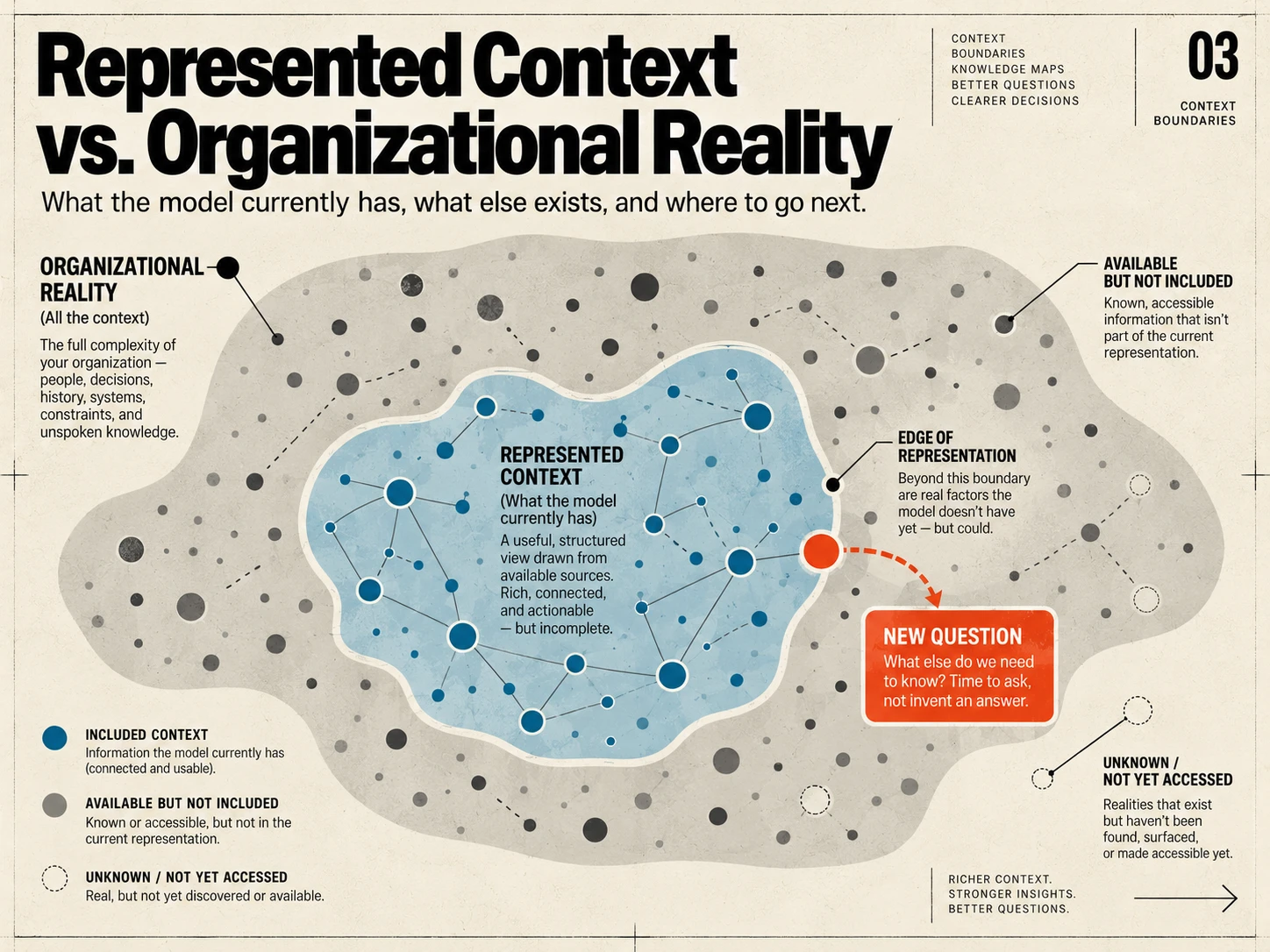
That changes how I think about the usual "AI lacks context" objection.
Of course it lacks context.
So does every individual person in a sufficiently complex program.
The useful question is not whether some perfect context exists.
It is:
Can cheap analysis tell me where expensive reality needs to enter?
That is a much more operational limitation.
Missing context stops being a metaphysical flaw and becomes something we can sometimes localize, investigate and deliberately bring into the work.
Designing what the analysis should notice
This is also where prompting stops being a bag of magic words and starts looking more like analytical design.
A very common prompt looks something like this:
"You are a world-class CFO. Review this plan."
That is a persona prompt.
Give the model a professional identity and ask it to answer from that position.
Sometimes that helps. It can affect vocabulary, emphasis, framing and which learned associations become salient.
But assigning an identity is not evidence that the model has acquired the expertise implied by the costume.
A large 2024 evaluation of persona prompting found no consistent factual-performance improvement from simply assigning expert or social personas across the models and questions tested.⁸ Later work has produced a more mixed picture, including positive effects in some conditions but also significant sensitivity to irrelevant persona details.⁹
That is enough for the distinction I care about.
Compare:
"You are a world-class CFO. Review this plan."
with:
"Inspect this plan for variable cost, unit economics, pricing dependence, downside exposure, switching costs, and assumptions behind the projected ROI. Ignore general product quality unless it changes one of those variables."
I call the second one a lens.
That is my word.
Not a scientific taxonomy.
Not a new prompting methodology.
Not something research has established as categorically "better than personas."
It is simply a distinction I find useful:
A persona specifies an identity. A lens specifies an analytical obligation.
Or, even more practically:
A lens tells the system what it is responsible for noticing.
If I am examining a rollout, one pass might be responsible for authorization boundaries and decision rights. Another might inspect recovery. Another might inspect vendor dependency or human operations.
Same underlying program.
Different obligations.
The problem determines the scrutiny.
Not the org chart.
That is why the optical metaphor keeps working for me.
A wide-angle lens and a telephoto lens can examine the same scene without inventing two different realities. A macro lens can make detail that was effectively invisible become the subject. A polarizing filter can suppress reflections that were obscuring information.
The scene did not change.
What the optical system made available for inspection did.
That is what I want from a lens.
Not synthetic personalities.
A deliberate change in what the analysis is required to notice.
And there is an important trap here.
Five lenses are not five independent experts.
If they use the same foundation model, similar context and similar underlying training, they can produce different prose while sharing remarkably similar blind spots.
Different outputs are not independent evidence.
At best, I am creating structured diversity of inquiry.
That can still be useful.
It just should not be mistaken for epistemic independence.
Sometimes I also separate analytical passes into fresh contexts so one path inherits less framing from another.
Sometimes that helps.
Sometimes I discover I also threw away context the second pass actually needed.
Fresh context is not epistemic holy water.
Again, the architecture is not the interesting part.
The interesting part is how cheaply I can try a different analytical configuration when the first one turns out to be wrong.
What the room is for now
A lot of professional scrutiny traditionally begins by getting people together.
Explain the problem.
Ask what can go wrong.
Generate possibilities.
Discover disagreement.
Find missing assumptions.
Realize somebody important was not invited.
Schedule another meeting.
Classic.
Sometimes that is still exactly the right thing to do.
People do not exist merely as expensive context APIs for an LLM.
But not every part of analytical formulation has to begin in the room anymore.
I can arrive with a causal path worth attacking.
An assumption worth exposing.
A signal worth monitoring.
A missing datum worth locating.
A disagreement worth preserving rather than smoothing over.
A specific question for the person most likely to know the answer.
That changes the starting point.
Instead of:
"What risks can anyone think of?"
the room can begin with:
"Is this causal path actually plausible here?"
"Who has authority at this step?"
"Would this really be the first observable signal?"
"What evidence are we missing?"
"What would prove this concern wrong?"
"What, if anything, should we change?"
The model does not replace the room.
It can change what the room is being asked to do.
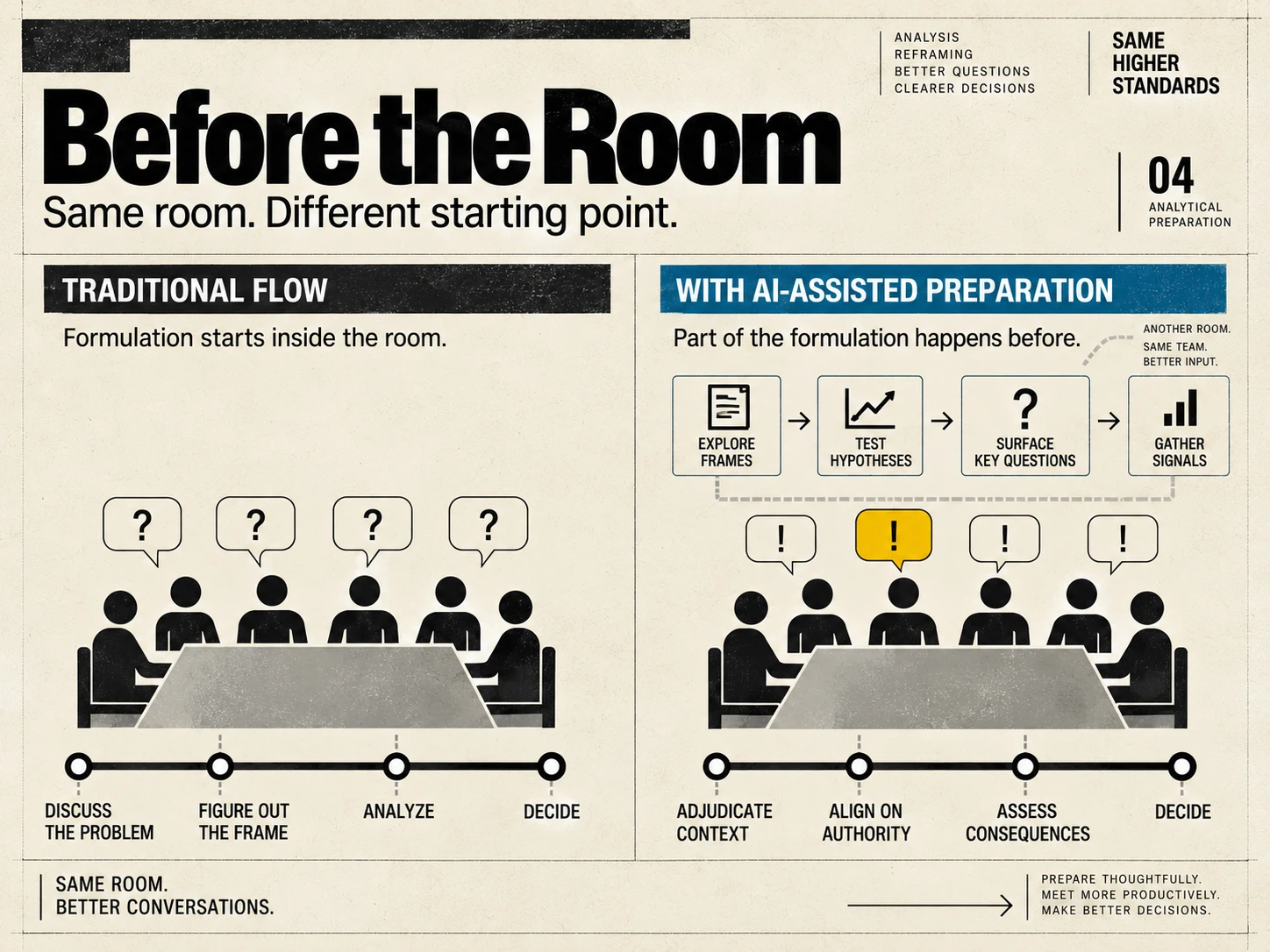
That distinction matters because analytical capability and contextual reality are not becoming cheap at the same rate.
I can instantiate another analytical pass almost trivially.
I cannot trivially recreate years of organizational history, tacit operational knowledge, stakeholder interpretation, political consequence or distributed authority.
So the opportunity is not:
let AI do the boring work so humans can do the important work.
I do not trust that sentence.
Organizations are under no obligation to distribute work according to philosophical elegance.
And some apparently boring work is also how professionals build situational awareness. Writing the status yourself may be a waste of an hour. Or it may be the exercise that forces you to reconcile six contradictory versions of reality and notice the one inconsistency that matters.
The surface task is not always its cognitive function.
A better sequence is:
Use cheap analysis to discover where expensive reality needs to enter.
Do some formulation before the room.
Use it to find the uncertainty.
Use it to identify which evidence is missing.
Use it to discover who should actually be involved.
Then spend scarce human coordination there.
This does not outsource responsibility for the decision.
A model can generate the concern, trace a failure path and identify evidence I should inspect.
I still decide whether the concern matters.
Whether the evidence is sufficient.
Whether the uncertainty is acceptable.
Whether we change the plan.
That distinction matters because I am accountable for a decision process, not for possessing supernatural knowledge of the future.
Sometimes a defensible decision will still produce a bad outcome.
Reality remains stubbornly noncompliant with project governance.
There is, regrettably, no prompt that forces it to sign the plan.
There is also another limit.
Once analysis gets cheap, stopping gets expensive in a different way.
There is always another lens.
Another critique.
Another reformulation.
Another subtle distinction that would unquestionably improve a paragraph nobody needed.
At some point, this becomes a hobby.
My stopping rule is deliberately crude:
Another analytical pass earns its cost when it has a realistic chance of changing what I monitor or do.
Does it change a watchpoint, owner, threshold, mitigation, timing, escalation path, participant or decision?
If not, I may have generated an excellent paragraph.
Congratulations to the paragraph.
The program remains unchanged.
What actually changed
The previous article asked:
What can I now afford to challenge more routinely?
My first answer was "more things."
True.
Not enough for another article.
What changed is not merely the quantity of scrutiny I can generate.
It is that I can start analytical work before I know exactly what analytical work the problem deserves.
I can instantiate a rough review, discover that I framed the problem badly, throw the frame away and reformulate.
I can do that around an object that previously would never have justified the setup cost.
I can take a vague objection and push it toward a causal path, evidence, signals and falsification.
I can use that inquiry to discover which unknown actually matters, what evidence is missing, who might know it and where human judgment needs to enter.
Then I can stop when another pass is unlikely to change anything outside the document.
Premortems are one example.
They happen to be one I like.
Lenses are one implementation detail.
Separate contexts are another.
None of those is the thesis.
The larger shift is a different sequencing of professional scrutiny.
And perhaps a different threshold for what deserves serious scrutiny at all.
For a Technical Program Manager working across technical systems, organizational boundaries, incomplete representations, distributed authority and people who have somehow managed to interpret the same sentence four different ways, that is not a minor change.
The leverage is not synthetic expertise.
It is not maximum scrutiny.
It is definitely not an AI council for every ticket.
It is simpler:
AI makes it cheap enough to be wrong about what review I need, discard it, and try again before I spend scarce human context.
That is a capability I did not previously have at anything like this price.
And it leaves me with a broader question than the one I started with:
What professional practice am I still rationing because I have not noticed that the cost of figuring out how to apply it has changed?
Selected sources
1. Gary Klein, "Performing a Project Premortem", Harvard Business Review, 2007.
2. Daniel Kahneman and Gary Klein, "Conditions for Intuitive Expertise: A Failure to Disagree", American Psychologist 64(6), 2009, 515-526. DOI: 10.1037/a0016755.
3. Deborah J. Mitchell, J. Edward Russo, and Nancy Pennington, "Back to the Future: Temporal Perspective in the Explanation of Events", Journal of Behavioral Decision Making 2(1), 1989, 25-38. DOI: 10.1002/bdm.3960020103.
4. Linnea Gandhi, Annie Duke, and Maurice Schweitzer, "Problems with Premortems: Self-Serving Attribution Bias in a Popular Debiasing Strategy", Academy of Management Proceedings, 2022. DOI: 10.5465/AMBPP.2022.12186abstract.
5. Philippe Laban, Hiroaki Hayashi, Yingbo Zhou, and Jennifer Neville, "LLMs Get Lost In Multi-Turn Conversation", ICLR 2026.
6. Central Intelligence Agency, Directorate of Intelligence, A Tradecraft Primer: Structured Analytic Techniques for Improving Intelligence Analysis, 2009.
7. Alessandro Pompei, Cinzia Battistella, and Fabio Nonino, "How generative AI supports novice project managers in creative reasoning: evidence from a pilot experiment in risk management", International Journal of Managing Projects in Business, 2026. DOI: 10.1108/IJMPB-10-2025-0451.
8. Mingqian Zheng, Jiaxin Pei, Lajanugen Logeswaran, Moontae Lee, and David Jurgens, "When 'A Helpful Assistant' Is Not Really Helpful: Personas in System Prompts Do Not Improve Performances of Large Language Models", Findings of EMNLP 2024. DOI: 10.18653/v1/2024.findings-emnlp.888.
9. Pedro Henrique Luz de Araujo, Paul Röttger, Dirk Hovy, and Benjamin Roth, "Principled Personas: Defining and Measuring the Intended Effects of Persona Prompting on Task Performance", EMNLP 2025. DOI: 10.18653/v1/2025.emnlp-main.1364.
About the Author
Diego Liñan is a Technical Program Manager with a background in software engineering, solution architecture, product development, and technical delivery. His current work focuses on AI-enabled delivery systems, agentic workflows, AI governance, engineering operating models, persistent context, evidence traceability, and human accountability in AI-assisted software development.
ORCID iD: https://orcid.org/0009-0004-6730-3150
© 2026 Diego Liñan. All rights reserved.