Two engineers can say "I don't read AI-generated code anymore" and mean completely different things.
These two posts caught my attention for exactly that reason.
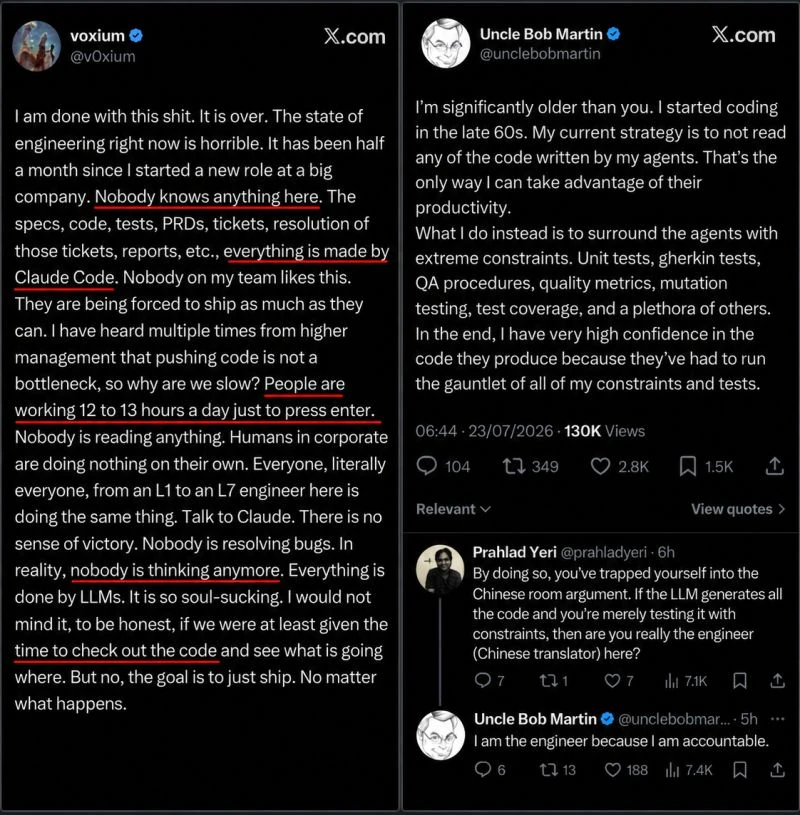
In the first one, an engineer describes a company where AI generates specs, code, tests, tickets and reports.
Nobody reads much anymore.
Not because they deliberately redesigned verification, but because the organization is pushing for more and more throughput.
The result sounds like:
AI generates -> humans press Enter -> more output -> less understanding.
Then there is Robert Martin, "Uncle Bob".
He also says he no longer reads the code produced by his agents.
But his reasoning is almost the opposite.
He surrounds those agents with constraints:
- unit tests
- Gherkin tests
- mutation testing
- quality metrics
- coverage
- QA procedures
- other deterministic checks
His goal is not to trust the agent.
His goal is to design a system in which the output has to survive a verification gauntlet.
And when someone challenged whether he could still call himself the engineer, his answer was wonderfully simple:
I am the engineer because I am accountable.
I think that distinction matters enormously.
Generation is not verification.
And not reading code can mean either:
- "We no longer have enough time to understand what we are shipping."
or:
- "We deliberately moved assurance somewhere stronger than manual inspection."
Those are radically different operating models.
But I would push the second model one step further.
Tests and constraints only give us confidence about the things they are capable of detecting.
If the same AI system misunderstands the requirement, generates the implementation, generates the tests and defines what "success" looks like, we can end up with something that is internally consistent and still wrong.
A green pipeline is not the same thing as a correct outcome.
That suggests a different question for AI-enabled software engineering.
Not:
"Who wrote the code?"
But:
Who defined the constraints?
What independently verifies the result?
And who remains accountable when everything is green but the system is still wrong?
That, to me, is where engineering is moving.